

Filipino worker returns test Gulf evacuation planning
Manila’s repatriation of 70 citizens from Saudi Arabia gives Washington an early indicator of civilian-movement stress during Middle East escalation.
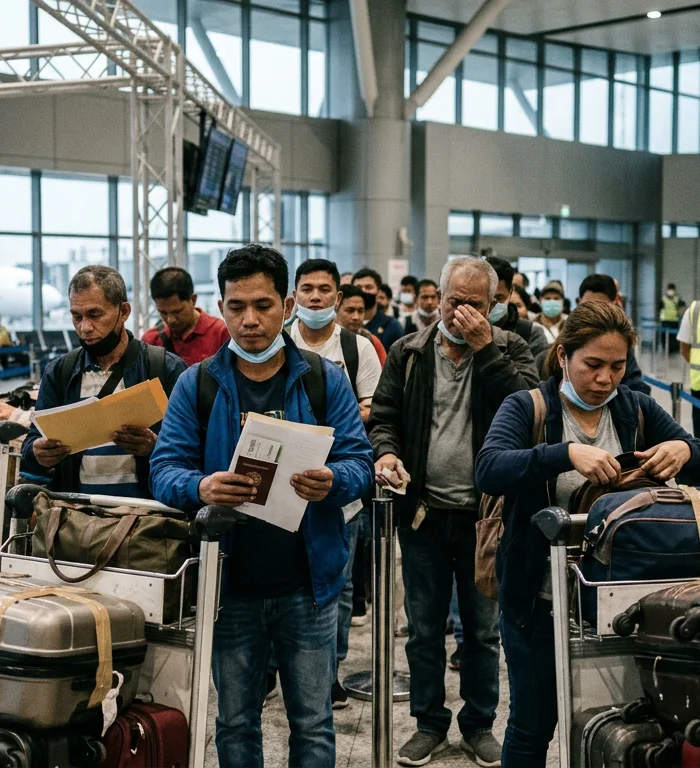
The Philippines’ Department of Migrant Workers said 70 overseas Filipino workers returned from Saudi Arabia to Manila as Middle East tensions widened.
The workers arrived at Ninoy Aquino International Airport Terminal 3 in Pasay City, the department said in a Saturday statement, adding to signs that governments are moving nationals before escalation disrupts commercial routes.
The Philippines
For Washington, the operational issue is less the size of this flight than the pattern it may represent. If more countries begin pulling workers from Gulf states at once, the burden can shift quickly from routine consular assistance to coordination among embassies, airlines, host governments and, in larger crises, military transport planners.
The Philippines has one of the world’s most active migrant-labor systems, and overseas Filipino workers form a visible part of the workforce in Gulf economies, including health care, logistics, services and domestic work. Their movement can become an early warning measure for stress in civilian infrastructure that US officials rely on during regional contingencies.
US Central Command and the State Department typically separate military operations from civilian departures, but large-scale evacuations can blur that line when commercial flights thin out, airports crowd and allied governments seek help moving nationals through safe corridors.
Manila is a US treaty ally
The case also matters for Indo-Pacific diplomacy. Manila is a US treaty ally, and any pressure on Philippine citizens in the Gulf can draw attention from both the State Department’s consular channels and the Pentagon’s planners if regional transport nodes become strained.
No US role in the 70-worker return was reported. The immediate action described by the Philippine department was a national repatriation effort, not a multinational evacuation operation.
The test is whether this remains a small bilateral movement or becomes part of a wider pattern. If repatriation flights stay limited and commercial routes continue operating, the macro effect is likely contained, Manila manages the case through regular migrant-worker channels, and Gulf employers absorb only localized staffing gaps.
If departures from Saudi Arabia and nearby states accelerate, the pressure would move up the chain. The macro risk would be disruption to labor-dependent services and transport systems; for Manila, the strain would fall on repatriation funding, airport processing and worker reintegration; for the wider Gulf economy, staffing shortages could appear first in sectors that rely heavily on foreign labor.
The clearest falsifiable marker is whether US embassies or defense officials begin coordinating evacuation corridors with allied governments. Without that, this remains a Philippine-led repatriation case rather than evidence of a broader US-backed civilian evacuation effort.
More stories
- Germans oppose Ukraine aid as poll shows support slipping
- Kim Jong-un receives 10 envoys after constitutional shift
- Ukraine claims Libya strike sinks Russian naval corvette
- COP31 climate talks collapse over fossil fuels and funds
- Russian military faces 1,087 recorded suicides in Ukraine war
- US faces China, Russia in Africa minerals contest
- UN agencies seek aid for 30.3m facing DR Congo hunger
- Hungary seizes nearly $20m in Orban-era corruption probe
- Qatar-led mediators press 7-day plan for Iran-US deal
- Häkkänen blames US politics for Ukraine Patriot delay
Latest news
- Trump prepares tariffs on China and other major exporters
- New-car buyers pay record average $50,087 in October
- Banks face ECB reserve debate over liquidity and profits
- Investors see Anthropic debut gains fade below $83 a share
- Iraq orders federal control over Kurdish-area oilfields
- Nvidia shares retreat as AI rally cools before PCE data
- Macy’s parade faces balloon limits as storm winds approach