EU migration framework targets sudden border surge rules
Ursula von der Leyen said the EU migration proposal would create an emergency framework for strictly defined border crises involving engineered migrant…
Lauren Collins ·
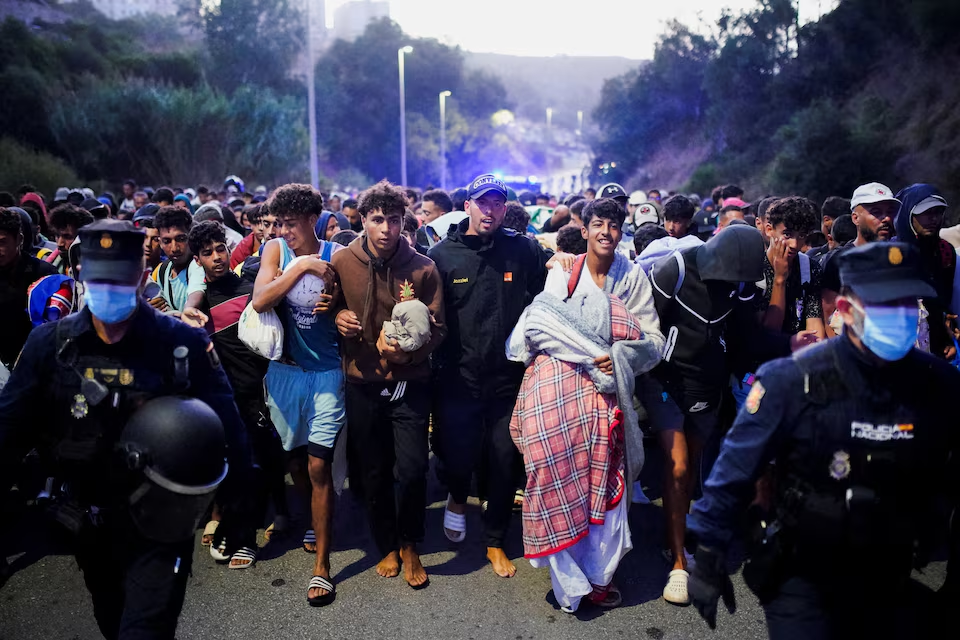
Ursula von der Leyen said the European Commission will propose one European Emergency Response Framework to curb sudden migrant inflows at EU borders.
The Commission president used her state of the union speech in Strasbourg on Wednesday to frame the plan as a response to exceptional border pressure. The proposal, as described by von der Leyen, would apply only when migrant movements are treated as deliberately created and used as a political instrument.
Strasbourg speech sets EU trigger
Von der Leyen said the bloc’s existing instruments need to change after the events of the summer, linking the proposal to emergency situations rather than normal asylum administration. “Europe needs the means to protect its borders at all times,” she said in the speech.
The remarks did not include draft legal text, activation thresholds or a timetable for adoption. That leaves the next stage with the Commission, which will have to translate the political commitment into rules that national governments and EU lawmakers can assess.
The central test is the definition of an emergency. If the criteria are written narrowly, the framework would be a reserve tool for unusual episodes; if they are written broadly, governments and rights groups are likely to scrutinize how far standard procedures can be adjusted.
Flexibility comes with rights pledge
Von der Leyen said the European Emergency Response Framework would allow “time-limited and strictly defined flexibility in standard procedures” in exceptional circumstances. That phrasing points to procedural leeway, not a permanent replacement for the bloc’s migration rules.
The Commission president also tried to set a boundary around the proposal. “We will always comply with our values and fundamental rights. But we will never compromise on protecting our borders,” she said.
That dual message reflects the pressure on EU migration policy: governments want faster tools when border arrivals are presented as a coordinated challenge, while EU institutions must keep any emergency response within rights obligations. The speech cast border protection and legal safeguards as parallel requirements, not alternatives.
For member states at external borders, the immediate importance is operational. A crisis framework could change how authorities process arrivals during a defined emergency, depending on the final text and the approval process.
Border agencies face scenarios
If the Commission proposes narrow activation rules and they survive negotiations, Brussels would gain a limited crisis instrument while preserving the standard system for ordinary cases. For the wider migration and border-management sector, that path would create a clearer emergency playbook for national agencies, reception centers and legal aid organizations.
If the criteria are broadened during negotiations, the framework could become a more frequently used tool for governments facing abrupt arrivals. In that scenario, the macro channel would run through public administration and border spending, as states would need staff, facilities and legal capacity to operate the procedures under time limits.
If the initiative stalls, the Commission would remain reliant on existing instruments when governments report sudden pressure at their borders. That outcome would leave national authorities with fewer EU-level procedural adjustments and could keep responsibility concentrated at the first point of arrival.
The industry effects would differ across those paths. Contractors serving border infrastructure and case-processing systems would have a stronger planning signal under a defined framework, while humanitarian and legal groups would focus on how any flexibility affects access to procedure and protection.
The main open question is whether the Commission can define engineered migration tightly enough to distinguish an emergency response from routine migration management. The answer will determine whether the framework becomes a narrow safeguard, a contested policy tool, or a proposal that struggles to advance beyond von der Leyen’s Strasbourg pledge.