China Iran talks press Hormuz reopening before Xi-Trump
China urged Iran and the U.S. to restore talks and reopen the Strait of Hormuz, tying regional restraint to energy security.
Lauren Collins ·
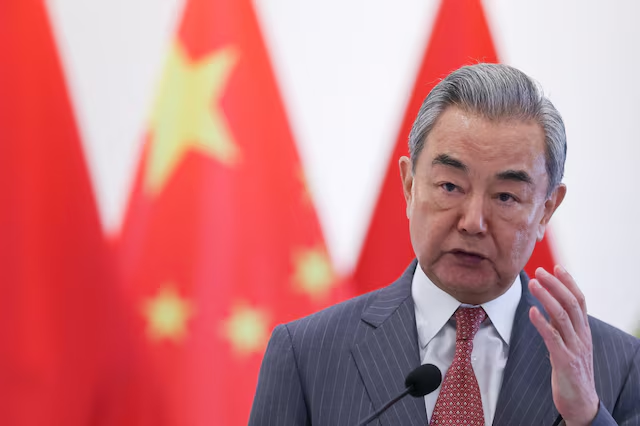
China Iran talks in Beijing put the Strait of Hormuz and a June interim peace deal at the center of diplomacy before Xi meets Trump.
Chinese Foreign Minister Wang Yi told Iranian Foreign Minister Abbas Araqchi on Wednesday that Tehran and Washington should remain rational, show restraint and return to talks, according to China's foreign ministry. Wang pointed to the interim peace deal signed in June as the basis for what he called substantive consultations.
Hormuz reopening tops Beijing agenda
Wang urged all parties to take effective steps to "reopen the Strait of Hormuz at an early date," China's foreign ministry said. He tied the call to the stability of international energy transport and supply chains, placing the waterway at the center of Beijing's public message.
The ministry said Wang also opposed any further spread of regional tensions into Yemen and the Red Sea. That warning linked the Hormuz dispute to a second maritime corridor already important to global trade and energy shipments.
June deal shapes negotiation push
Wang said Tehran and Washington should rebuild the negotiation mechanism based on consensus reached so far, according to the Chinese account. The formulation left Beijing pressing for a return to process rather than publicly endorsing either side's claims.
Araqchi, who was in Beijing for a one-day visit, said Iran was ready to defend its sovereignty, territorial integrity and security while remaining open to diplomacy, according to Iranian state media. He said Tehran welcomed diplomatic solutions that ensure the rights of the Iranian nation.
The meeting came a week before an expected Washington meeting between Chinese President Xi Jinping and President Trump. U.S. Treasury Secretary Scott Bessent said Tuesday that Trump and Xi would continue discussions on Iran and China's financial links to Tehran, which Washington has been trying to push out of Western financial systems.
Oil ties meet U.S. pressure
Beijing's exposure is direct: China is the main buyer of Iranian oil, while the Strait of Hormuz is a key route for energy shipments from the Gulf. That makes safe navigation a practical economic issue for China, not only a diplomatic position.
China has repeatedly called for normal and safe passage through the strait, but the diplomatic accounts show Beijing has largely avoided a direct public challenge to Tehran's threats to shipping. Wang instead framed the crisis as evidence that the Middle East's security architecture is inadequate and needs reform.
That language gives China room to present itself as a mediator while preserving its relationship with Tehran. Wang said China's policy toward Iran remained consistent and stable, and that Beijing was ready to promote peace, fairness and justice in the region.
Three paths for the chokepoint
If the June framework holds and Hormuz reopens, the immediate mechanism would be lower disruption risk for energy transport and supply chains. For China, that would protect access to Iranian oil; for the wider shipping and refining sectors, it would ease planning around Gulf cargo flows.
If consultations fail and navigation remains impaired, the pressure would run through delayed shipments, insurance costs and rerouted trade. That path would expose China to supply uncertainty, keep Iran under heavier financial and diplomatic pressure, and leave energy traders focused on the durability of any maritime restrictions.
A third path is regional spillover into Yemen and the Red Sea, the risk Wang identified explicitly. In that case, the global macro issue would broaden from one chokepoint to multiple shipping lanes, while China, Iran and the energy sector would face a more complex security problem with fewer quick diplomatic fixes.