EU Canada alliance plan tests bloc appetite for looser ties
Ursula von der Leyen proposed Canada as the EU’s first associate member, but member states must decide whether the idea advances.
Lauren Collins ·
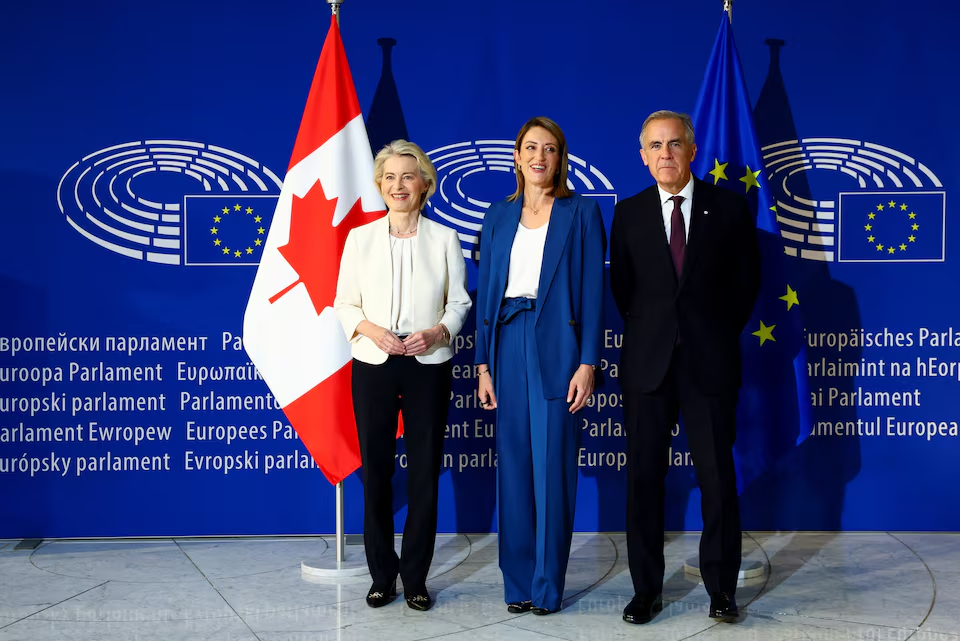
EU Canada alliance plans gained a new label Wednesday as Ursula von der Leyen proposed Canada as the bloc's first associate member.
The European Commission president made the offer in Strasbourg during her annual State of the Union address, with Canadian Prime Minister Mark Carney seated in the European Parliament. Lawmakers applauded before von der Leyen embraced Carney, but any new status would require support from EU member governments.
Carney hears Strasbourg overture
Von der Leyen framed the proposal as a response to pressure on allied democracies, telling lawmakers that partnerships needed to be rebuilt in what she called “the cold fragility of today’s world.” She said Europe and Canada were aligned on artificial intelligence, climate policy, the Arctic, Ukraine, defense, raw materials and supply chains.
“I would like to work with you on opening the door for Canada to be the first associate member of the EU,” von der Leyen said. Carney, who is due to address the European Parliament on Thursday, said earlier this week that Canada wanted a “unique alliance” with the EU rather than membership.
A flexible status with limits
The phrase associate member has no settled legal meaning in the EU system, where the 27-nation bloc has generally avoided flexible arrangements that sit between partnership and accession. A German proposal in May to create an associate path for Ukraine as a step toward full membership drew a cautious response from EU capitals.
One EU diplomat described surprise at von der Leyen's language, saying “nobody really knows what it means.” The diplomat also said there were worries that the Commission president “is overpromising and won't be able to deliver,” a sign that the political label may be running ahead of institutional agreement.
Seven EU diplomats in Canada and Europe said before the speech that work was underway on deeper cooperation in trade, defense and digital security, but that no detailed plan for a broader Canada-EU structure had reached high-level discussion. Mark Manger, a professor of political economy and global affairs at the University of Toronto, has said EU officials remain frustrated by Canada’s protection of telecommunications and dairy, two sectors that limit scope for wider market opening.
Trade rift shifts Ottawa
The Canadian push comes after trade talks with the United States broke down last month, followed by retaliatory tariff measures between Ottawa and Washington. The dispute has added urgency to Carney's pledge to double Canada's non-US trade over the next decade, compared with its current dependence on its southern neighbor.
Canadian Foreign Minister Anita Anand said the relationship had tightened recently. “Our relationship with the EU has become increasingly close, especially over the past year and a half,” Anand said.
Defense, tech and Arctic channels
Von der Leyen said the EU and Canada would work across intelligent manufacturing, technology, defense industrial capacity and the Arctic. She described the Arctic as a joint project and said the partnership was “not against anyone else,” language aimed at framing the initiative as alignment rather than exclusion.
The wider setting is less neutral. The EU faces Russia's war against Ukraine at its border, while both Brussels and Ottawa are managing trade and strategic pressure from President Trump's administration and from China.
Carney has said more detailed discussions will start at a Canada-EU summit in Montreal in late October. If EU governments give the associate-member idea a mandate, the mechanism would likely run through supply-chain rules, defense procurement and digital standards, linking macro resilience, Canadian trade diversification and sector access for manufacturers and technology firms.
If EU capitals narrow the idea to existing cooperation, the global effect would be smaller and Canada would remain more exposed to the US trade dispute. The main open issue is whether Ottawa offers concessions in protected sectors, because dairy and telecom barriers could determine whether the political language turns into market access.