Delhi police detain hundreds during election protest
Delhi police detained hundreds on October 10 as protesters sought election chief Gyanesh Kumar's resignation over disputed voter rolls.
Raj Patel ·
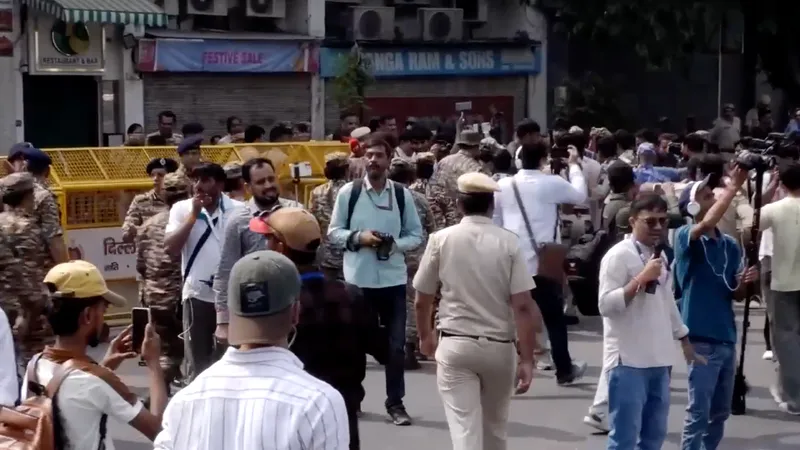
Delhi police detained hundreds on October 10 as protesters sought election chief Gyanesh Kumar's resignation over disputed voter rolls.
Authorities restricted access to central Delhi before a planned gathering at Jantar Mantar, closing dozens of markets and metro stations and suspending mobile internet in the business district. The operation disrupted travel and commerce as a dispute over electoral records brought demonstrators onto the capital's streets.
Thousands of police officers and paramilitary personnel were deployed, with checkpoints at entrances to the city and along major roads. Officers searched buses for demonstrators, inspected vehicles and positioned riot-control equipment along key routes.
Organizers from the Cockroach movement had intended to assemble thousands at Jantar Mantar, but security personnel blocked access before the rally started. Smaller gatherings nevertheless emerged elsewhere, including at a crafts market and Mahatma Gandhi's memorial.
An eyewitness account described officers pursuing demonstrators and taking people away in buses while others continued arriving. Police offered no immediate response about the detentions, leaving the precise number held and the grounds for individual detentions unclear.
The Cockroach Janta Party said police detained founder Abhijeet Dipke and senior figures Saurav Das and Ashutosh Ranka upon their arrival from Mumbai. The group sought their release and said it would press ahead with its protest.
Aircraft footage showed Dipke confronting officers, one of whom disputed that the intervention constituted an arrest. Separately, the president of the Supreme Court's bar association said lawyers demonstrating outside the court were detained and subsequently released.
Voter deletions divide commission and opposition
The central dispute concerns revisions to electoral registers before recent state contests. Opposition parties allege that removals benefited Prime Minister Narendra Modi's Bharatiya Janata Party (BJP) and influenced results in states the party won; the Election Commission and BJP deny wrongdoing.
Election Commission data put the number of deleted entries at approximately 130 million. That total included 63 million associated with relocation, 30 million involving people officials could not locate and 28 million associated with deaths.
The commission says those removals concerned records identified during preparation of draft registers, and eligible citizens mistakenly excluded can register again. The figures alone do not establish how many eligible voters were wrongly removed or whether deletions changed election outcomes.
Kumar had not commented on the allegations. The commission's explanation and the opposition's claims address different questions: the stated administrative grounds for removing entries, and whether the process excluded eligible voters or favored a party.
State elections approach with dispute unresolved
The BJP attributes its victories to Modi's public support and economic growth, while accusing rivals of circulating false information after electoral defeats. Party spokesperson Sambit Patra defended Saturday's outcome as a victory for democratic processes over crowd pressure.
Congress leader K.C. Venugopal condemned the restrictions as a confrontation between the government and citizens. The disagreement extends beyond Kumar's position to how electoral authorities handle disputed registrations and how the government responds to public challenges.
A succession of state elections is scheduled to begin in early 2027, giving the registration dispute an approaching electoral deadline. If eligible voters secure reinstatement before voting, corrections would address their exclusion; if cases remain unresolved, those voters' ability to participate would remain at issue.