China AI rivals narrow US lead as chip gap closes, Lee says
Kai-Fu Lee says China AI companies could challenge the US edge as domestic chips improve and open-weight models gain commercial traction.
Jason Kwon ·
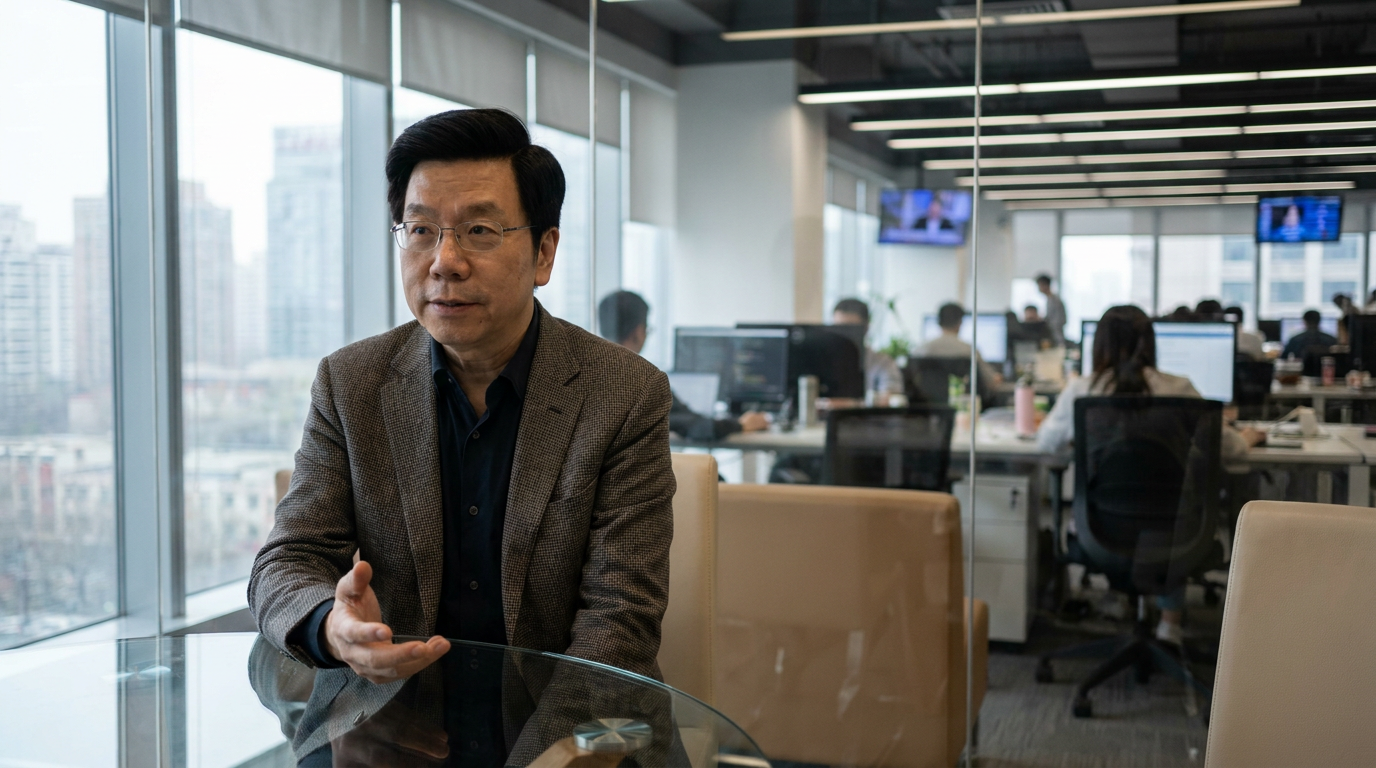
China AI companies could benefit from self-sufficient domestic chips within two to three years, challenging the US edge, Kai-Fu Lee said.
Lee, chairman of Beijing-based Sinovation Ventures and founder of 01.AI, argued that the US advantage in artificial intelligence is real but not permanent. His view matters because he has spent years mapping the technology rivalry between Washington and Beijing, including in his 2018 book AI Superpowers .
Lee sizes the talent gap
Lee said the difference between the two countries is clearest at the narrowest layer of AI talent. “If you look at the top 1,000 people in AI in the US, they are significantly better than the top 1,000 people in China. However, if you look at the top 100,000, the two countries are very comparable.”
That distinction puts the contest on a longer clock than the current model leaderboard cycle. A small group of frontier researchers can define breakthroughs, but a much broader engineering base determines how quickly models are copied, tuned, deployed and made useful inside companies.
Domestic chips set the timetable
Lee predicted that China’s domestic semiconductor supply for AI would become “completely self-sufficient” within two to three years. He said that shift would weaken the long-term force of export restrictions such as those pursued by President Trump’s administration.
The claim should be read as Lee’s forecast, not a settled industry outcome. US controls have targeted China’s access to advanced AI chips, but Lee’s argument is that domestic manufacturing progress could reduce the choke point if local suppliers close enough of the performance gap.
For AI developers, chips define both training capacity and inference economics. If China can secure enough domestic compute, companies such as 01.AI would have a clearer path to serving enterprise customers without depending as heavily on restricted US hardware.
DeepSeek and Moonshot test doubts
Lee also pushed back on the view that Chinese AI labs are mainly benefiting from distillation, a technique in which a smaller model learns from the outputs of a larger one. “Distilling alone cannot lead to the success that DeepSeek and Moonshot have had.”
That is a direct challenge to a common critique of Chinese AI progress. Distillation can lower training costs and speed up product development, but Lee’s point is that it cannot by itself explain the commercial and technical gains associated with firms such as DeepSeek and Moonshot.
The open-weight model trend adds another lever for Chinese labs. Models whose weights are available for adaptation can spread faster through corporate buyers, developers and cloud partners, creating distribution advantages for companies that are not trying to sell only closed frontier systems.
01.AI targets enterprise deployment
Lee’s own company, 01.AI, is positioned around helping businesses use AI rather than only building benchmark-focused models. The source compared that approach with Anthropic-backed Ode and OpenAI’s DeployCo, both aimed at moving AI systems deeper into company workflows.
That deployment layer is where model capability turns into revenue, and where lower-cost or open-weight systems can compete with better-known US products. If customers prioritize customization, data control and price, Chinese vendors may find openings even before they match the very top US models.
The macro path depends on whether Lee’s chip timetable holds. If domestic supply improves within his two- to three-year window, China could reduce exposure to US controls, 01.AI could gain a more stable hardware base, and the AI sector could see stronger price pressure from Chinese model providers.
If the chip gap remains wider than Lee expects, US firms would keep an infrastructure advantage, 01.AI would face tighter scaling economics, and Chinese labs would rely more heavily on software efficiency, distillation and open-weight distribution. The central uncertainty is whether China’s chip manufacturing can deliver usable AI compute at the scale its model companies need.