

Newsom announces California clemency for 548 on death row
Gavin Newsom announced clemency for 548 California death row prisoners, replacing execution with lifelong imprisonment, his office said.
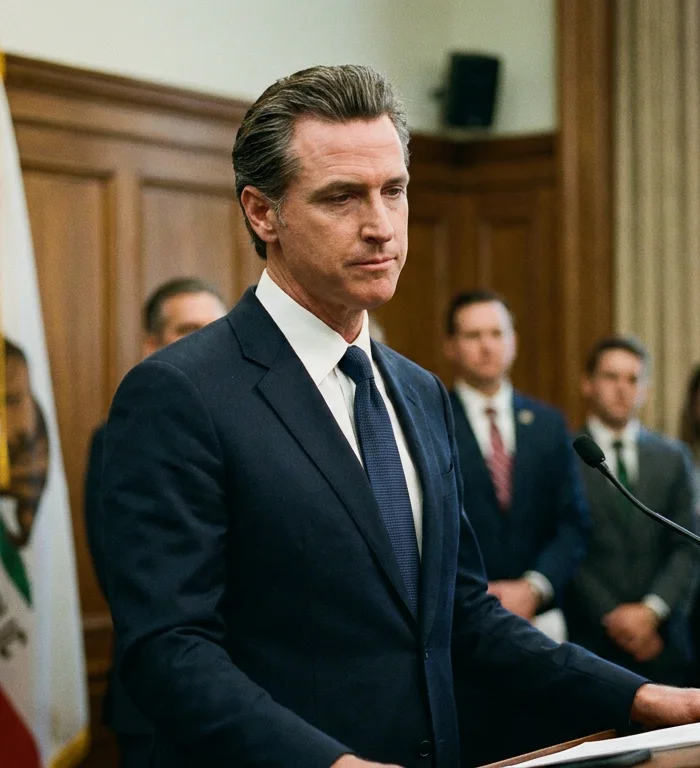
Gavin Newsom announced clemency for 548 California death row prisoners, replacing execution with lifelong imprisonment, his office said.
The governor said the sentences would become imprisonment without parole, rather than allowing prisoners to leave custody. Some grants require approval from California’s highest court, a qualification to the announcement’s promise of protection against execution under a successor.
Clemency extends beyond the execution pause
Newsom’s announcement builds on the execution moratorium he imposed in 2019. That measure suspended executions without removing the underlying sentences; the announced commutations would change the punishment itself.
California last executed a prisoner in 2006, according to the supplied account. The state nevertheless retained capital punishment in law, leaving people sentenced to death subject to a punishment that was not being carried out.
In his letter announcing the decision, Newsom identified 529 men and 19 women as recipients. He described the action as consistent with his opposition to executions and acknowledged that the announcement could revive painful memories for relatives of murder victims.
The distinction between clemency and abolition remains important: changing existing sentences does not itself remove capital punishment from state law. California remains among the 27 states that retain it, according to the supplied material.
Legal representation delays affect hundreds
The governor’s office cited prolonged waits for lawyers to challenge convictions or sentences through habeas proceedings. Of the 548 prisoners covered by the announcement, 220 had spent at least 15 years awaiting an appointed lawyer for that process, the office said.
It also reported that 139 prisoners had waited at least 20 years for representation. Separately, the office said 45 prisoners had completed their appeals and would face execution without the moratorium, presenting that figure as evidence of the stakes if the pause ended.
Newsom said court approval would be necessary for recipients with multiple felony convictions. The number of grants subject to that requirement, and a timetable for judicial consideration, were not specified in the supplied account.
Families and advocates weigh permanent sentences
The American Civil Liberties Union welcomed the announcement, alongside death penalty opponents Martin Luther King III and lawyer Bryan Stevenson. Jeanne Woodford, a former California prisons director who supervised four executions, also supported the decision, citing the danger of executing an innocent prisoner.
Support also came from Jess Nichol, whose sister Polly Klaas was killed at age 12 in 1993. Nichol said she had previously favored executing her sister’s killer but no longer regarded an execution as connected to her recovery or public safety.
Those endorsements do not establish a consensus among victims’ relatives. Newsom acknowledged the distress the announcement might cause families while maintaining that clemency was necessary; the supplied account included no response from opponents of the decision.
For prisoners whose grants require judicial approval, the next institutional step is court consideration. If those grants receive approval, life without parole would replace their death sentences; until that process is resolved, the announcement alone does not establish that every sentence change is final.
More stories
- China may test US resolve as Kagan flags military strains
- Store closes after Fairfield shooting; six people wounded
- Store closes after Fairfield shooting; six people wounded
- Judge dismisses Trump’s $10 billion Epstein letter lawsuit
- Cyclone Arnab kills at least three on India's east coast
- Trump midterm convention draws candidates to GOP push
Latest news
- Chesky's AI lab adds a new layer to Airbnb's travel plans
- 2026 midterms squeeze GOP margins across deep red states
- Switch 2 price holds at $499 as Nintendo sales fall 37.4%
- Tundu Lissu faces Nov. 6 treason ruling in Tanzania
- AVPA sees Africa risk-capital gap despite $4tn in assets
- Frankfurt violence splits Merz coalition after 100 police injured
- Eisenkot wins 67 endorsements for Israel mandate
- Guinea-Bissau halts hepatitis B trial involving 14,000 babies