

Judge dismisses Trump’s $10 billion Epstein letter lawsuit
Judge Darrin Gayles dismissed President Donald Trump’s $10 billion Epstein letter lawsuit with prejudice, closing the case in district court.
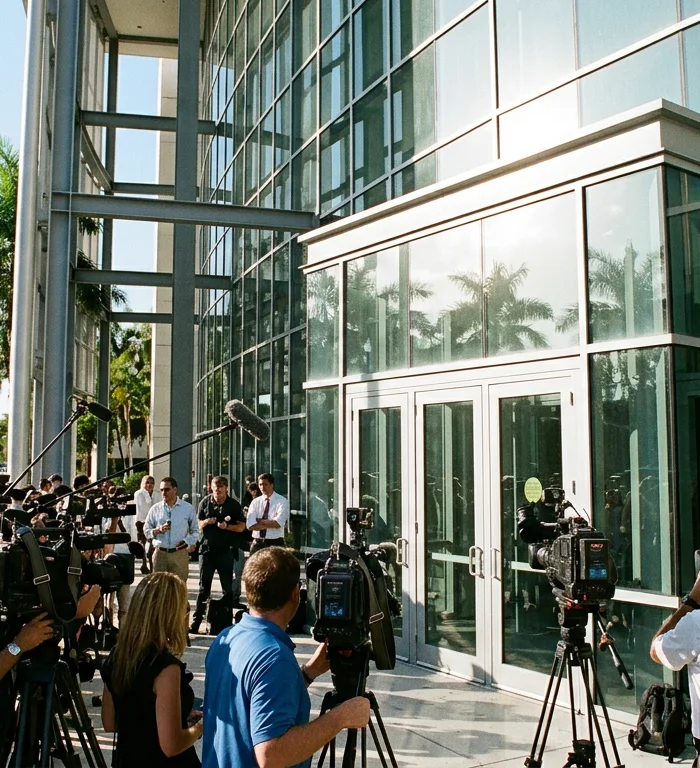
Judge Darrin Gayles dismissed President Donald Trump’s $10 billion Epstein letter lawsuit with prejudice, closing the case in district court.
The Miami federal judge ruled Saturday that Trump’s revised complaint still lacked sufficient allegations of actual malice against Rupert Murdoch and the other defendants. The decision prevents another amended complaint in that court; a representative of Trump’s lawyers said the president intends to appeal.
The ruling did not resolve whether Trump wrote the disputed birthday message. Instead, it addressed whether his allegations about the newspaper’s reporting met the legal threshold required for a public figure’s defamation case.
Malice allegations fail a second time
Gayles issued the dismissal about six months after rejecting the initial lawsuit, which sought $10 billion in damages. The new decision ends Trump’s effort to address the shortcomings identified in that earlier district-court ruling.
In his 20-page decision, Gayles described the reporting process as a “thoughtful and detailed investigation.” He rejected the amended complaint’s arguments that the newspaper had investigated inadequately, left out relevant information and proceeded despite denials from Trump and his representatives.
Those denials were central to one of Trump’s arguments against publication. Gayles reasoned that treating a public figure’s denial as grounds to prevent unfavorable reporting would conflict with constitutional protections for speech and the press.
The amended complaint also alleged that Murdoch told Trump “I will handle it” during a telephone conversation about the planned article. That account was an allegation in Trump’s pleading, not a finding establishing what Murdoch promised or how the publication decision was made.
Birthday letter remains disputed
The dispute concerns reporting published on July 17, 2025, about a message purportedly included in an album prepared for Jeffrey Epstein’s 50th birthday in 2003. The article alleged that the message carried Trump’s signature and that Ghislaine Maxwell had requested it.
Maxwell, a close associate of Epstein, was later convicted of procuring underage girls for him to sexually abuse. The birthday message’s authorship, however, remained contested throughout the litigation described in the supplied account.
Trump denied creating either the message or its accompanying illustration when the allegations emerged. His response included the statement: “This is not me. This is a fake thing.”
The distinction between authorship and the publication process is central to understanding the outcome. Gayles rejected the adequacy of Trump’s allegations against the defendants without deciding whether the underlying document was authentic.
Trump’s lawyers point to appeal
A spokesperson for Trump’s legal team said Saturday that the president would continue pursuing the defendants. The supplied account contains no substantive response from representatives of Murdoch or the newspaper following the dismissal.
If Trump pursues an appeal, the next stage would be a challenge to the dismissal rather than another revision of his district-court complaint. His team’s statement establishes an intention to appeal, not that an appeal has already been filed.
For Murdoch and the newspaper, the immediate result is dismissal with prejudice, rather than a judicial finding on the letter’s authenticity. Whether that dismissal survives any appeal is the remaining procedural uncertainty identified by Trump’s announced plans.
More stories
- Store closes after Fairfield shooting; six people wounded
- Store closes after Fairfield shooting; six people wounded
- Cyclone Arnab kills at least three on India's east coast
- Trump midterm convention draws candidates to GOP push
- Guyana deportees arrive as US third-country deal starts
- Trump mail ballots order faces Supreme Court test again
Latest news
- Apple AI budgets fall as engineers face lower daily caps
- Israel coalition talks loom as rivals fall short of power
- AI stocks split as Democrats win Congress and tech gains
- US Treasury expands Iran sanctions on maritime operators
- Energy drinks show 11-fold cardiac-arrest reporting signal
- Shoals-ARRAY merger targets up to $2.4bn 2027 revenue
- Serbia, Georgia and Turkey face EU accession limits over alignment
- British Airways restores daily Dubai-Heathrow flights