

Israel coalition talks loom as rivals fall short of power
Israel’s certified election results open coalition talks with neither Benjamin Netanyahu nor Gadi Eisenkot commanding a parliamentary majority.
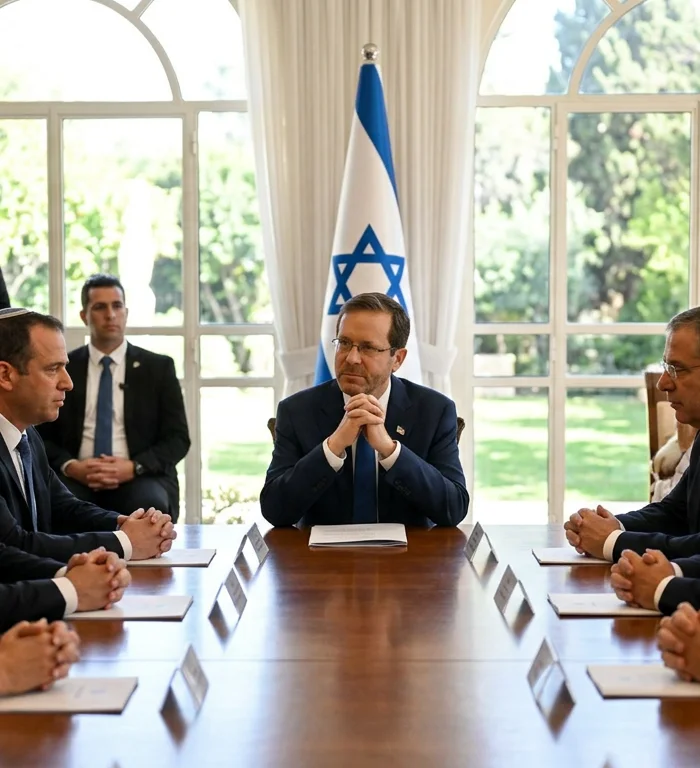
Israel’s certified election results open coalition talks with neither Benjamin Netanyahu nor Gadi Eisenkot commanding a parliamentary majority.
The Central Elections Committee delivered the October 27 voting results to President Isaac Herzog on Wednesday. Netanyahu’s alliance finished ahead of Eisenkot’s, but neither reached the 61 seats required for a majority in the 120-seat Knesset.
Herzog is due to choose which contender receives the initial opportunity to assemble a government in the coming days. Netanyahu continues as caretaker prime minister while the process proceeds, leaving the election outcome separate from the question of who can govern.
Herzog urges concessions from rival parties
Herzog called on parties to reconsider commitments made during the campaign, arguing that preventing another election would require flexibility. His appeal addressed the obstacle facing both camps: a parliamentary result that gives neither enough seats to govern alone.
President Isaac Herzog, whose office is largely ceremonial, set out that distinction in his speech. “I am not asking anyone to give up their core values,” he said.
The president also appealed for creative approaches to negotiations rather than insisting that every electoral pledge could survive them. His remarks frame the coming bargaining as a test of which commitments parties are prepared to modify, not simply which bloc secured more seats.
Eisenkot’s route depends on Arab parties
Eisenkot, a centrist and former general, leads a camp with 48 seats, according to the certified results. That leaves his alliance 13 seats below the majority threshold, despite a possible numerical route through cooperation with two Arab parties.
Those parties together hold 19 seats, enough to bring a combined grouping with Eisenkot’s camp to 67. Such an arrangement would stand six seats above the minimum needed for a majority, but the arithmetic alone does not establish an agreement among the parties.
If those parties reached an arrangement with Eisenkot, their combined strength would overcome his existing shortfall. Without their participation, his current camp would remain below the threshold; the possible combination is therefore a negotiating route rather than a settled governing coalition.
Netanyahu’s lead leaves governing questions unresolved
Netanyahu has continued to allege irregularities in the voting, even as certification advanced. Those claims remain allegations and should not be confused with the committee’s formal presentation of the election outcome.
For Netanyahu, finishing ahead of Eisenkot does not resolve the need to secure additional parliamentary backing. If his camp can attract enough support, the numerical lead could translate into a governing arrangement; without that support, it leaves the majority question unresolved.
Herzog’s selection will establish who gets the first attempt, not guarantee a successful coalition. The next decisions are whether potential partners will negotiate together and what concessions they will accept, with another election the outcome Herzog has explicitly urged them to avoid.
More stories
- Serbia, Georgia and Turkey face EU accession limits over alignment
- British Airways restores daily Dubai-Heathrow flights
- Pedro Sánchez ties US midterms to Spain’s election fight
- Ethiopian Human Rights Commission puts Shirka toll at 48
- Abu Dhabi draws private-equity firms as secondary deals hit $121bn
- NNPC puts Nigeria crude output at 1.8m bpd after reforms
- Lebanon families face $700 autism-care bill as war disrupts routines
- France plans troop deployment ahead of Saturday protests
Latest news
- Apple AI budgets fall as engineers face lower daily caps
- AI stocks split as Democrats win Congress and tech gains
- US Treasury expands Iran sanctions on maritime operators
- Energy drinks show 11-fold cardiac-arrest reporting signal
- Shoals-ARRAY merger targets up to $2.4bn 2027 revenue
- Türkiye Desk: e2vc opens $150m growth fund for games and tech
- Data centers face backlash after Democratic midterm wins
- Democrats hold Michigan Senate seat with El-Sayed victory