Guyana deportees arrive as US third-country deal starts
Guyana deportees from Cuba and Afghanistan entered a one-year US-backed process, with officials saying the group had no criminal background.
Lauren Collins ·
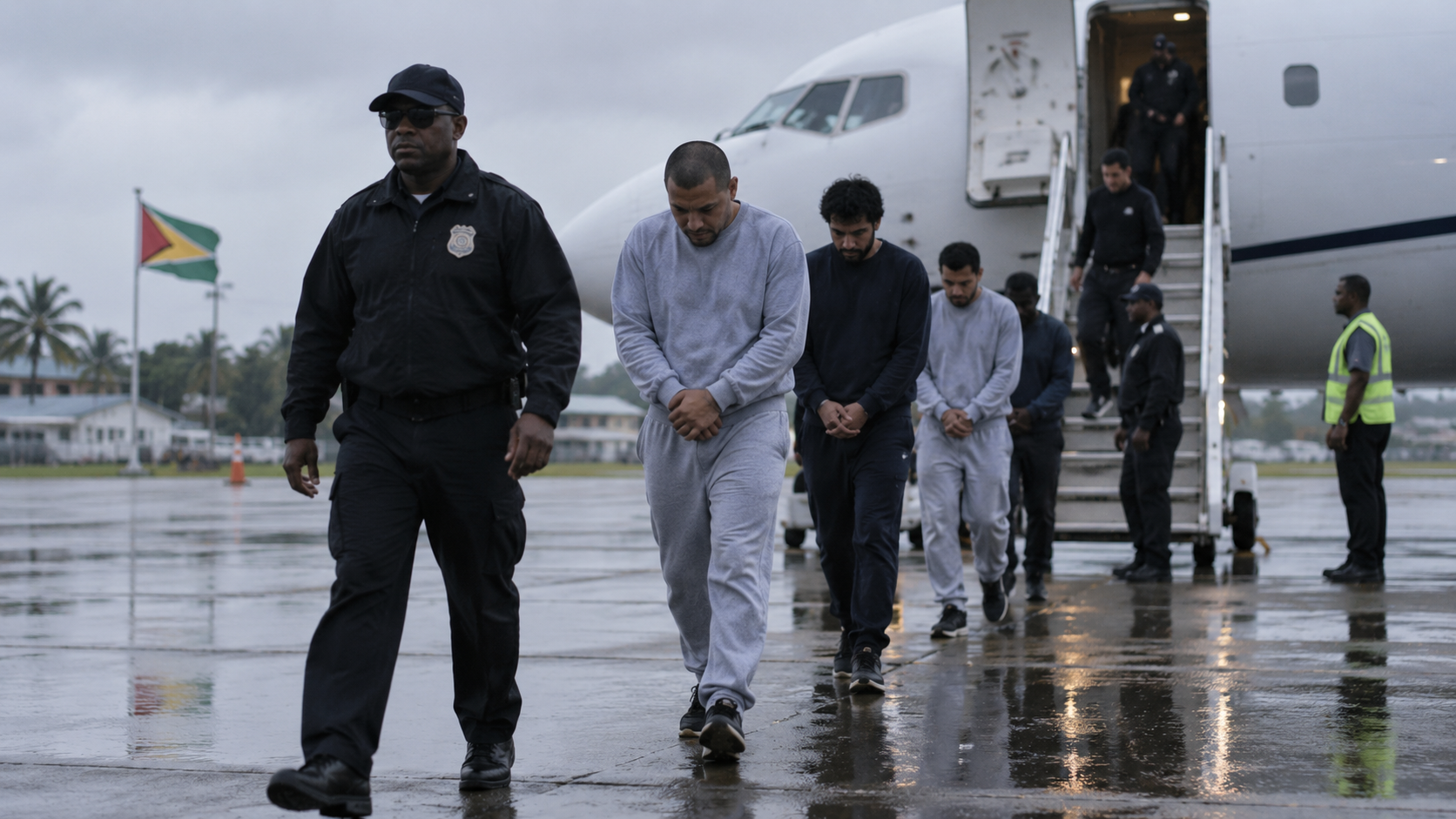
Guyana deportees began arriving under a US third-country program after officials accepted six vetted migrants from Cuba and Afghanistan. The stay is temporary.
The government in Georgetown said Saturday that the first person in the group arrived Friday, opening a one-year arrangement negotiated with the White House. Foreign Secretary Robert Persaud said all six were screened by Guyanese authorities and were found to have no criminal background.
Six migrants enter Georgetown process
Persaud said the removals from the US were tied mainly to immigration matters, not criminal cases. He said Guyana agreed to host the group after months of talks with President Trump's administration.
The arrangement places Guyana inside a wider US effort to relocate some deportees to countries other than their places of origin while their cases are resolved. Under the process described by Guyanese officials, the migrants will wait in Guyana while authorities determine their immigration status.
Persaud said the agreement does not amount to permanent resettlement. He also said “the U.S. has not made any further requests,” limiting the current arrangement to the six people already accepted.
One-year deal limits Guyana role
The government said the deportees are being handled through the Assisted Voluntary Return Program. People placed in the program could ultimately go back to their countries of origin or be moved to another location, according to Guyanese authorities.
The U.N. International Organization for Migration is responsible for implementing the program, the government said. Georgetown said it will not cover housing or support costs, a detail that narrows the direct fiscal exposure for a country taking part in a politically sensitive migration arrangement.
For Guyana, the numbers are small, but the policy issue is larger than the first arrival. Third-country removals can move migration pressure from the deporting country to transit or host states, especially when origin-country returns are delayed by legal, diplomatic or logistical barriers.
Caribbean states accept small groups
Guyana is a founding member of the 15-nation Caribbean Community, a bloc where several governments have already accepted limited groups of US deportees. Officials named St. Kitts and Nevis, Belize and St. Lucia among the member states involved, with St. Lucia due to take its first group this week.
The regional pattern matters because each small placement can create a precedent for further requests, even when the initial cohort is limited. For Caribbean governments, the immediate test is administrative capacity: screening arrivals, coordinating with the migration agency and keeping the arrangement from becoming permanent by default.
The White House gains another destination for migrants whose status remains unresolved, while Guyana receives a narrow role bounded by time, cost and case size. The open question is whether those limits hold if US deportation volumes rise or if more origin-country returns stall.
Status reviews decide final destination
If the one-year terms hold and no additional US request follows, the wider effect should remain limited to migration case management and regional diplomacy. Guyana would act as a temporary host for six people, and the Caribbean migration-services network would absorb a small, agency-run process.
If Washington seeks more placements, the mechanism changes: host countries would face new screening decisions, the U.N. migration agency would need more operating capacity, and Caribbean governments would weigh cooperation against domestic political risk. In that scenario, Guyana's role would become a reference point for other states asked to join or expand similar arrangements.
The next practical step is the status determination for the six migrants now covered by the agreement. Their final destination, whether return to Cuba or Afghanistan or relocation elsewhere, will show how temporary the program is in practice.