

Cyclone Arnab kills at least three on India’s east coast
Cyclone Arnab left at least three people dead in eastern India, disaster official Narendra Singh Bundela said, after coastal evacuations.
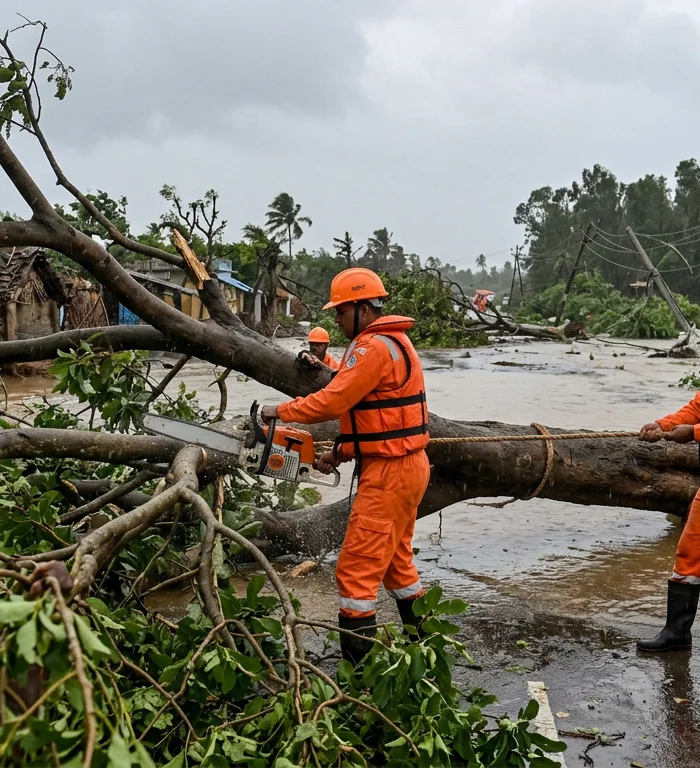
Cyclone Arnab left at least three people dead in eastern India, disaster official Narendra Singh Bundela said, after coastal evacuations.
The storm reached Andhra Pradesh early on October 28, bringing heavy rain and winds reaching 135 km/h. Fallen trees blocked highways, electricity supplies failed in several areas, and transport and school closures disrupted daily life.
At least 180,000 people had been moved from Andhra Pradesh and neighboring Odisha before landfall. Authorities said the projected storm corridor encompassed communities with more than 12 million residents, a population figure rather than a count of people confirmed to have suffered damage.
Andhra Pradesh reports deaths and damage
Bundela, a senior official with the National Disaster Response Force, identified Andhra Pradesh as the state suffering the greatest impact. His account put the initial death toll at three; a complete breakdown of the circumstances was not available.
Chief Minister N Chandrababu Naidu reported the destruction of at least 180 homes in correspondence with federal Home Minister Amit Shah. He also recorded 220 toppled trees and electricity interruptions across multiple locations, providing an early measure of the damage rather than a financial estimate.
Air and rail cancellations accompanied the evacuations, while some schools shut. Together with blocked roads and damaged homes, those disruptions leave separate questions about when transport can resume and when displaced residents can return safely.
Weaker classification leaves coastal flood risk
Arnab reached the coast under the classification “very severe cyclonic storm,” the third-highest tier of the applicable scale. Its designation subsequently fell to “severe” as it traveled inland, but that change alone does not establish that flooded communities are safe.
India’s Meteorological Department had projected a surge reaching 1.5 meters above the prevailing tide. The department warned that coastal terrain at low elevations in Andhra Pradesh faced inundation; the forecast height should not be read as a confirmed measurement of flooding.
The distinction matters for recovery: lower wind intensity and receding water are different conditions. If roads remain submerged or obstructed, access to affected neighborhoods could remain difficult even after the cyclone weakens; if routes reopen, those transport constraints would ease.
Nepal and Sri Lanka issue warnings
The regional precautions extended beyond India’s damaged coastline. Nepalese authorities advised tourists on October 27 to avoid high-altitude destinations, citing possible intense rainfall, snowstorms and avalanches associated with Arnab between Thursday and Saturday.
Those warnings came during Nepal’s peak hiking season, placing mountain travel alongside coastal transport among the activities facing disruption. They described anticipated hazards, not confirmation that avalanches or storm-related casualties had occurred in Nepal.
Sri Lanka also shut schools, while its Department of Meteorology warned of possible flash flooding and landslides. Those measures broadened the regional response, although the available account did not establish a comparable damage toll there.
The immediate uncertainties concern the completeness of India’s casualty count, the extent of housing losses and the duration of electricity interruptions. Updated damage assessments, restored transport services and subsequent weather advisories will help establish whether the emergency is shifting toward recovery or whether flooding requires continued restrictions.
More stories
- Trump midterm convention draws candidates to GOP push
- Guyana deportees arrive as US third-country deal starts
- Trump mail ballots order faces Supreme Court test again
- Nepal flood rescuers find two alive at Trishuli project
- Gallup finds terrorism confidence tied at US record low
- C-Track breach hits court systems in 11 U.S. states, USVI
Latest news
- EU rules bar Nord Stream return under 2027 gas phaseout
- Investors weigh OpenAI strengths against Anthropic growth
- Bolsonaro reaches Miami after defeat and fleeing Brasil
- Clariane posts 4.7% organic revenue growth
- GE Vernova lifts 2026 free-cash-flow outlook to $16bn-$17bn
- South African parties split over Cape Town's 30,000-home annual gap
- Kinross Gold faces Q3 test after 2%-3% output cut
- Ruto seeks Russian investment in Kenya's $380m trade push