Brazil election polls put Lula and Flavio in runoff tie
Brazil election campaign closes with Lula narrowly ahead in round one but tied with Flavio Bolsonaro in a likely runoff.
Claire Dubois ·
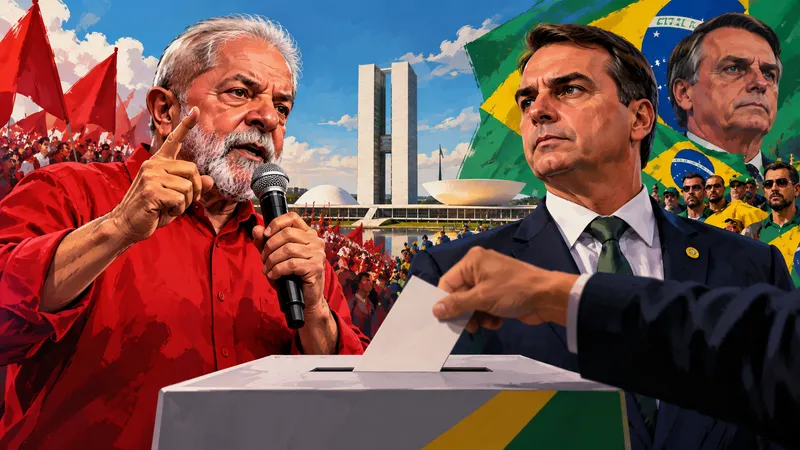
Brazil election polls show Lula and Flavio Bolsonaro effectively tied for an October 25 runoff, tightening a vote with trade and crime stakes.
The campaign closes Thursday before Sunday’s first-round vote, where 13 candidates are on the ballot. Polls cited in the campaign suggest President Luiz Inacio Lula da Silva may lead the opening round but fall short of the majority of valid votes needed to avoid a second contest.
A poll released Tuesday put Lula at 47.6% of second-round voting intention, compared with 47.7% for Senator Flavio Bolsonaro. A Quaest poll published Monday showed undecided voters down to 5% of the electorate, narrowing the pool both campaigns can still reach.
Runoff numbers tighten
The likely second round would match Lula, seeking a fourth non-consecutive term, against the son of former Brazilian president Jair Bolsonaro. Jair Bolsonaro’s conviction last year over a plot to overturn his 2022 election defeat remains central to conservative politics and has drawn criticism from President Trump, who called the prosecution a "witch hunt."
Lula has framed the election partly around sovereignty, warning of foreign interference and pointing to fresh US tariffs on Brazilian goods. Leonardo Barreto, cofounder of Think Policy, said Lula sees Brazil’s trade ties with China as a reason to preserve room for maneuver from Washington.
The Bolsonaro family has taken the opposite approach, using links with President Trump and White House visits to reinforce its standing with conservatives. Barreto said the family views US support as a form of political insurance if the race or its aftermath turns contentious.
Household costs squeeze Lula
Lula’s early advantage has narrowed even as his administration points to lower inequality and unemployment. Voters are also weighing a rising cost of living, heavy household debt and the influence of criminal groups, three issues that have weakened the case for another Lula term.
The president has answered with late campaign measures, including a more generous welfare program, debt relief policies for families and a crackdown on online betting. Rodrigo Russo, a partner at Control Risks, said Lula recognized the electoral risk and used government tools to protect votes he still needs.
Lula’s appeal to business leaders last week showed the narrowness of the race. "I don't want to marry you," he told hundreds of executives, adding: "I just want one vote."
Families and crime dominate
Flavio Bolsonaro has leaned on his father’s political brand, including an AI-generated avatar of Jair Bolsonaro that appeared at a July campaign rally. The appearance drew controversy because rules tied to Jair Bolsonaro’s conviction bar him from public communication, while also showing Flavio Bolsonaro’s reliance on his father’s support among right-wing voters.
Lula has faced family pressure of his own as his son, Fabio Luis Lula da Silva, remains under federal police investigation over accusations of influence peddling. The case adds to a campaign already strained by public anger over corruption and the fallout from the now-defunct Banco Master.
Daniel Vorcaro, Banco Master’s former head, was arrested earlier this year over his alleged role in a multibillion-dollar fraud. The investigation has drawn in figures across Brazil’s political class, including Supreme Court Justice Alexandre de Moraes and Flavio Bolsonaro, who is under investigation over money laundering tied to the case.
Violent crime has pushed both candidates toward tougher security language. Flavio Bolsonaro has promised five supermax prisons modeled on El Salvador, while Robert Muggah, cofounder of Igarape Institute, said, "There's plenty of political mileage in promising tougher punishment."
Trade paths diverge
If Lula holds his first-round edge and wins the runoff, Brazil is likely to keep stressing policy independence between Washington and Beijing, with tariffs and China trade shaping the global angle. That path would keep pressure on Brazilian exporters exposed to US measures while giving Lula more space to extend welfare, debt and betting policies at home.
If Flavio Bolsonaro instead converts the runoff tie into a win, closer alignment with President Trump would become the main foreign-policy mechanism to watch. For Brazil’s companies and lenders, the immediate test would be whether tougher crime pledges and corruption investigations calm voters or deepen uncertainty around regulation, credit and political risk.