The Price of Assad: After the Base Deal, What Would It Take for Moscow to Give Him Up?
Matteo Ricci ·
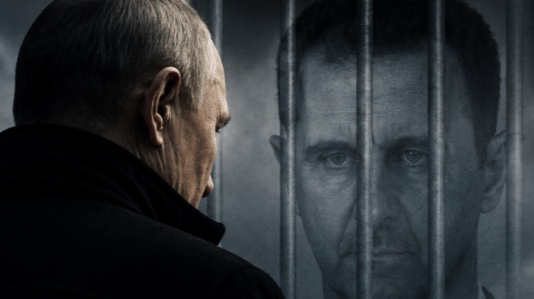
A Syrian court sentenced former president Bashar al-Assad to death in absentia on Tuesday for crimes against humanity, capping a week in which the two governments with the most at stake in his fate; the one that wants to try him and the one that shelters him; concluded a separate bargain that conspicuously left him out.
The Fourth Criminal Court in Damascus, ruling in Case No. 1 of 2026, found Assad guilty of war crimes and crimes against humanity arising from the regime's 2011 crackdown in the southern city of Daraa, the cradle of the uprising that became Syria's civil war. Judge Fakhreddine al-Aryan, in a session carried live on Syrian state television, described Assad as "the highest decision-maker" in a state apparatus turned against its own citizens. The court also sentenced Assad's brother Maher, the former Fourth Division commander, to death in absentia, and issued the same sentence, in person, against Atef Najib, the Assad cousin whose security directorate in Daraa detained and tortured the schoolboys whose graffiti lit the 2011 revolt. The court ordered its warrants circulated internationally and converted prior asset freezes into enforceable seizures.
The sentence is, for now, unenforceable against its principal target. Assad has lived in Moscow since fleeing Damascus on December 8, 2024, under asylum that Russian officials describe as a personal decision by Putin, granted on humanitarian grounds. No credible reporting indicates Russia is reconsidering. Interfax and TASS carried Lavrov's January 29 remarks to Turkish media dismissing the question outright; Kremlin spokesman Dmitry Peskov, asked after the October 2025 Putin–al-Sharaa summit whether extradition had come up, told reporters: "We have nothing to report on Assad here."
THE TIMING is the story. On August 9, Syria's foreign ministry announced, via state agency SANA, a memorandum of understanding with Moscow under which Syria assumes control of civilian facilities at Latakia's airport and a commercial berth at Tartus port, while the two Russian military installations; the Tartus naval base and Hmeimim air base, Moscow's only permanent military footholds on the Mediterranean; become joint training and capacity-building centres over a three-month transition. Russia's foreign ministry called the arrangement a step toward improving military cooperation. A Syrian source told Reuters some Russian forces will remain.
For eighteen months, analysts had framed those bases as Damascus's single greatest piece of leverage over the Assad question. Al-Sharaa himself told The New York Times in April 2025 that Syria had asked for extradition as a condition attached to Russia's military presence, and that Russia refused. The events of the past week suggest the transitional government has, at least for now, decoupled the two files: it took the sovereignty and reconstruction gains available from Moscow, then delivered its answer on Assad through its own courts two days later.
WHAT DAMASCUS HAS BUILT is a legal architecture designed to outlast Russian protection. The in-absentia death sentence follows a September 27, 2025 arrest warrant issued by a Damascus investigative judge on charges of premeditated murder, torture leading to death and deprivation of liberty, also rooted in the Daraa file. Syrian officials confirmed in May 2026 that a formal extradition request had been transmitted to Russia; Deputy Interior Minister Abdul Qader al-Tahhan and Attorney General Hassan al-Turba described parallel tracks of in-absentia warrants, asset freezes and Interpol coordination. On August 12, a day after the verdict, the justice ministry announced a committee to pursue the extradition of those sentenced, working through Interpol channels.
Damascus can also invoke a treaty Moscow itself signed. Russia and Assad's own government concluded an extradition treaty in St. Petersburg in June 2022; an instrument now available to the government that overthrew him. Two of its provisions cut against Damascus, however: a death sentence permits Russia to refuse extradition absent assurances the sentence will not be carried out, and in-absentia convictions trigger retrial requirements. In practice, legal specialists note, the treaty is moot so long as Russia treats Assad as a protected asylee.
THE STAKEHOLDERS' incentives have hardened into a stable standoff. For al-Sharaa's government, Assad's prosecution is a foundational legitimacy claim; the promise of accountability made to a population of which, by United Nations estimates cited throughout the conflict, hundreds of thousands died and millions were displaced. For Moscow, the calculus runs the other way. Analysts at Western think tanks and Russian independent media converge on the same three points: handing over a sheltered client would devalue Russian protection for every other partner watching, from the Sahel juntas to Central Asia; the precedent of Viktor Yanukovych, hosted since 2014, shows Moscow does not surrender exiles; and Assad in a Damascus courtroom could testify to a decade of Russian military conduct in Syria. The military analyst Sergey Auslender told Novaya Gazeta Europe in February 2025 that Russia had already decided against extradition, adding that Assad had moved a considerable fortune into Russia; a factor, he argued, in Moscow's hospitality. That characterization is analyst assessment, not an official position of either government.
The United States, which received al-Sharaa at the White House in November 2025 and repealed the Caesar Act sanctions in December through the annual defense bill, has treated Assad's fate as a Syrian-Russian bilateral matter rather than a condition of normalization. Gulf states funding reconstruction have likewise not made his handover a prerequisite. That leaves Damascus's accountability drive running primarily through courts; its own, and Europe's.
The European track is live but constrained. France's highest court ruled in July 2025 that Assad's head-of-state immunity shielded him from a warrant issued while he held office over the 2013 chemical attacks near Damascus, while making clear that as a former president he can now be pursued; French investigating judges had already issued a fresh warrant in January 2025 over a 2017 strike that killed a French-Syrian national. At the International Court of Justice, the torture case brought by Canada and the Netherlands against the Syrian state continues, with the transitional government engaging rather than stonewalling. Syria has not acceded to the International Criminal Court, despite a January 2025 Damascus visit by its then-prosecutor; a step that would cut both ways, exposing opposition-era conduct to the same jurisdiction.
Assad himself has not been seen publicly since his flight. Reporting by Die Zeit and The Guardian describes a sequestered life between a central Moscow apartment and a suburban villa under state protection, with a bar on political activity as the reported condition of asylum. The Syrian Observatory for Human Rights claimed he was hospitalized near Moscow in September 2025 after a suspected poisoning; a single-source account that Russia denied and that no independent outlet has confirmed. Lavrov said in October that Assad had no problems living in the Russian capital.
The week's sequence; a base deal Saturday, a death sentence Tuesday; reads less like coincidence than choreography, though neither government has said so. Damascus banked what Moscow would give. Then it put on the record, in its own courtroom, what Moscow would not.