

BMO reaches 68.68% defense rate in device AI tests
The arXiv preprint says boundary-aware model obfuscation outperformed a 22.32% baseline, but the method has not been peer reviewed.
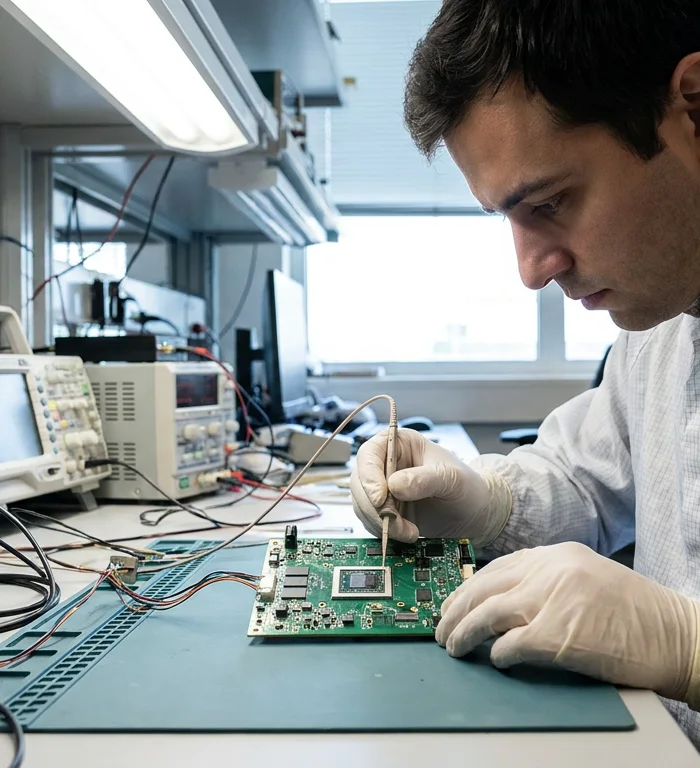
Researchers including Yuyang Zhang said BMO achieved a 68.68% average defense success rate in an arXiv preprint published Oct. 21 on attacks against on-device AI models.
The result matters because the authors said the strongest baseline reached 22.32% against cross-node attacks, a threat model in which one compromised edge device can aid attacks on peer models.
The paper addresses a security problem in on-device machine learning, where models run on edge devices rather than only in cloud systems. The authors said compromised devices may give attackers white-box access, meaning direct visibility into deployed model internals.
“Most existing defenses target known vulnerabilities, yet white-box access still enables attackers to uncover more unknown weaknesses,” the authors said in the preprint abstract.
BMO, short for boundary-aware model obfuscation, is designed to alter model parameters so peer devices do not share the same decision geometry. A decision boundary is the mathematical separation a model uses to assign inputs to different classes.
The authors said their method separates parameters into boundary-position and boundary-curvature components using null-space constraints, then injects noise into the boundary-curvature component. The goal is to create differentiated decision boundaries while preserving normal, non-adversarial accuracy.
The preprint said BMO was tested across four major types of adversarial attacks and four widely deployed on-device models.
The commercial relevance is tied to the spread of AI chips and edge deployment. The authors said on-device machine learning is gaining use because it can reduce latency and support privacy, but the same distribution model can create shared exposure when devices run models from a common source.
The arXiv record lists the work under Cryptography and Security and Artificial Intelligence, with submission history showing version 1 submitted on Oct. 19.
More stories
- Europe faces attribution gap after 16 cyber, physical incidents
- PIF backs Grand Theft Auto as Saudi players embrace game
- Signal limits screenshots to curb AI access to messages
- Cognition runs Devin Mac workspaces on EC2 in 6 AWS regions
- Salesforce engineers cut 600-failure triage to 90 minutes
- Türkiye Desk: GTA 6 puts console access and network demand in focus
- Sceye tests 4G service from 54,000 feet over Japan
- DeepSeek updates AI model as speed and cost rivalry grows
- SpaceX Falcon 9 Launches Slow in Pivot to Starship
- AI Chipmaker Cerebras Systems Aims for $3.5B in IPO
Latest news
- Trump prepares tariffs on China and other major exporters
- New-car buyers pay record average $50,087 in October
- Banks face ECB reserve debate over liquidity and profits
- Investors see Anthropic debut gains fade below $83 a share
- Iraq orders federal control over Kurdish-area oilfields
- Germans oppose Ukraine aid as poll shows support slipping
- Kim Jong-un receives 10 envoys after constitutional shift
- Ukraine claims Libya strike sinks Russian naval corvette