Attacks test German power grid as RWE cuts 4,200 MW offline
German power grid operators kept supply stable after police opened a second sabotage investigation and RWE removed 4,200 megawatts of lignite capacity.
Lauren Collins ·
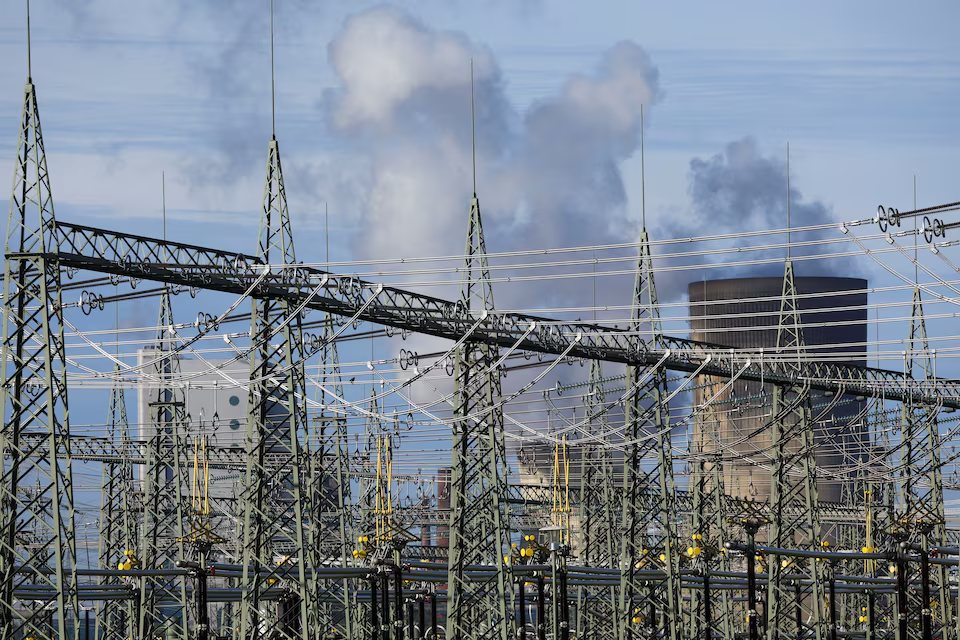
German power grid security came under renewed strain after police opened a second sabotage inquiry near Bergheim, though electricity supply held.
Local police said the case involves suspected premeditated damage to technical infrastructure at a substation near the western German city. The incident was recorded at 4:00 p.m. Tuesday, the same day a separate attack damaged power lines in Brandenburg.
Bergheim supply stayed stable
Police did not describe the damage at the Bergheim site, leaving the scale of the incident unclear. The police account said regional power supply was not disrupted, anchoring the case as a security breach rather than an immediate outage.
Amprion, the electricity grid operator involved in the area, said external interference was the likely cause of the western Germany incident. The company said grid stability and power supply were maintained throughout, according to its statement.
RWE cuts lignite capacity
RWE said the incident led it to take lignite-fired units at Neurath and Niederaussem off the grid. The affected units have 4,200 megawatts of combined capacity, a figure tied by the company to the two power plant sites.
The utility said the units were expected to return to service over the next few days. RWE also said it remained in contact with Amprion and the authorities, placing the operational response inside a wider security investigation.
The Bergheim case followed the Brandenburg incident earlier Tuesday, where devices carrying conductive material damaged power lines in the eastern state. The two events give German investigators parallel cases on different parts of the electricity system: a substation in the west and transmission lines in the east.
Infrastructure alerts widen
Germany has been on heightened alert over threats to critical infrastructure, including energy networks and transport nodes. On Tuesday, Berlin blamed Russia for an attempted drone attack last month on a Ukrainian cargo plane at Leipzig/Halle airport and ordered new measures in response.
That accusation remains the German government's account of the airport case. The grid incidents add another pressure point for authorities already examining how physical attacks, drones and sabotage attempts could affect infrastructure that supports industry and households.
Germany's electricity system has faced attacks before, including incidents attributed by authorities to suspected left-wing militants. The latest cases differ in geography and method, but both involved physical interference with equipment rather than a reported cyberattack.
Three paths for investigators
If the Bergheim damage remains contained and RWE reconnects the units within the company's stated timetable, the macro effect is likely limited to security costs and contingency planning. For RWE, the mechanism would be a short operational interruption; for the power sector, the lesson would be tighter protection around substations and line corridors.
If investigators identify a link between Bergheim and Brandenburg, the issue would shift from isolated vandalism to a coordinated infrastructure threat. That would put more pressure on German security agencies, require grid operators to reassess physical access points and increase the likelihood that utilities face higher surveillance and repair spending.
If further incidents follow, the wider macro channel would run through confidence in Germany's energy reliability, especially for power-intensive industry. The company-level risk for RWE would be repeated dispatch disruptions at large plants, while the sector risk would be a broader hardening cycle across substations, transmission lines and power station interfaces.
The main open questions are the extent of the Bergheim damage, whether the Brandenburg and Bergheim cases share a method or sponsor, and how quickly the RWE units return. Until investigators answer those points, the immediate facts remain narrower: two physical grid incidents on Tuesday, no reported supply failure near Bergheim and 4,200 megawatts temporarily removed from RWE's lignite fleet.