Oil prices hold near highs as Hormuz supply risks rise again
Oil prices held near one-month highs as traders weighed US-Iran strikes, Hormuz traffic risks and signs that crude shipments still reached buyers.
Lauren Collins ·
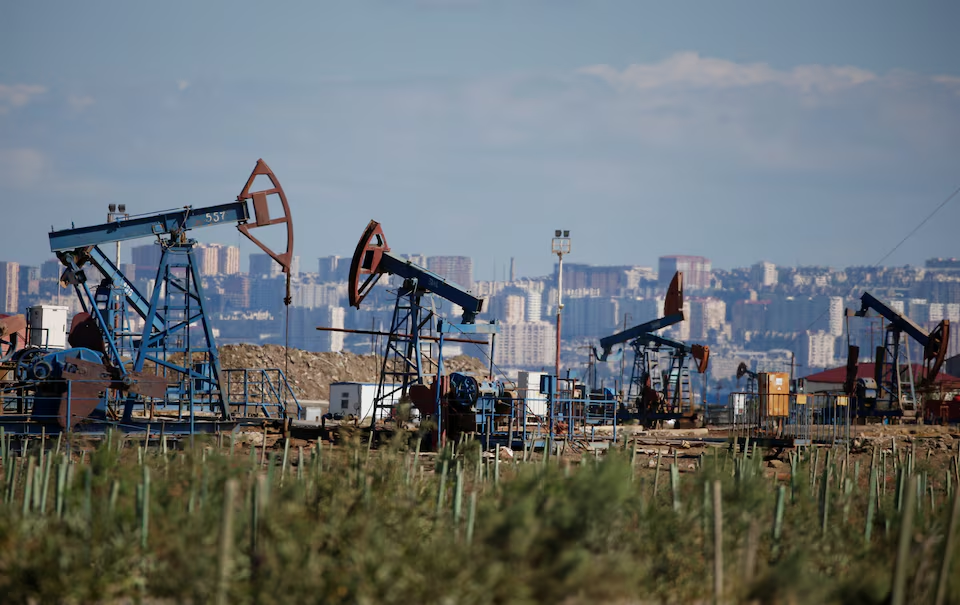
Oil prices steadied near one-month highs Wednesday as traders balanced US-Iran supply risks against evidence that crude shipments still moved. Brent crude futures gained 9 cents, or 0.1%, to $94.74 a barrel by 0805 GMT after rising earlier, while West Texas Intermediate slipped 19 cents, or 0.21%, to $90.03.
The market’s narrow moves followed the most serious exchange of fire between Washington and Tehran in several weeks. The US threatened additional strikes, while Iran’s Islamic Revolutionary Guard Corps said the US attacks would further limit traffic through the Strait of Hormuz.
Hormuz traffic anchors the risk
The Strait of Hormuz is the central pressure point in the oil market because it carried about one-fifth of global oil consumption before the conflict reduced flows. Iran has effectively closed the route to commercial shipping, according to the account provided, leaving traders to judge whether physical barrels can still reach refiners.
US Secretary of Energy Chris Wright said Tuesday that 17 million barrels of oil moved through the Strait of Hormuz on Monday. Wright said that was the highest daily volume through the waterway since the Iran war began cutting shipments, a counterweight to the market’s concern over disruption.
Tankers seek different cargoes
The latest exchange came after a weekend flare-up in hostilities, the first reported since July. It also followed attacks on two tankers leaving the Strait of Hormuz on Monday, an event that disrupted supply routes and pushed traders to look for replacement crude cargoes.
Tim Waterer, chief market analyst at KCM, tied the price risk to whether the escalation continues. "Both Brent and WTI have traded above the $90 level this week, and a return toward $100 oil cannot be ruled out if the current escalatory phase continues," Waterer said.
Analysts at ING also framed the market around the gap between continuing flows and higher crossing risk. "We’ve seen oil flow through the Strait of Hormuz despite the stalemate between the US and Iran, but rising tensions clearly put crossings at risk," they wrote in a client note.
Odesa attack widens energy strain
The oil-market tension was not confined to the Gulf. Russia launched what Ukrainian transmission system operator Ukrenergo described as a "massive" missile and drone attack overnight on energy infrastructure in Ukraine’s southern Odesa region.
The Odesa strike adds a separate energy-security stress point for traders already watching tanker movements and Hormuz traffic. For Europe, repeated attacks on Ukrainian energy infrastructure can complicate grid repairs and regional fuel logistics, even when the immediate price signal is driven by crude flows in the Middle East.
Scenarios turn on Strait flows
If Hormuz traffic remains close to the 17 million-barrel figure cited by Wright, the global macro effect may be more contained because refiners would still have access to physical crude. In that case, Brent and WTI would have less support from scarcity, while shippers, insurers and refiners would remain focused on route reliability and operating costs.
If the IRGC’s warning is followed by tighter restrictions or further tanker incidents, the mechanism would run through freight rates, insurance premiums and replacement cargo demand. That path would put upward pressure on crude benchmarks, raise input costs for refiners and increase the risk that energy prices feed into inflation-sensitive policy debates.
A third path is a split market: oil continues to pass through Hormuz, but each crossing carries a higher perceived risk. The open question is whether Monday’s reported flow level can be repeated after the latest exchange, or whether traders begin pricing supply security separately from the barrels still reaching the market.