Global stocks fall as U.S.-Iran strikes push oil higher
Global stocks fell after U.S. and Iranian attacks near Hormuz lifted Brent crude to $94.87 and pushed bond yields higher.
Atlas Newsdesk ·
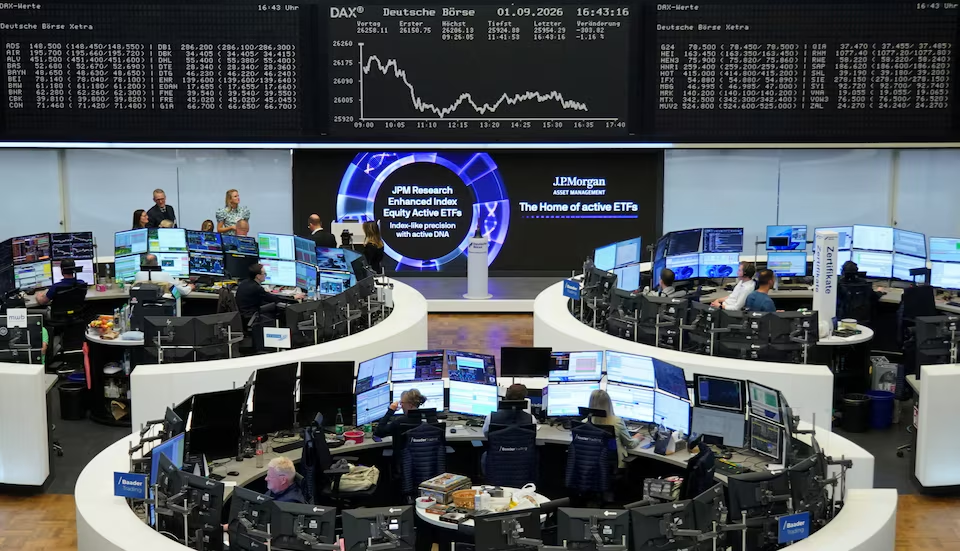
Global stocks fell as Brent crude reached $94.87 after U.S.-Iran attacks near Hormuz, leaving investors with higher oil and yields.
The market moves followed U.S. airstrikes on Iranian military targets near the Strait of Hormuz, a chokepoint for seaborne energy flows. Tehran said it had attacked U.S. assets elsewhere in the region, extending the most severe exchange reported in weeks.
Brent crude futures were up 0.1% from the previous close at $94.87 a barrel, a five-week high, as traders assessed the risk of supply disruption. The oil move added pressure to bond markets already adjusting to higher rate expectations in the United States.
Hormuz risk lifts Brent
The Strait of Hormuz is central to the pricing reaction because oil supply risk can feed quickly into inflation expectations. If shipping or production is interrupted, higher fuel costs can pass through to transport, manufacturing and household energy bills.
“The recent increase in energy prices has put additional upward pressure on bond yields, which had already been on the rise on the back of some fiscal concerns,” said Kiran Ganesh, multi-asset strategist at UBS Global Wealth Management.
The U.S. 10-year Treasury yield rose to an intraday high of 4.8122%, its highest level in almost three years. Japan’s 10-year government bond yield held above 3% for a second session after touching a three-decade high earlier in the week.
Yields tighten equity conditions
Higher yields can make government debt more attractive relative to stocks, while also raising the discount rate applied to future corporate earnings. That mechanism is most visible in growth shares and in sectors whose valuations rely heavily on long-dated cash flows.
MSCI’s global equity gauge fell 0.2% from the previous session and hovered near a one-month low. Europe’s STOXX 600 slipped 0.3%, while Asia absorbed heavier selling: South Korea’s KOSPI dropped almost 4% and Japan’s Nikkei 225 declined 2.9%.
U.S. stock-index futures pointed to a muted open after the prior Wall Street selloff. The dollar index gained 0.05% to 99.734, close to its highest level since August 17, as investors weighed the relative return on dollar assets.
Ganesh said dollar positioning left room for a reversal if the Federal Reserve delivers a less aggressive path than markets expect. “With the market already pricing quite a hawkish outlook for the Fed, we think there's much more scope for downward surprises for the dollar than there is for some of the other currencies,” he said.
Fed bets rise before payrolls
The rate debate now turns on U.S. labor data before the Federal Reserve’s September 16 meeting. ADP private payrolls figures are due Wednesday, followed by the nonfarm payrolls report on Friday.
Fed funds futures implied a 68% probability of a 25-basis-point increase this month, up from 37% one week earlier, according to CME Group’s FedWatch tool. The repricing followed hawkish comments from Federal Reserve Chair Kevin Warsh and the broader selloff in government bonds.
Currency moves were uneven outside the dollar. The New Zealand dollar fell 1.2% from its prior level to $0.58220 after the Reserve Bank of New Zealand lifted its policy rate by 25 basis points to 2.75%, matching expectations.
Other assets also softened. Gold was down 0.1% from the previous close at $4,322.24 an ounce, bitcoin edged 0.6% lower to $76,951.01, and ether fell 1% to $2,394.57.
Three paths for markets
If the U.S.-Iran exchange remains contained, the main macro effect would likely run through risk premiums rather than physical energy shortages. In that scenario, UBS Global Wealth Management’s rate-sensitive allocation view would stay tied to data surprises, while equity sectors exposed to fuel costs could still face margin pressure.
If attacks disrupt shipping near Hormuz, the mechanism changes: higher crude prices would threaten inflation progress and give central banks less room to ease financial conditions. Energy producers could benefit from higher prices, but airlines, transport companies and other fuel-intensive industries would face higher operating costs.
If U.S. labor data weakens before September 16, markets may question whether a 25-basis-point Fed increase priced at 68% is sustainable. The open question is whether energy-driven inflation risk or softer employment data carries more weight for policymakers and for investors already holding stocks near a one-month low.