The far left wins Berlin. Now comes the hard part
A tenants' revolt has made Die Linke the largest party in the German capital for the first time. Turning that into a government will be harder than winning it
Claire Dubois ·
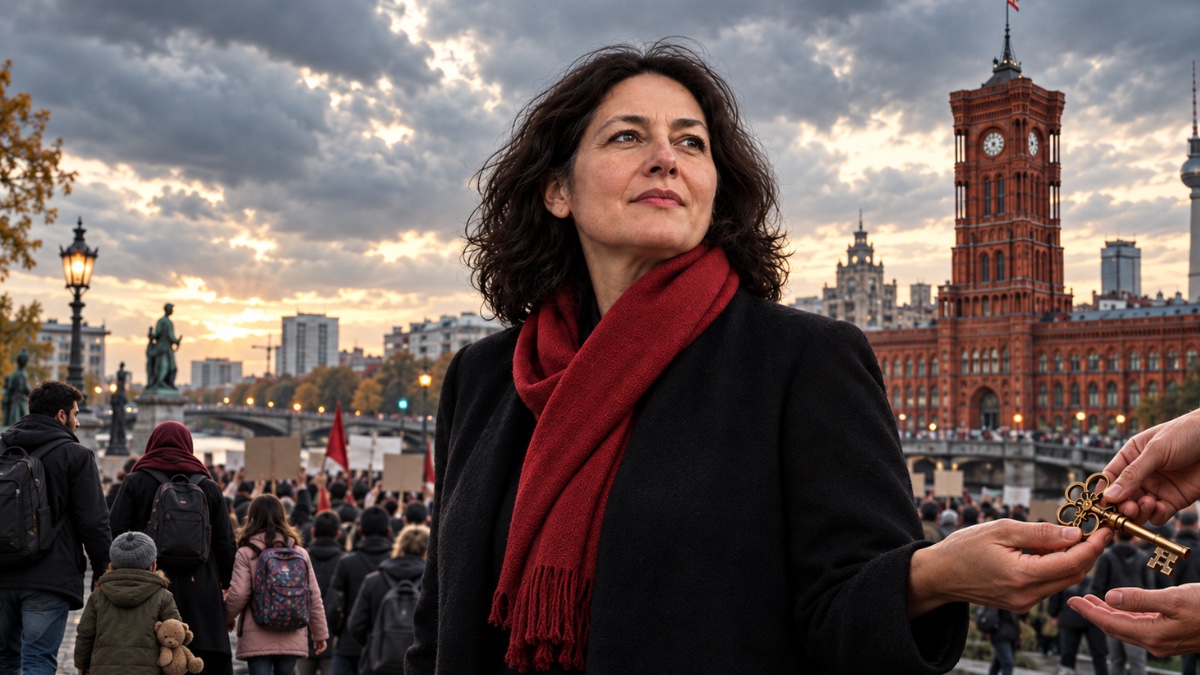
FOR MOST of its history, Germany's capital was a Social Democratic city. On September 20th its voters put a party to the left of the Social Democrats in first place for the first time. According to projections by ARD and ZDF, the public broadcasters, Die Linke (The Left) took between 25% and 25.5% of the vote in the election to Berlin's state parliament, more than doubling its 2023 result. The Christian Democrats (CDU), who have led the city government since 2023, fell to 20%. The Greens took roughly 15%, the far-right Alternative for Germany (AfD) between 14% and 16%, and the Social Democrats (SPD) 12%, the worst result in the party's Berlin history. Turnout by mid-afternoon was running nine points above 2023.
The face of the upset is Elif Eralp, a 45-year-old lawyer who has sat in the state parliament since 2021 and became her party's lead candidate last November. "Together we have written history," she told supporters on election night. She was equally clear about what she wants next: to become Berlin's governing mayor, a post that combines the roles of city mayor and state premier. Stefan Evers, the CDU's candidate, conceded within the hour. "We are evidently not the strongest force," he said, "and so I congratulate the strongest force."
Rent, not revolution
The result owes less to ideology than to housing. Berlin's rents have roughly doubled over a decade, most residents are tenants, and a 2021 referendum in which 57.6% of voters backed expropriating the city's largest private landlords has never been implemented. Ms Eralp built her campaign on that unfinished business. Her party promises to carry out the referendum, freeze rents for a year in the 404,000 flats owned by the city's own housing companies and cap subsequent increases at 1% a year, and set up a task-force to pursue usurious landlords. On election night she said the party remained "committed" to expropriation.
The campaign itself was as notable as the platform. Ms Eralp, the daughter of immigrants who arrived in Germany in 1980, spent months knocking on doors in the immigrant-heavy district of Kreuzberg, which she represents. German newspapers took to calling her "Berlin's Mamdani", after Zohran Mamdani, the democratic socialist who won New York's mayoralty last year on a similar diet of affordability and shoe leather. The comparison is not entirely journalistic licence: Ms Eralp has said Mr Mamdani is "a role model for all parties of the left", and confirmed that one of his campaign strategists visited Berlin in the spring to advise hers.
The pollsters missed the scale of it. The final surveys had Die Linke and the CDU within one or two points of each other; Infratest dimap's late-August poll put the CDU ahead. The projections suggest the Left's ground operation was worth three to four points that nobody measured. Die Linke had already come first in Berlin in the February 2025 federal election, with 19.9%, a result widely treated as a protest vote. It now looks like a trend.
The CDU's collapse had its own causes. Kai Wegner, the incumbent mayor, withdrew as his party's candidate in July after months of criticism over his handling of a January blackout that left tens of thousands of households without power, and over contradictory accounts of what he had done that day. Mr Evers, the finance senator, had 71 days to introduce himself. "We lost," he said on Sunday, "but we gained against the downward trend."
The arithmetic
Coming first does not make Ms Eralp mayor. Berlin's parliament elects its governing mayor, and no two parties command a majority. ZDF's seat projection gives Die Linke 37 of 130 seats, the CDU 28, the Greens 22, the AfD 19, the SPD 17 and the Sahra Wagenknecht Alliance (BSW), a left-populist splinter, seven, provided it clears the 5% threshold, on which it sits exactly. A majority is 66. Only two combinations get there: Die Linke, the Greens and the SPD, with 76 seats, or the CDU, the Greens and the SPD, with 67.
That makes the Greens and the SPD the arbiters, and both have named their price. Werner Graf, the Greens' lead candidate, said on election night that his party had "the greatest overlap" with Die Linke and the SPD. But Felix Banaszak, the Greens' federal co-leader, added that any deal would require "a clear commitment against antisemitism". The demand is not abstract. In late August a rapper invited by Die Linke's Neukölln branch performed a song containing the line "Death to the IDF" at a party rally. Ms Eralp condemned the performance "in the strongest terms"; the head of the Central Council of Jews in Germany called her words "lip service". The state party leadership later declared the performance a mistake and made the district branch promise to clear future events with it, but nobody was disciplined.
The SPD's objection is economic. Bettina König, the party's Berlin co-chair, said voters had "just voted us out", and signalled that the party remains opposed to expropriation, the one policy Ms Eralp has said she will not trade away. Steffen Krach, the SPD's candidate, called the night "a caesura": "We were once the Berlin party. We are not any more."
What it means beyond Berlin
Three things follow. The first is political. Die Linke, once a party of East German pensioners, has remade itself as a party of young urban tenants, and Berlin is its proof of concept. The result is also an early warning for Friedrich Merz, the chancellor, whose CDU shed eight points in the capital on the same day the AfD came within two points of first place in the state of Mecklenburg-Western Pomerania.
The second is legal and fiscal. If Die Linke leads the next government, Germany will get its first serious attempt to socialise private housing under Article 15 of the constitution, a provision that has never been used. Compensation could run to tens of billions of euros for a city already carrying heavy debt, and the matter would almost certainly end up before the constitutional court.
The third is about representation. Should Ms Eralp form a government she would be the first woman to run Berlin and the first child of immigrants to lead any German state government from the left; Cem Özdemir of the Greens became the first state premier from an immigrant family in Baden-Württemberg in May. Ms Eralp has been careful not to make her origins the story. Asked about the politics of her parents' homeland, she speaks in generalities about democracy and the rule of law and names no names. Her campaign was about rent. Her mayoralty, if she gets one, will be judged the same way.
The official preliminary result is due overnight. In 2023 it took Berlin two and a half months to form a government. Ms Eralp has the votes to start the negotiation. Whether she has the partners to finish it is the question that will occupy the capital until winter.