

Mining Sector Faces Regulatory Pressure Over Declining Fly-In Fly-Out Accommodation Standards
Declining accommodation standards for FIFO workers are driving psychosocial risks and legal exposure, prompting new government guidelines and calls for…
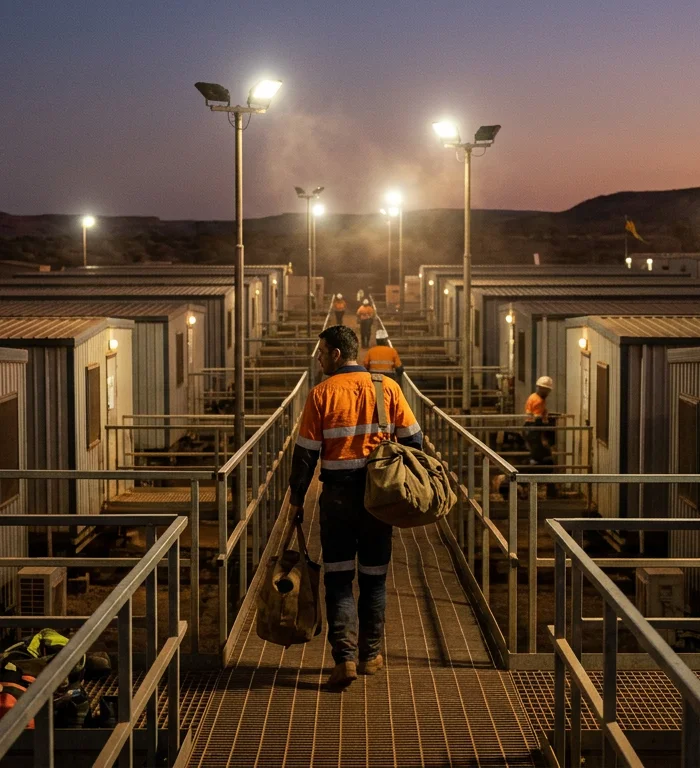
Advocates and researchers report a decline in accommodation standards for fly-in fly-out (FIFO) workers across the Australian mining sector. Current living conditions, ranging from demountable units to motel-style overflow, are increasingly linked to psychosocial hazards, including isolation, bullying, and sexual harassment. Experts suggest that the built environment accounts for approximately 60 percent of these psychosocial issues, with poor living conditions contributing to workforce instability and reduced productivity.
In response to these concerns, the Western Australian government is finalizing a code of practice for worker accommodation, expected to receive endorsement in 2026. While the code will not be legally binding, it is intended to serve as a benchmark for safety and amenity standards, including requirements for improved lighting, secure door locks, and reliable connectivity. Legal experts note that compliance with such codes may become a critical factor in litigation regarding workplace hazard management.
Industry analysis indicates that mining firms often prioritize superficial amenities over structural improvements, a practice described by researchers as "wellbeing washing." Economic modeling suggests that upgrading accommodation to a neutral standard—focusing on acoustics, bedding, and connectivity—could yield approximately $1.6 billion in annual revenue through improved worker retention and performance. Despite these potential gains, researchers report a pervasive culture of silence, where workers fear retaliation for reporting health and safety concerns.
This environment of suppressed feedback has been linked to recent industrial action and ongoing class-action litigation against major mining operators. Advocates are now calling for mandated 24/7 family contact points to integrate support networks into the safety framework. As regulatory scrutiny intensifies, mining companies face increasing pressure to align their infrastructure investments with long-term psychosocial health outcomes to mitigate legal and operational risks.
More stories
- The Week in Games: GTA 6 turns attention into cash
- US data centres emit 25.7m tonnes of CO2, Harvard says
- German founders need 3,942 hours to open small business
- Leaked Deutsche Bank files test Sewing's reform narrative
- UAE employers plan 2.8% pay rises for 2027
- Bessent urges Nvidia to seek outside CEO as scrutiny grows
- CapitaLand, Neon target China's $2.8 trillion experience economy
- Listed firms in Indonesia face fire scrutiny as 2.88m hectares burned
- MIT ammonia-to-hydrogen claim could shift port capex onto customers
- AppLovin CEO says ads are ML 1.0, pushing game UA toward model-based buying
Latest news
- Social Security raises 2027 benefits 3.6%
- Hull City 2–0 Brighton: When Resilience Beat Reputation
- David Parr House to honor Victorian art-workman with blue plaque
- Iran's attacks hit 25 tankers near Strait of Hormuz
- FCC approves prison cellphone jamming despite 2.5-mile warning
- Russia strikes Ukraine as Odesa faces electricity strain
- Bahrain reports two injuries after Iranian aerial attacks
- Congress tests Black Democrats' growing policy influence