

Listed firms in Indonesia face fire scrutiny as 2.88m hectares burned
Rainforest Action Network and Nusantara Atlas cited cases on palm oil and pulpwood concessions and urged banks to condition finance on fire prevention.
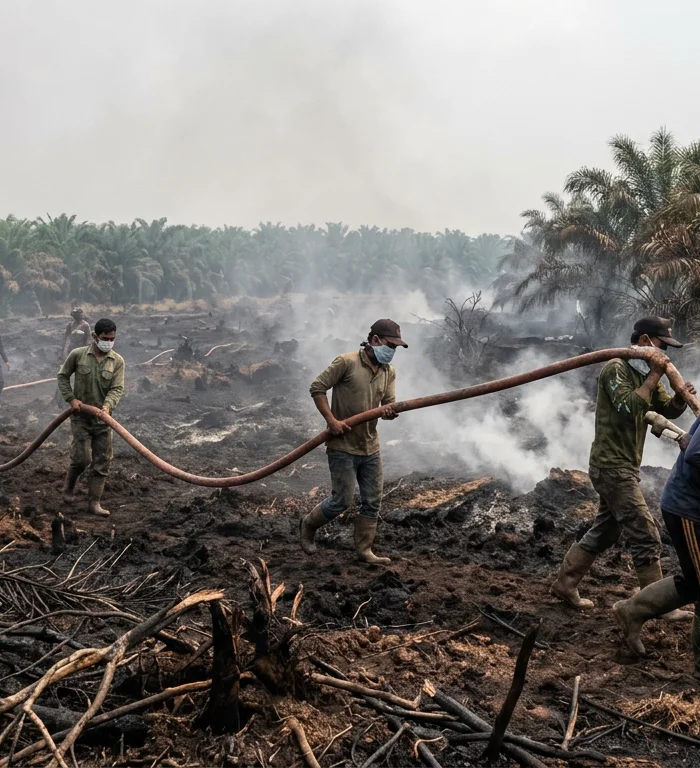
Listed firms active in Indonesia faced fresh scrutiny on Nov. 13 after a Rainforest Action Network and Nusantara Atlas study said fires damaged 2.88 million hectares between January and October 2026.
The finding matters for plantation operators, lenders and regional governments because fire damage in the first three quarters was 35% above the same period in 2019, Nusantara Atlas said.
The joint study attributed the 2026 damage to severe El Nino conditions, extreme heat, forest conversion for large-scale plantations and degraded peatlands. Peatland is carbon-rich wetland soil that becomes highly flammable when drained.
Indonesia’s fires were linked to a rise in respiratory illness domestically, while air-quality alerts and school closures spread across the region, the report said. Fire emissions rose to three times the seasonal average, according to the same account.
“It’s not really a question of who lit the match, but who drained the peat and created the conditions,” said Alex Helan, research and investigations lead at Rainforest Action Network.
The study did not determine how individual fires started. It said the risk lay in damaged peat areas, weak fire controls on fast-growing plantation concessions and bank finance that supports companies operating in fire-prone areas.
Rainforest Action Network and Nusantara Atlas examined fire outbreaks on large holdings, including concessions tied to business groups under investigation in Singapore under its transboundary haze law. The report said banks and investors financing risky Indonesian operations should “make access to financing conditional on credible fire prevention”.
One case involved more than 14,600 hectares burned on the Bumi Mekar Hijau pulpwood concession, which the report described as an exclusive supplier to Indonesia’s Asia Pulp & Paper. Asia Pulp & Paper said it could not comment on the study’s findings.
The study also identified at least 3,742 hectares of burned land within the Kayung Agro Lestari oil palm concession in West Kalimantan, operated by Singapore-listed First Resources. Nearly 2,000 hectares of that area was forest classified as “high conservation value”, according to the report.
Reuters said First Resources had not replied to its request for comment. The company told Rainforest Action Network it followed a “zero burning policy” for land clearing and had put fire-prevention measures in place.
A third case cited satellite analysis showing 4,473 hectares of burned land inside an oil palm concession operated by Bumitama Agri. The study said 88% of the burned area was on peatland vulnerable to fire.
Bumitama did not respond to an emailed request for comment, Reuters said. The company told Rainforest Action Network that investigations were continuing and that it was not yet able to address specific allegations.
“These companies have made business decisions in their offices... to operate in an extremely fire-prone landscape, and to develop plantations in those landscapes for profit,” Helan said.
Source: News report, Reuters via The Straits Times, Nov. 13, 2026
More stories
- CapitaLand, Neon target China's $2.8 trillion experience economy
- BCP Investment seeks ICMB merger at 126% premium
- Woolcott avoids jail over AI-assisted Touchstone takeover fraud
- Deal Sheet: Unity talks put $25 billion on game-tools table
- SoftBank faces leverage test after 60% share drop
- American Airlines puts premium products near half ticket revenue
- ACCO Brands lifts 2026 EPS outlook to $0.98-$1.02
- US tech faces 48-hour AI incident reporting push
Latest news
- FAA halts US departures after communications disruption
- Europe faces unity test as Trump revives Ukraine diplomacy
- Democrats push AI regulation as two state veterans arrive
- Lutnick faces AI chip scrutiny as Bessent faults Commerce
- AI investment boom binds global suppliers to US spending
- Senate Democrats face leadership fight after midterm gains
- Trump extends Jones Act waiver for another 90 days: official
- Russia reports 1% growth as refinery output declines 18%