

CapitaLand, Neon target China’s $2.8 trillion experience economy
Weak goods spending is pushing mall and entertainment operators to compete on service-led formats rather than leases alone.
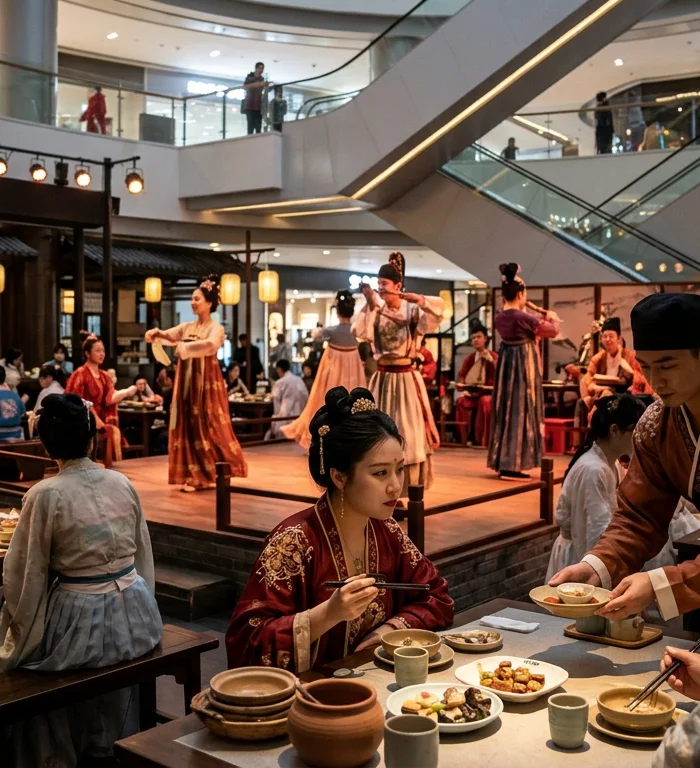
CapitaLand Investment and Neon are using experience-led venues in China, where the experience economy reached $2.8 trillion by November 2025, Channel NewsAsia reported in a Nov. 13 news article.
For CapitaLand Investment and Neon, the opportunity stands out because official data showed China's retail sales grew 1.1% in the first nine months of 2026, while services retail rose 5% and goods sales increased 1%.
At Raffles City The Bund in Shanghai, a CapitaLand-operated mall, Xuyan offers a Tang dynasty-themed dinner theatre with an eight-course meal, costumes and performances. A dress-up package costs S$55, or US$43, while seats can reach S$133.
Reservations at Xuyan are booked six to seven months ahead, CNA reported. The venue sits alongside a 1990s Shanghai-style food court and a British-style tennis club, part of the mall's effort to give visitors reasons to make the trip.
Ervin Yeo, CEO of commercial management at CapitaLand Investment, said online retail's prevalence in China requires malls to offer concepts that physical stores can defend. “We think more about the experiential part of shopping. What are the things that we enjoy about shopping?
The sense of discovery, sense of something new to feel and touch,” he said.
Xuyan's global partner and chief creative officer, Rick Garson, said the format competes on value rather than food alone. International tourists now account for about 45% of Xuyan diners, compared with 5% to 10% when it opened in February.
The broader market has expanded quickly. China's experience economy, spending tied to activities and service-rich consumption, reached 18.4 trillion yuan, or $2.8 trillion, by the end of November 2025, up 22.6% year on year, according to the China Academy of Information and Communications Technology.
Kow Juan Tiang, executive director for China at Enterprise Singapore, said Chinese retail is shifting as consumers spend more on services. “It is really about providing an experience to the consumer, and that is the trend that is happening globally. It is also very (prevalent) in China,” he said.
CapitaLand remains invested in China and manages 49 malls in the country, with more planned, CNA reported. The company put occupancy across its malls above 94%.
The strategy carries execution risk. “Experiential can very easily become gimmicky. Experiential can last, gimmick cannot,” Yeo said.
Neon, the Singapore entertainment company behind attractions including Harry Potter: Visions of Magic at Resorts World Sentosa and Jurassic World: The Experience at Gardens by the Bay, brought Machu Picchu and the Golden Empires of Peru to the Shanghai Museum in July. The virtual-reality and multisensory exhibition is expected to attract more than 3 million visitors over its 16-month run.
Ron Tan, Neon's group CEO, said even well-known intellectual property no longer assures ticket sales. “China probably has another layer of difficulty because of (its) access to technology,” he said.
More stories
- Listed firms in Indonesia face fire scrutiny as 2.88m hectares burned
- BCP Investment seeks ICMB merger at 126% premium
- Woolcott avoids jail over AI-assisted Touchstone takeover fraud
- Deal Sheet: Unity talks put $25 billion on game-tools table
- SoftBank faces leverage test after 60% share drop
- American Airlines puts premium products near half ticket revenue
- Malaysia EMS growth tied to China-plus shift, press release says
- Dangote refinery IPO aims to raise $1.6bn, with 87% control retained
Latest news
- FAA halts US departures after communications disruption
- Europe faces unity test as Trump revives Ukraine diplomacy
- Democrats push AI regulation as two state veterans arrive
- Lutnick faces AI chip scrutiny as Bessent faults Commerce
- AI investment boom binds global suppliers to US spending
- Senate Democrats face leadership fight after midterm gains
- Trump extends Jones Act waiver for another 90 days: official
- Russia reports 1% growth as refinery output declines 18%