A Chinese platform is renting human faces for $15 to populate AI game assets
An emerging market in China is paying individuals flat fees of $15 to $700 to license their likenesses for AI-generated content.
Jason Kwon ·
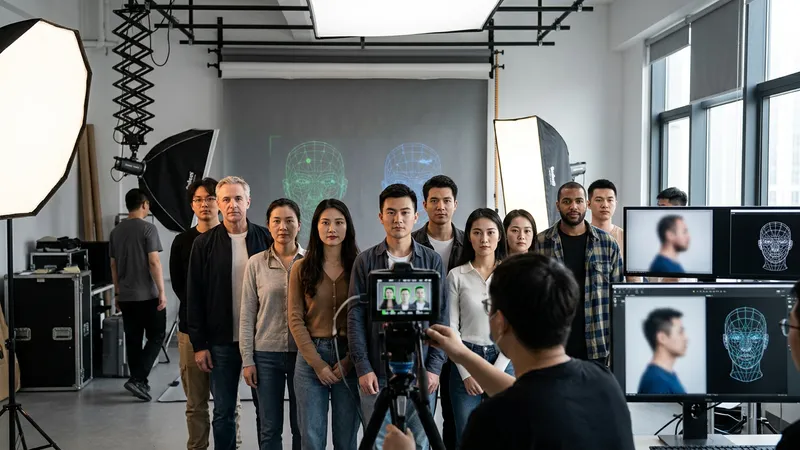
A human face is now a game development asset that can be acquired for roughly the cost of a modest lunch. In China’s rapidly expanding artificial intelligence sector, individuals are leasing out their likenesses to platforms for use in AI-generated microdramas, digital advertising, and video games, with payouts ranging from $15 to $700 per face, according to a Firstpost report .
The arrangement creates a new, commoditized marketplace for digital identity. Rather than hiring background actors for performance capture or tasking concept artists with inventing original facial features, platforms are directly purchasing the rights to map real human faces onto AI-generated bodies. While the Firstpost report highlights the phenomenon's primary roots in China's booming microdrama industry—short-form, algorithm-driven video series meant for mobile consumption—the explicit inclusion of video games points to a subtle structural shift in how low-cost assets are sourced.
The $15 character model feeds a voracious mobile pipeline
To understand why a game developer would buy an AI-generated face, you have to look at the bottom line of modern production. Designing, modeling, and texturing a unique character from scratch is a highly specialized, time-intensive process. For a top-tier console release, that cost is justified by the need for bespoke, hyper-detailed protagonists. But for mobile titles, visual novels, or live-service games requiring a constant treadmill of new content, those labor costs create a vicious production bottleneck.
At $15 to $700 a pop, licensed AI faces offer a blunt economic shortcut. The immediate application is unlikely to be fully rigged 3D models running around in a major blockbuster. Instead, this marketplace feeds the voracious demand for 2D portraits, dialogue-box avatars, and user-acquisition marketing materials. If you have ever scrolled past a mobile game advertisement featuring a strangely lifelike but slightly stiff actor reacting to gameplay, you are looking at the exact tier of production this marketplace is built to supply.
The marketplace creates a stark geographic labor arbitrage
This marketplace also sets up a stark contrast in global development labor. Over the past year, Western voice and performance actors have actively mobilized—and in some cases, gone on strike—to secure protections against AI cloning and the unauthorized use of their digital likenesses. Meanwhile, this emerging Chinese platform operates as an entirely opt-in, flat-fee clearinghouse for facial rights.
Because China remains one of the world's primary hubs for game development outsourcing, with massive domestic publishers and independent service studios handling asset generation for global companies, this local marketplace has global implications. If Western studios face union friction or rising costs to secure background actor likenesses at home, they may increasingly rely on offshore vendors who can legally source cleared, ready-to-use human faces for a few hundred dollars. The $15 face could quietly find its way into the background crowd assets shipped to international clients, shifting leverage away from traditional concept artists and character modelers.
A licensed face still hits a technical ceiling in a game engine
This is where the frictionless marketplace hits a practical ceiling. Licensing a flat likeness is not the same as securing a usable, animated 3D asset that can react to dynamic lighting or player interaction. The technical gap between pasting a face onto a 2D microdrama character and integrating it into an interactive game engine means traditional technical artists are still required to clean up and implement the output.
Furthermore, players possess a highly attuned radar for the uncanny valley. The moment a background non-playable character moves in a way that betrays its AI origins, the immersion shatters, often leading to immediate online backlash. Renting a real human face solves the initial generation problem, but it does not solve the animation and rigging hurdles that make a game actually feel alive.
Platform policies are the only friction left at the storefront
There is also the mounting risk of platform intervention. While the upfront cost of renting a face is undeniably cheap, the downstream distribution risks are growing. Steam, the dominant PC storefront, now requires developers to explicitly disclose the use of pre-generated AI content within their games, subjecting those titles to heightened player scrutiny and potential review-bombing campaigns.
Beyond store policies, there is the unresolved question of brand safety. When a platform pays an individual $15 for their likeness, the boundaries of how that face can be used in an interactive medium remain legally murky. If a licensed face is attached to an in-game vendor in a title that becomes embroiled in controversy, or if the AI generation inadvertently matches a real citizen to a compromised digital scenario, the initial savings on a concept artist suddenly looks like a massive legal liability.
Over the next six to twelve months, the real test for this marketplace will not be whether platforms can source enough faces, but whether developers can deploy them without triggering platform restrictions or player revolts. The industry will be watching to see if Apple or Google update their mobile store guidelines to specifically address real-world likeness licensing in AI game assets, or if major outsourcing firms begin to explicitly advertise—or deny—the use of these marketplaces in their client pitches. The barrier to entry for digital human creation has officially plummeted, leaving studios to figure out exactly how much reality they can afford to buy at bargain-bin prices.