

Xizang earthquake blocks highway as crews build shelters
Xizang earthquake responders assembled shelters for thousands facing freezing conditions while rockfalls obstructed a highway and railway services underwent…
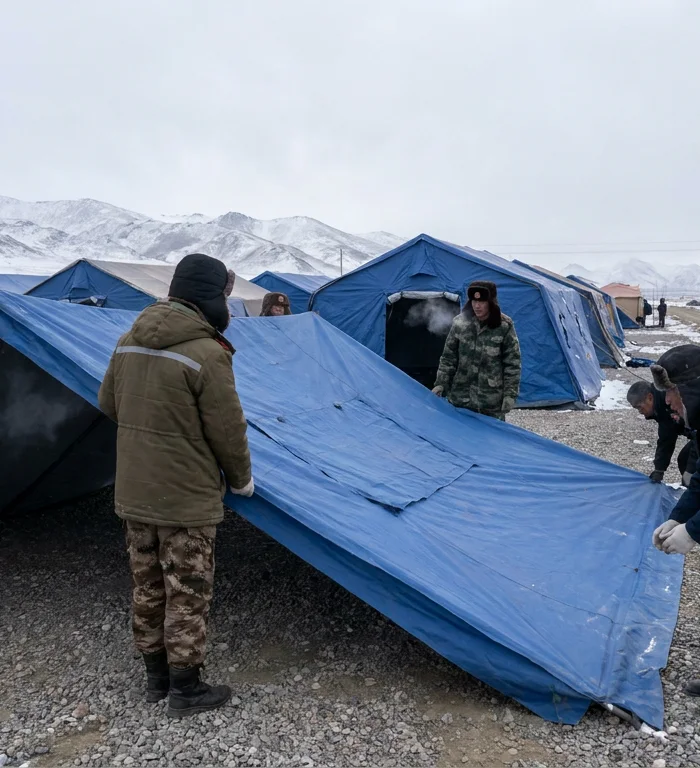
Xizang earthquake relief teams assembled shelters for thousands as rockfalls obstructed a highway, according to an account of the operation.
The account reported that a magnitude-7.0 earthquake struck late Thursday, leaving at least 16 people dead and dozens injured. By Friday, military personnel and civilian responders were constructing accommodation while search crews continued examining damaged buildings and attempting to reach isolated communities.
Highway rockfalls restrict relief access
Rockfalls obstructed a section of a major highway, and rail operations paused while safety checks took place, according to the account. Those disruptions accompanied a response in mountainous terrain, with the affected area described as roughly 4,800 meters above sea level.
Access and accommodation present connected problems for the relief effort. If highway restrictions persist, moving bulky shelter components into affected settlements could become harder; if transport links reopen safely, crews could gain more options for delivering the materials needed to house displaced families.
Aftershocks continued during the response, the account said, as rescuers searched buildings and tried to reach settlements beyond the main operation. The immediate task therefore extended beyond supplying established relief sites to locating people and assessing conditions in communities that remained difficult to access.
Nagqu crews assemble emergency accommodation
Drone footage described in the account showed activity at a relief site in Nagqu, where workers handled building supplies and troops stood near tents. Personnel also coordinated vehicle movements through the site, placing shelter construction and the movement of equipment within the same operation.
The account put the number of homes damaged or destroyed above 330, with thousands of residents seeking safety. That combined housing figure does not distinguish buildings requiring repairs from those lost entirely, a distinction that would matter for assessing how long families might need temporary accommodation.
Authorities dispatched prefabricated units alongside tents, portable beds and supplies for cold weather, according to the account. Police assisted residents leaving affected areas and helped assess damage, while hundreds of firefighters, police and other responders participated with search dogs and dozens of emergency vehicles.
Freezing conditions shape shelter needs
The account identified freezing weather and difficult terrain as obstacles to the operation. For displaced households, assembling accommodation is only part of the immediate challenge: the response also includes bedding and winter supplies, making delivery of those items relevant alongside the number of shelters erected.
If crews can reach isolated settlements and establish usable accommodation, the response could shift toward supporting residents through displacement while damage assessments continue. If aftershocks or access restrictions interrupt that work, search operations, transport checks and shelter construction could remain simultaneous demands on emergency personnel.
The immediate priorities described in the account remained locating people, accommodating displaced families and checking transport infrastructure. Progress on those tasks would determine whether assistance can extend beyond accessible relief sites to settlements where terrain and damaged routes complicate the response.
More stories
- Venezuela protests seek elections as vote dates stay unset
- Typhoon Champi weakens but keeps Taiwan largely shut down
- Zelensky urges Trump to press Putin into ceasefire talks
- France limits protests as Paris braces for more closures
- Portugal housing shortage prompts call for more building
- Canada signs Turkey partnership to widen global trade options
- Rubio urges Ukraine peace as leaders' meeting stays open
- France unrest puts Macron's budget agenda under pressure
Latest news
- Bruno Fernandes keeps United captaincy after Como criticism
- Oil rises as Aramco staff reportedly told to leave offices
- Damages dispute puts Trump finances at center of lawsuit
- Apple Finally Folds, and the Critics Are Mostly Charmed
- Citi gets China securities license, now faces scale test
- Oil and Iran frame Trump’s pitch before November midterms