

Oil and Iran frame Trump’s pitch before November midterms
President Trump says he is releasing $150 million to expand US refining capacity, linking fuel production to his midterm campaign.
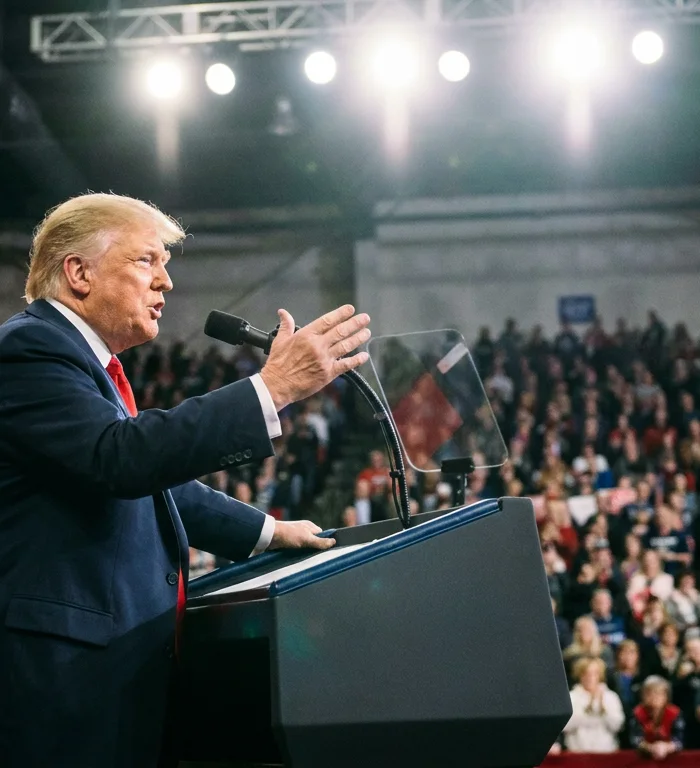
President Trump says he is releasing $150 million to expand US refining capacity, linking fuel production to his midterm campaign.
Speaking Thursday at a campaign event in Sioux City, Iowa, Trump said his administration was invoking the Defence Production Act to support additional gasoline and diesel production. The announcement came before the November 3 midterm elections, alongside his claims about American oil resources and restrictions on Iran.
Refining pledge lacks a delivery schedule
The funding announcement concerned refining capacity, rather than a specified increase in crude extraction. Trump described the objective as producing “more diesel and more gasoline,” but gave no output target in the remarks supplied.
That distinction limits what the announcement establishes: a dollar commitment does not itself quantify additional fuel production. The supplied account identifies neither recipient companies nor facilities, and provides no schedule for allocating the money or bringing additional capacity into operation.
Trump also invoked record production levels without supplying a measurement period or a comparison figure. His remarks therefore offered a political commitment to expand fuel supplies, but not enough operational detail to assess the scale of the proposed increase.
Trump leaves oil comparison undefined
Trump compared the American oil position with the combined position of Russia and Saudi Arabia. His quoted formulation, “we have more oil than Russia and Saudi Arabia combined,” did not specify whether he meant reserves, current production or future output.
Those measures are not interchangeable, and the supplied material contains no supporting figures for the comparison. It also provides no numerical basis for his reference to a different energy landscape eight or nine years earlier.
For companies that might receive the funding, the immediate unanswered questions concern eligibility, award size and permitted projects. For the wider refining sector, the missing capacity target prevents a quantified assessment of how much additional gasoline or diesel the initiative would supply.
Hormuz dispute accompanies the energy pitch
Trump also asserted that Iran had received no oil for an extended period, linking that claim to what he described as reciprocal restrictions involving the Strait of Hormuz. He did not specify dates, shipment volumes or the exact scope of the restrictions in the supplied remarks.
The accompanying account says negotiations between Washington and Tehran have stalled over recent months. It also says Trump rejected Iran’s latest proposal for reopening the strait within seven days, without providing the proposal itself or a separate account from Tehran.
If the refining funding produces additional usable capacity, participating companies would gain production capability and the sector would have more fuel to supply. Any wider economic effect would depend on the volume and timing of that output; neither is established here.
If implementation instead takes longer, the funding announcement alone would not establish an immediate increase in available fuel. The concrete next steps are publication of the funding terms, identification of recipients and clarification of the US and Iranian positions on reopening Hormuz.
More stories
- Damages dispute puts Trump finances at center of lawsuit
- Congress faces Supreme Court rulings with control at stake
- US visa revocations exceed 300,000 in Trump's second term
- White House backs Katie Zacharia as credentials face test
- Musk gives $158 million as Republicans defend Texas seat
- Trump halts execution livestream plan after backlash grows
- AI regulation fight widens as Trump resists slowdown calls
- Trump midterm convention exposes GOP's cost gap in Dallas
Latest news
- Bruno Fernandes keeps United captaincy after Como criticism
- Oil rises as Aramco staff reportedly told to leave offices
- Apple Finally Folds, and the Critics Are Mostly Charmed
- Venezuela protests seek elections as vote dates stay unset
- Citi gets China securities license, now faces scale test
- Xizang earthquake blocks highway as crews build shelters
- Typhoon Champi weakens but keeps Taiwan largely shut down
- Zelensky urges Trump to press Putin into ceasefire talks