

Trump halts execution livestream plan after backlash grows
President Trump halted an execution livestream plan after retired military leaders condemned it and critics warned against public punishment.
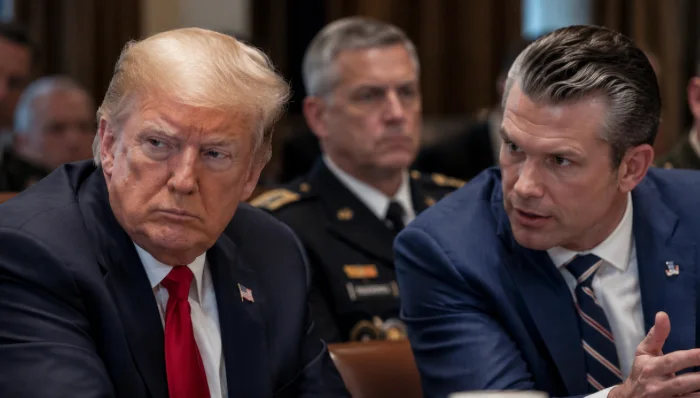
President Trump halted an execution livestream plan after more than 70 retired military leaders condemned the proposal, according to the account.
The proposal, attributed in the account to Defense Secretary Hegseth, involved livestreaming the execution of a former military officer. Trump reversed the plan after opposition from retired military leaders, who condemned the order as "barbaric."
Retired commanders force reversal
The account says more than 70 retired military leaders objected to making the execution publicly viewable. Their intervention matters because the criticism came from inside the military community, not only from outside opponents of capital punishment.
Hegseth’s case for the plan, as described in the account, was deterrence: a visible death would discourage similar conduct. A historian quoted in the material challenged that logic, arguing that "Americans at the republic’s founding debated that premise."
The available account did not identify the former officer, the charges, the sentence, the court record or the date when the execution was expected to occur. Those omissions limit any assessment of the legal posture of the case, while leaving the public-broadcast proposal as the central reported issue.
A 1936 precedent frames dispute
The account put the most recent known public execution in the United States in 1936, making the livestream proposal a break with nearly nine decades of practice. It also said Iran and Afghanistan are the only countries that still regularly conduct public executions.
The distance from 1936 is the central factual anchor in the dispute. A livestream would not recreate a crowd gathered at an execution site, but it would expand access far beyond a prison chamber and make recording, redistribution and commentary part of the event.
That difference is the institutional risk identified by the critics cited in the account. Once an execution is broadcast, the state loses practical control over how images are clipped, shared and used by supporters, opponents or foreign audiences.
Kabul memory sharpens warning
Writer Dexter Filkins, recalling a Taliban-staged execution in Kabul, wrote: "What I saw was different, but not by much." The force of the line was comparative rather than legal: it placed the proposed livestream beside a public killing staged by the Taliban.
A former military officer who had studied execution videos made a separate moral and institutional critique. The officer wrote, "no sane person enjoys looking at an execution… to do so for the crass purpose of entertainment is even worse."
Hegseth’s incentive, as presented in the account, was to link visibility with discipline. The retired leaders’ objection rested on a different concern: that military justice would be judged not only by the penalty imposed, but by the government’s decision to display it.
Deterrence claim meets display risk
The core dispute is not whether the state can punish grave offenses; the account does not provide enough information to assess the underlying case. It is whether punishment gains or loses authority when the government turns an execution into a public broadcast.
If Hegseth’s deterrence argument held, supporters could frame a public execution as a warning aimed at would-be offenders. The mechanism would be visibility: a state-imposed penalty made hard to ignore, with the costs displayed as part of the sanction.
If the critics’ view holds instead, visibility becomes the risk. Public display could make the government appear closer to coercive spectacle than disciplined justice, weakening the institutional boundary between lawful punishment and political performance.
If Trump’s cancellation remains in place, the government avoids creating a new visual precedent while the underlying case proceeds out of public view. The next unresolved issue is whether the administration treats the reversal as final policy or only as a decision in this case.
More stories
- White House backs Katie Zacharia as credentials face test
- Musk gives $158 million as Republicans defend Texas seat
- Zampolli loses envoy post after reported diplomatic feud
- Trump's Iran war pledge links military claims to oil costs
- Kimberly Guilfoyle resigns as U.S. ambassador to Greece
- Trump reviews Guilfoyle amid disputed ethics allegations
- Trump rally splits tone of America's 250th birthday party
- Michigan Senate primary gains Ocasio-Cortez endorsement
Latest news
- Exiro Nickel takes Thompson mines with up to $200m to invest
- Very hot coffee and tea show threefold esophageal SCC association
- Nighttime light exposure correlates with small heart changes in 11,000 adults
- Washington and Moscow in Talks on Data Centers, Nuclear Energy, Putin’s Envoy Claims
- Starshield limits disrupt Ukraine drones, officials say
- Tesla seeks $50,000 Roadster deposits after rocket-assisted demo
- Albanian students challenge Rama after 152 arrests
- Singapore P2P fares rise 12.3% in August