

Albanian students challenge Rama after 152 arrests
Three days of unrest in Tirana have widened pressure on Albania’s prime minister as anger over living costs, education and governance converges.
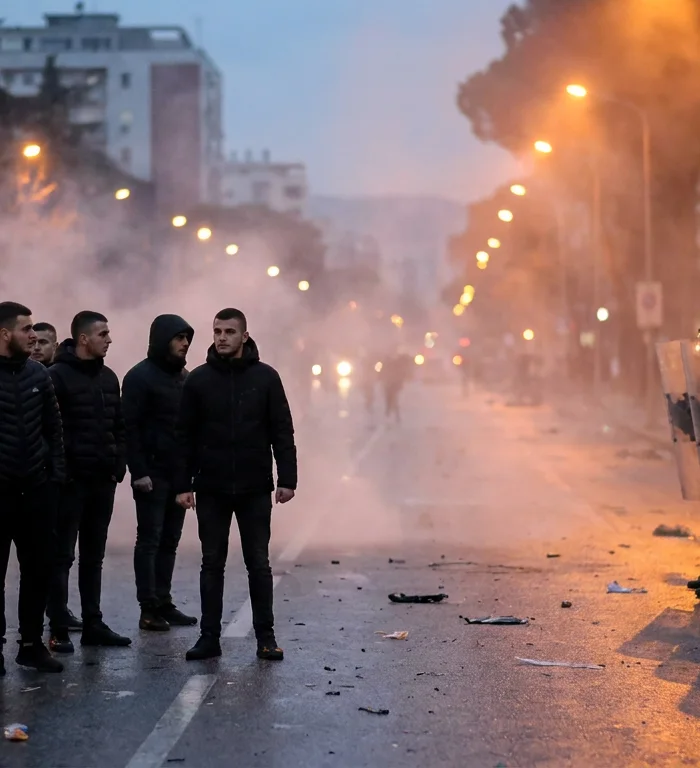
Albanian students pressed Prime Minister Edi Rama to resign after 152 arrests during three days of protests in Tirana, Deutsche Welle reported in an Oct. 16 news article.
The arrests were more than twice the 71 police injuries reported by police, according to Atlas360 calculations, while 324 people were under investigation after clashes in the Albanian capital.
University teaching in Tirana has been disrupted by student boycotts over campus conditions, higher-education costs and limited job prospects after graduation. The protesters say they will not negotiate their demands with Rama, who has led Albania since 2013.
The demonstrations turned violent over the past three days. Bins, businesses, buildings and banks were set on fire, tear gas was used, and injuries were reported among both protesters and police officers. No total figure for injured protesters was provided.
Samanta, a 22-year-old economics master’s student quoted by DW, framed the unrest around wages and housing. “How could I ever afford an apartment in one of these towers on a salary of €540 [$608]?” she said.
The figure was presented against Tirana’s luxury high-rises and the student’s account of sharing rent with strangers after her family emigrated.
The student mobilisation grew out of the “Flamingo Revolution,” an anti-government protest movement that began in late May over a multimillion-euro tourism project linked to Jared Kushner, son-in-law of U.S. President Donald Trump, in the protected coastal area of Zvernec.
The unrest fits a broader pattern of disputes over development and governance. Atlas360 reported on Oct. 2 that Albania’s centralized, large-scale infrastructure development program was facing public protests and allegations of weak transparency, environmental harm and governance failures.
Rama stayed silent during the first two days of the latest student protests, then released a video from the fire-damaged College of Europe building near his office on Tirana’s Boulevard of the Martyrs of the Nation.
“These are the hands of an opposition that, hiding behind masked people, wants to drag Albania back to a place it will never return to,” Rama said in the video.
Rama rejected the demand that he resign, telling Reuters that governments are changed through elections. He later accused “foreign hands” of trying to block Albania’s path toward European Union membership.
Sali Berisha, the 82-year-old leader of the opposition Democratic Party and a former prime minister, denied Rama’s allegation that the opposition was responsible for the violence. “The Democratic Party fully supports this protest and will stand by it until the end. Resign and leave immediately!”
Berisha said at a press conference.
The unrest comes as Albania pursues EU membership. Brussels called for calm and restraint, urging all sides to avoid further escalation and enter dialogue.
Student anger is also aimed at Albania’s wider political establishment. “We want the political class of the past 35 years to go. We want a new Albania with new leaders,” Skerdi Topalli, a 20-year-old journalism student, told DW.
Rigels Xhemollari of Qendresa Qytetare, an Albanian civil society organization, told DW the revolt followed four months of peaceful protests and cited the economy, corruption cases and successive scandals. Mark Marku, dean of the Faculty of History and Philology at the University of Tirana, told DW that even Rama’s resignation and new elections would not necessarily produce new leadership.
More stories
- CoreWeave falls more than 5% premarket after 15.5% drop
- Pomdoctor faces Nasdaq suspension after shares stay below $1
- Goldman cuts Schwab target to $117 after deposit decline
- EU develops 348-satellite IRIS² network for secure links
- Zurich couples keep €9,140 after rent in Deutsche Bank gauge
- Anthropic IPO plans take focus as smaller US deals stall
- Treasury yields rise as 10-year hits January 2025 high mark
- G20 meeting exposes Russia rift as US pushes growth agenda
Latest news
- Nighttime light exposure correlates with small heart changes in 11,000 adults
- White House backs Katie Zacharia as credentials face test
- Musk gives $158 million as Republicans defend Texas seat
- Washington and Moscow in Talks on Data Centers, Nuclear Energy, Putin’s Envoy Claims
- Starshield limits disrupt Ukraine drones, officials say
- Tesla seeks $50,000 Roadster deposits after rocket-assisted demo
- Singapore P2P fares rise 12.3% in August
- Marisa Stachelski chooses risk-reducing surgery after BRCA2 test