

EU develops 348-satellite IRIS² network for secure links
OHB’s nearly €1 billion satellite order highlights Germany’s role as reported Starlink limits in Ukraine sharpen Europe’s autonomy debate.
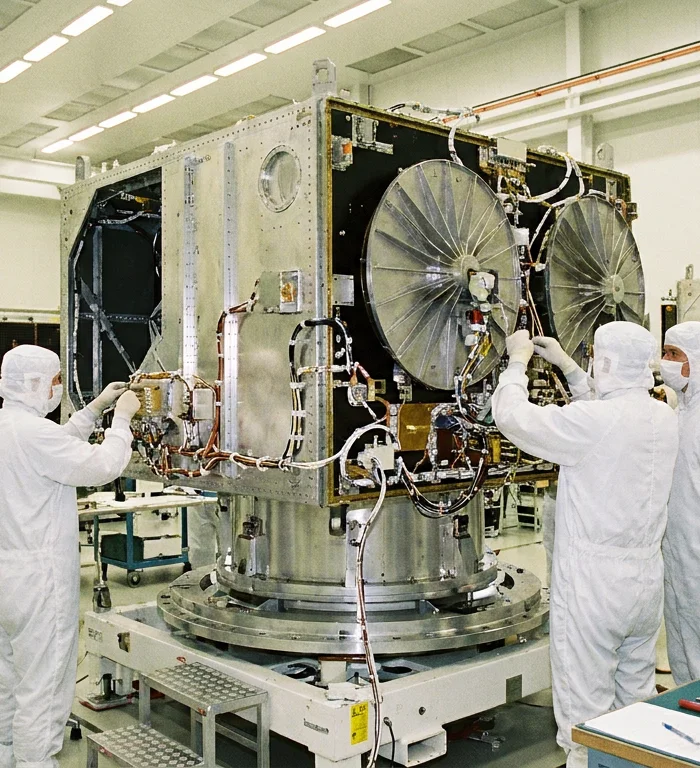
The European Union is developing IRIS² as a 348-satellite secure communications network, with first launches scheduled for 2029, according to a Euronews report published Oct. 16.
The programme would add 66 satellites for defence, security and emergency services, lifting secured capacity for EU public-sector users by 60% and worldwide capacity by 54%, Euronews reported, citing Commission calculations.
IRIS², short for Infrastructure for Resilience, Interconnectivity and Security by Satellite, is designed to serve governments, companies and citizens, while reducing mobile coverage gaps in Europe and Africa. The planned network comprises 330 satellites in low Earth orbit and 18 in medium Earth orbit.
The EU effort has gained relevance as Ukraine’s army reported Starlink restrictions this week on receivers moving faster than 160 kilometres per hour, including drones. Euronews said the service was partly restored but that an upper limit remained, and that it was unclear who ordered the restriction.
Elon Musk rejected responsibility on X for ordering the shutdown, saying Starshield is under direct U.S. government control. Starlink and Starshield are both developed by SpaceX, but Starlink serves private and business users while Starshield is designed for governments and militaries.
Polish Foreign Minister Radosław Sikorski challenged Musk publicly on X, writing: "Hey, Elon Musk, you big man, are you once again playing politics with your products? As your European customers we are keeping a close eye on you." Euronews reported that Poland has paid for a large share of Ukrainian terminals.
Atlas360 reported Oct. 16 that Kyiv is turning toward EU-made military and satellite technology to reduce reliance on Washington as geopolitical uncertainty mounts. IRIS² therefore sits inside a wider European push to control infrastructure that governments and armed forces may depend on in a crisis.
The European Commission and the SpaceRISE consortium agreed in early August on implementation of IRIS², according to Euronews. The system is expected to rely on quantum technology for encryption through the European quantum communication infrastructure, EuroQCI, a framework intended to secure communications.
Germany’s industrial role centres on Orbitale Hochtechnologie Bremen, known as OHB. On Aug. 31, OHB signed a contract worth just under €1 billion with satellite operator SES to build 18 medium Earth orbit satellites for IRIS².
Each satellite is expected to weigh about 2.6 tonnes at launch. OHB Chief Executive Marco Fuchs sees the programme as an important step toward greater European independence, according to Euronews.
German participation has already been politically sensitive. Euronews, citing Frankfurter Rundschau, reported that the Federal Ministry for Economic Affairs sent a sharply worded letter in December 2023 to companies involved in the project seeking urgent clarity on German industry’s share of the work and value creation.
Separately from IRIS², Germany’s Bundeswehr is planning a national satellite communications network financed by the federal government. Major General Armin Fleischmann, the Bundeswehr’s space commissioner in the Cyber and Information Domain, told MDR the plan was for a constellation similar to Starlink but smaller; he told Handelsblatt the military wanted "flying Fritzboxes" in space.
Defence Minister Boris Pistorius said in September 2025 that Germany would invest €35 billion in military space projects by 2030. The Bundeswehr project, SATCOMBw 4, is planned to reach a three-digit number of low Earth orbit satellites, cost €8 billion to €10 billion and begin with up to 40 satellites operational as early as 2029.
IRIS² is scheduled to begin launching its first satellites in 2029, starting the EU’s test of whether the 348-satellite network can move from contract awards to deployment. Initial IRIS² services are due to be introduced gradually in 2029 or 2030 for governments, companies, citizens and public-sector users.
Germany plans full operations for SATCOMBw 4 in 2030, after an initial partial constellation of up to 40 satellites expected as early as 2029.
Source: news report, Euronews, Oct. 16, 2026
More stories
- Albanian students challenge Rama after 152 arrests
- CoreWeave falls more than 5% premarket after 15.5% drop
- Pomdoctor faces Nasdaq suspension after shares stay below $1
- Goldman cuts Schwab target to $117 after deposit decline
- Zurich couples keep €9,140 after rent in Deutsche Bank gauge
- Anthropic IPO plans take focus as smaller US deals stall
- France economy stalls as first-half GDP clouds budget plan
- Venezuela OPEC exit plan tests Trump oil reach in Caracas
Latest news
- Nighttime light exposure correlates with small heart changes in 11,000 adults
- White House backs Katie Zacharia as credentials face test
- Musk gives $158 million as Republicans defend Texas seat
- Washington and Moscow in Talks on Data Centers, Nuclear Energy, Putin’s Envoy Claims
- Starshield limits disrupt Ukraine drones, officials say
- Tesla seeks $50,000 Roadster deposits after rocket-assisted demo
- Singapore P2P fares rise 12.3% in August
- Marisa Stachelski chooses risk-reducing surgery after BRCA2 test