

Wits students link Eskom cuts to worse sleep in 1,100-person survey
Late-evening power outages and unequal backup access at a Johannesburg university are linked to increased anxiety and disrupted student sleep.
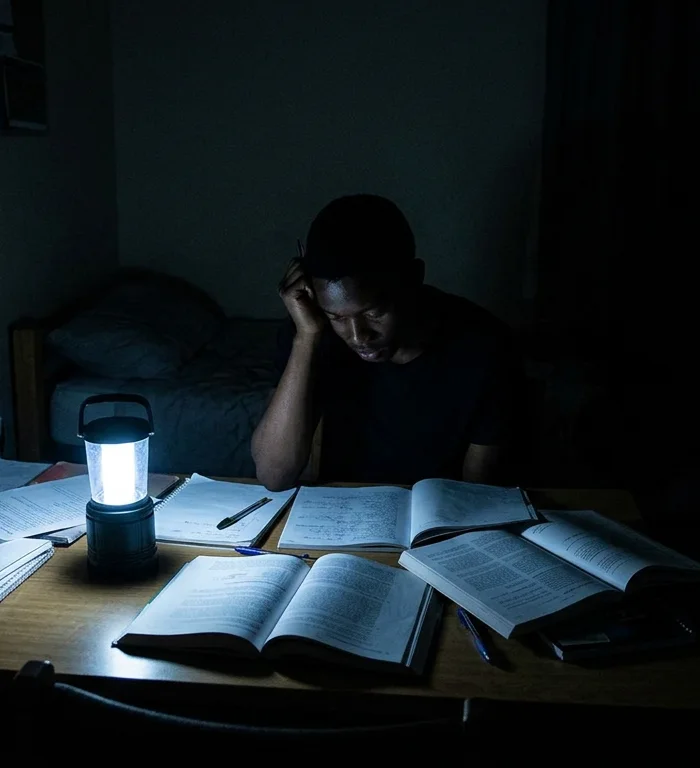
University of the Witwatersrand students linked Eskom power cuts to worse sleep and academic disruption in a survey of more than 1,100 respondents, researchers wrote in The Conversation Africa on Oct. 22.
The Conversation Africa article said South Africa’s 2023 loadshedding was its worst, with power off on 335 of 365 days, though the country has not had planned cuts for more than a year and a half since.
The anonymous online survey ran from August to November 2023 at the Johannesburg university. Researchers asked how loadshedding, the local term for scheduled electricity cuts by Eskom, affected sleep, backup power access, studying and grades.
Nearly three in four students considered their sleep affected by loadshedding, according to the article. Of those students, four in five said the outages worsened their sleep, most often by breaking it into shorter periods.
“Poor sleep and poor studying went together.”
The reported causes were practical and psychological. Almost half said they lay awake worrying about appliances, food, phones or internet routers without power, while nearly a third cited security worries in darkness.
A similar share said bedrooms became too hot or too cold without fans or heaters. About a third reported longer sleep onset because of disrupted routines and generator noise.
Timing also mattered. Students said outages from 8 p.m. to 12:30 a.m. were the most disruptive because that window overlapped with cooking, washing, studying and their average bedtime of 11 p.m.
Backup power was associated with a smaller reported sleep penalty, but unevenly. Students with an alternative supply had roughly 60% lower odds of reporting worse sleep after researchers accounted for age, sex and where they lived.
Only 40% of participants had backup power access. Students in university residences had more access than those living at home, and the university had a generator fleet that partly powered on-campus residences at the time.
Among students with backup power, generator and battery inverter users reported worse sleep about half the time. Among solar users, the share was fewer than one in four, according to the researchers.
The academic link was also self-reported. Two-thirds of students said loadshedding affected their studies, more than half of that group reported lower grades, and more than four in 10 said they studied less during outages.
Students who slept worse were more likely to report lower grades and arrive late for class. The researchers said the study could not prove that loadshedding caused grades to fall.
The article said the findings raise practical questions for universities, households and energy planners, including whether quieter backup power and fewer late-evening outage slots could reduce disruption.
Source: The Conversation Africa article, Oct. 22, 2026.
More stories
- Russian military faces 1,087 recorded suicides in Ukraine war
- US faces China, Russia in Africa minerals contest
- Russian war deaths top 460,000, Guardian says
- Monrovia mayor-designate seeks $14.5m city budget
- Iran's attacks hit 25 tankers near Strait of Hormuz
- Russia strikes Ukraine as Odesa faces electricity strain
- Ethiopia's coffee sector faces $453m EU export risk
- EU faces Vietnam rights test over $57.9bn trade gap
- Singapore prepares grid for up to 6.5% annual demand growth
- ECB faces 6.1% Lithuania inflation with 2.50% rate
Latest news
- Nvidia board gets Trump input on Jensen Huang return as CEO
- Rwanda faces budget strain from 85% electricity access push
- ICE arrests at Seattle airport draw protests and scrutiny
- AI doubts leave Asian stocks facing a new investment test
- EU rejects COP31 deal as fossil fuel divisions block pact
- Deal Sheet: Fortis shutdown costs over 400 jobs
- Germany to pay about $11 a month into child pension accounts