

US Marines Deploy to Baltic Sea to Enhance Undersea Infrastructure Security
US Marines have deployed to the Baltic Sea to bolster NATO surveillance of critical undersea infrastructure against potential Russian interference.
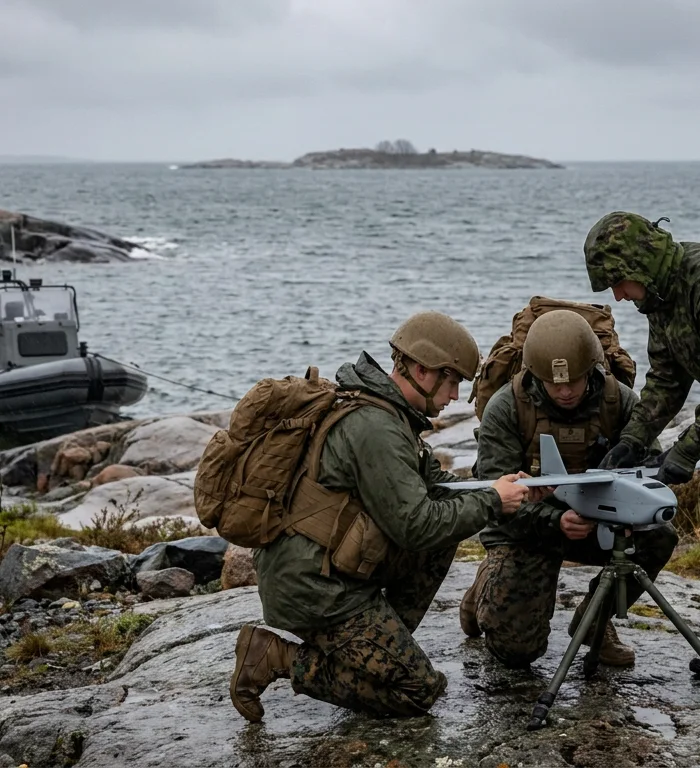
Approximately 48 US Marines from the 2nd Reconnaissance Battalion and II Marine Expeditionary Force Information Group have deployed to the Baltic Sea to support NATO’s Enhanced Vigilance Activity, known as Baltic Sentry. The detachment is tasked with providing surveillance capabilities, utilizing uncrewed aerial systems and littoral sensors to integrate data into NATO’s shared operational picture. This deployment serves in a supportive capacity to European-led command structures, specifically Allied Joint Force Command Brunssum and Allied Maritime Command.
The mission focuses on the protection of critical undersea infrastructure, including fiber-optic cables and energy pipelines, which have faced increased security risks. The deployment follows a series of documented incidents involving the severance of subsea cables and power lines in the region, as well as reports of Russian vessels loitering over critical communication nodes. Intelligence reports indicate that Russian deep-sea research assets have conducted rehearsals for potential subsea sabotage, prompting NATO to prioritize the monitoring of these exposed assets.
US Marines
This operation marks the second such deployment of US Marine reconnaissance units to Finland since the implementation of a bilateral defense cooperation agreement in 2024. The integration of US intelligence assets with the Finnish Coastal Brigade is intended to bolster regional situational awareness and deter hybrid threats. The deployment occurs against a backdrop of heightened regional tensions, characterized by reports of airspace violations, alleged state-sponsored sabotage attempts, and evolving nuclear rhetoric from Moscow.
Strategic planners view the Baltic littoral as a high-risk zone for hybrid warfare, where commercial proxies are increasingly utilized to conduct covert operations against critical infrastructure. By enhancing the density of sensor coverage, NATO aims to increase the cost of covert interference and improve the attribution of potential subsea attacks. Future developments will likely involve further integration of AI-driven surveillance and the potential hardening of legal frameworks regarding the protection of international subsea infrastructure.
More stories
- Germans oppose Ukraine aid as poll shows support slipping
- Kim Jong-un receives 10 envoys after constitutional shift
- Ukraine claims Libya strike sinks Russian naval corvette
- COP31 climate talks collapse over fossil fuels and funds
- Russian military faces 1,087 recorded suicides in Ukraine war
- US faces China, Russia in Africa minerals contest
- War-zone water attacks triple to more than 135 incidents in 2025
- Lulu Retail posts 2% Q3 revenue gain with 53% online sales growth
- Lufthansa cuts profit outlook on 28% fuel-bill increase
- AI giants compete for Europe capital after $250bn bond wave
Latest news
- Trump prepares tariffs on China and other major exporters
- New-car buyers pay record average $50,087 in October
- Banks face ECB reserve debate over liquidity and profits
- Investors see Anthropic debut gains fade below $83 a share
- Iraq orders federal control over Kurdish-area oilfields
- Nvidia shares retreat as AI rally cools before PCE data
- Macy’s parade faces balloon limits as storm winds approach