Trump says Iran tensions meeting at UN went well for US
Iran tensions reached the UN as President Trump reported a “very good” meeting while Hormuz, Gaza and Yemen added new security risks.
Mei Lin ·
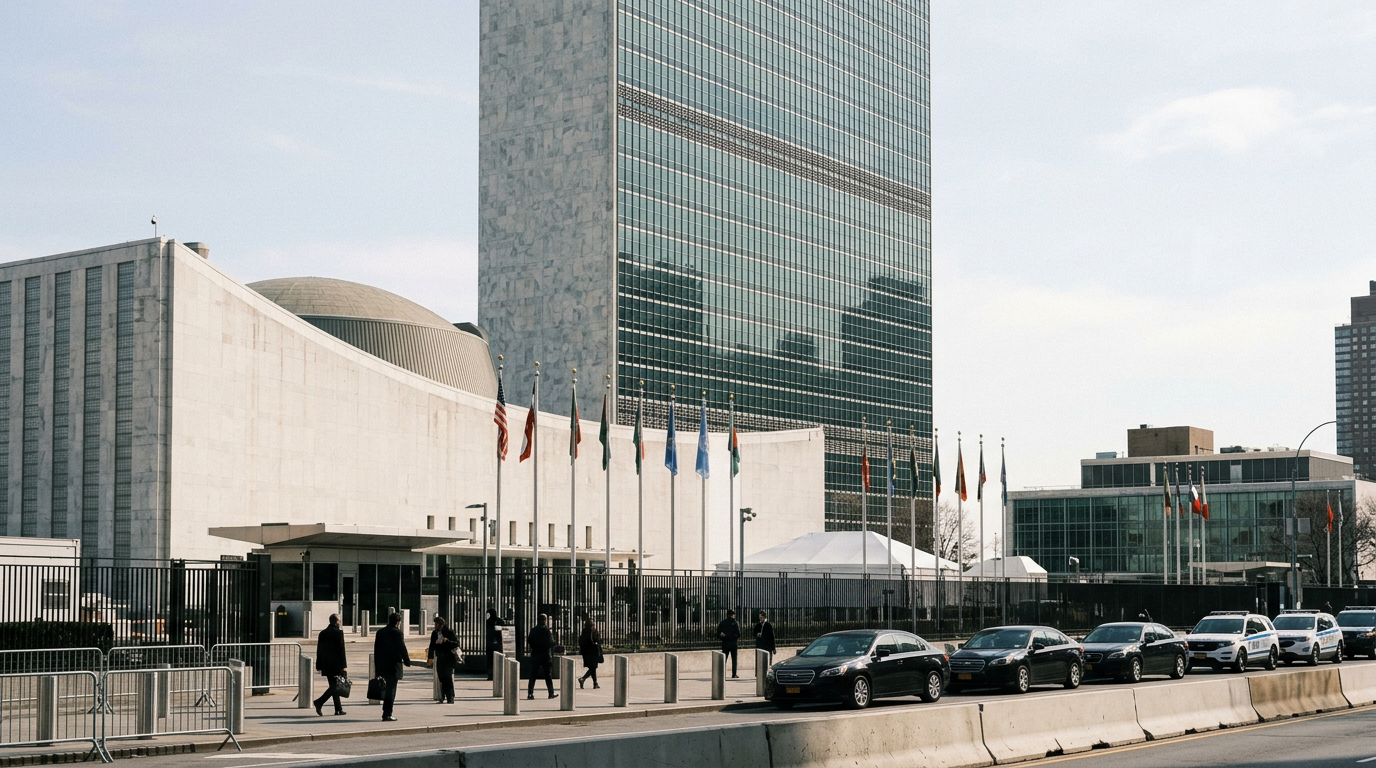
Iran tensions reached the UN as President Trump reported a “very good” meeting while Hormuz, Gaza and Yemen added security risks.
Trump told reporters at the United Nations that US officials had held a “very good” session with Iranian representatives. Iranian state media separately said Foreign Minister Abbas Araghchi met US Special Envoy Steve Witkoff to restate Tehran’s conditions for reopening the Strait of Hormuz.
UN meeting leaves conditions intact
The two accounts point to contact at senior levels, but not to a settled path out of the standoff. The Iranian report framed the meeting around Hormuz, a shipping corridor whose status has become central to the confrontation between Washington and Tehran.
Araghchi also warned that European countries hosting US military bases could be “complicit in aggression.” The statement widened the diplomatic audience for Iran’s position from Washington to allied governments that provide basing access in the region.
Iran’s military dismissed Trump’s threats as “domestic propaganda” after the president told the United Nations General Assembly that he was weighing whether to “annihilate the Islamic Republic.” The remark, as reported from the assembly, marked a higher rhetorical ceiling even as US and Iranian officials were described as meeting.
Qeshm explosion stays unexplained
Iranian media reported an explosion near Qeshm Island, which sits in the Strait of Hormuz. The cause was not established in the reports, leaving the incident as a security signal rather than a confirmed military event.
The uncertainty matters because Hormuz is now part of the negotiating language as well as the battlefield vocabulary. If access to the strait becomes the practical test of any diplomacy, shipping and energy markets would read local incidents through that lens.
Qatar’s prime minister warned against “cycles of escalation” in the Gulf, while Jordan, Turkiye and Qatar criticized Israeli actions in Gaza and the West Bank. Those statements put Arab and regional governments on record against a wider conflict even as they addressed separate theaters.
Gaza and Yemen add pressure
In Gaza City’s Tuffah neighborhood, an Israeli drone strike killed two Palestinians and wounded three near a school, a Palestinian news agency reported. The casualty figures were reported for a single strike, and no Israeli account was included in the source material.
Yemen added another front to the regional picture. Fighting continued between Saudi-backed government forces and the Houthis in Taiz, Marib and al-Jawf, while Yemeni government forces said they targeted Houthi positions in Mocha and al-Bayda province.
Taken together, the reports describe overlapping pressure points rather than one linear crisis. Gaza, Hormuz and Yemen each carry different actors and mechanisms, but each can narrow the political space for a US-Iran understanding.
November 3 shapes the clock
Sigurd Neubauer, a Middle East and Gulf analyst, said “time is on Trump’s side” before the November 3 congressional elections. He said Trump was waiting for the midterms because he believes “the Iranians cannot wait for much longer because their economy is really in dire straits.”
Neubauer said the main change after the elections would be the condition of Iran’s economy, rather than Trump’s political authority. “If Trump continues to hold the US Senate he will be in the same political situation that he is now, with full command over the Republican Party,” he said.
He added that even a midterm loss would “not necessarily impact his ability as commander-in-chief to prosecute this war.” In his view, the larger constraint would be political: “I don’t think that much really changes from Trump’s perspective, other than the fact that it will be much more difficult for him to launch a full-scale military operation against Iran which he has held back from – at least until now.”
If Hormuz remains open under negotiated conditions, the global macro effect would run through lower disruption risk, shipping operators would keep routes closer to normal, and the energy sector would avoid a fresh insurance and freight shock. If access is instead restricted, the mechanism would be the opposite: higher transport risk, delayed cargoes, and renewed pressure on governments to secure Gulf flows.
The open questions are narrow but consequential: whether the US-Iran contact produces written terms, whether the Qeshm incident is attributed to an actor, and whether Gaza or Yemen fighting draws in more states. Until those points are clarified, the diplomacy and the regional security track remain tied together.
Continued high-level diplomatic channels between Washington and Tehran are likely to yield incremental, tactical de-escalation measures rather than a comprehensive peace breakthrough in the immediate term. Across global markets, even fragile backchannel dialogue could temporarily anchor crude oil prices and mitigate maritime insurance spikes, provided the Strait of Hormuz remains navigateable without major interdictions.
However, unchecked tactical miscalculations—such as unclaimed maritime sabotage near critical bottlenecks or expanding cross-border strikes in Gaza and Yemen—pose severe risks of triggering an unintended regional confrontation. Historically, dual-track strategies combining maximum economic sanctions with sporadic high-level contact often prolong market volatility as regional allies and non-state actors test strategic boundaries.
On the other hand, if these preliminary talks manage to establish formal maritime ground rules, it could unlock a crucial opportunity to stabilize vital trade corridors and lower global shipping costs. Ultimately, the outlook remains cautiously guarded, as the potential for a diplomatic bridge depends heavily on whether both nations prioritize risk-reduction protocols over domestic political posturing in the coming months.