

Transfer-learning method cuts 3D-print emissions-model error by 20%
The arXiv preprint, not yet peer reviewed, tests selective knowledge transfer on 729 additive-manufacturing experiments across five materials.
Muhammad Umar Farooq and Daniel R. Cooper described a reinforcement-learning method that achieved a 5.2 g CO2e-per-part test RMSE in an arXiv preprint submitted Oct. 13.
In the preprint, Farooq and Cooper said the result was 20.00% lower than target-only training and 10.30% lower than indiscriminate source-target pooling, a comparison relevant to manufacturers with limited data on new materials.
The method addresses a common problem in industrial modeling: a new product, process or material may need characterization before enough operating data exist to train a reliable model. RMSE, or root-mean-square error, measures prediction error in the same unit as the target variable.
Farooq and Cooper said existing factory data can help, but warned that broad reuse may backfire when domains differ. Indiscriminate reuse of prior operations data, they wrote, “can cause negative transfer in learning of the new, target domain.”
Their proposed policy uses reinforcement learning, a training approach that rewards preferred choices, to decide when transfer is useful. Given limited target-domain data, it can choose predictors built from individual source operations, source subsets, fully pooled data, or target data alone.
A validation gate then uses the transferred prediction only when it improves on the supervised alternatives, according to the preprint. The authors frame the method as a way to control harmful transfer during prediction rather than diagnosing it after errors appear.
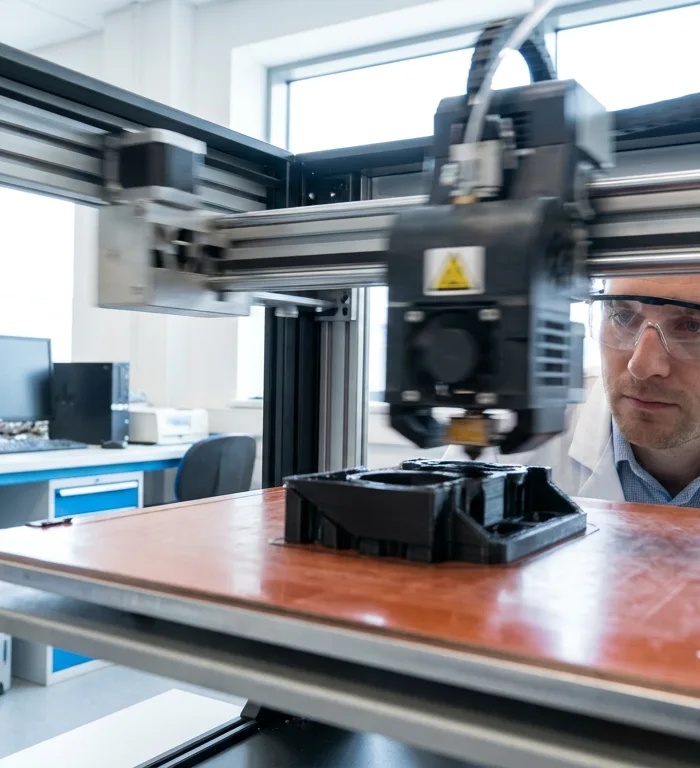
The demonstration focused on embodied greenhouse-gas emissions for parts made by material-extrusion additive manufacturing. The dataset covered 729 experiments across ABS, PETG, TPU, PLA and recycled PLA, with 22 features describing material, process and toolpath conditions.
The response variable combined measured fabrication electricity with polymer-specific cradle-to-gate production factors. CO2e, or carbon dioxide equivalent, expresses greenhouse-gas emissions using a common warming-impact measure.
In a leave-one-material-out evaluation, the method performed better when target-domain data were especially scarce. Farooq and Cooper said the RMSE was 32.5% lower than target-only training when only 5% to 10% of the target training data were available.
The paper’s limits are material. The arXiv version is a preprint and is not yet peer reviewed, and the reported evidence comes from one additive-manufacturing setting covering five materials. The source material does not report an industrial deployment.
The arXiv page lists the work as a 2026 journal reference for the Tackling Climate Change with Machine Learning workshop at NeurIPS 2026.
Source: arXiv preprint, Oct. 13, 2026
More stories
- Europe faces attribution gap after 16 cyber, physical incidents
- PIF backs Grand Theft Auto as Saudi players embrace game
- Signal limits screenshots to curb AI access to messages
- Cognition runs Devin Mac workspaces on EC2 in 6 AWS regions
- Salesforce engineers cut 600-failure triage to 90 minutes
- Türkiye Desk: GTA 6 puts console access and network demand in focus
- Türkiye Desk: Tencent’s Flow Games move tests Türkiye’s mobile thesis
- Rockstar plans GTA 6 PC release by March 2027, GamesBeat says
Latest news
- Trump prepares tariffs on China and other major exporters
- New-car buyers pay record average $50,087 in October
- Banks face ECB reserve debate over liquidity and profits
- Investors see Anthropic debut gains fade below $83 a share
- Iraq orders federal control over Kurdish-area oilfields
- Germans oppose Ukraine aid as poll shows support slipping
- Kim Jong-un receives 10 envoys after constitutional shift
- Ukraine claims Libya strike sinks Russian naval corvette