

US Navy Awards $347 Million Contract for Lionfish Undersea Drones
The US Navy is investing $347 million to expand its Lionfish undersea drone fleet to 200 units by 2030, focusing on modular, autonomous technology.
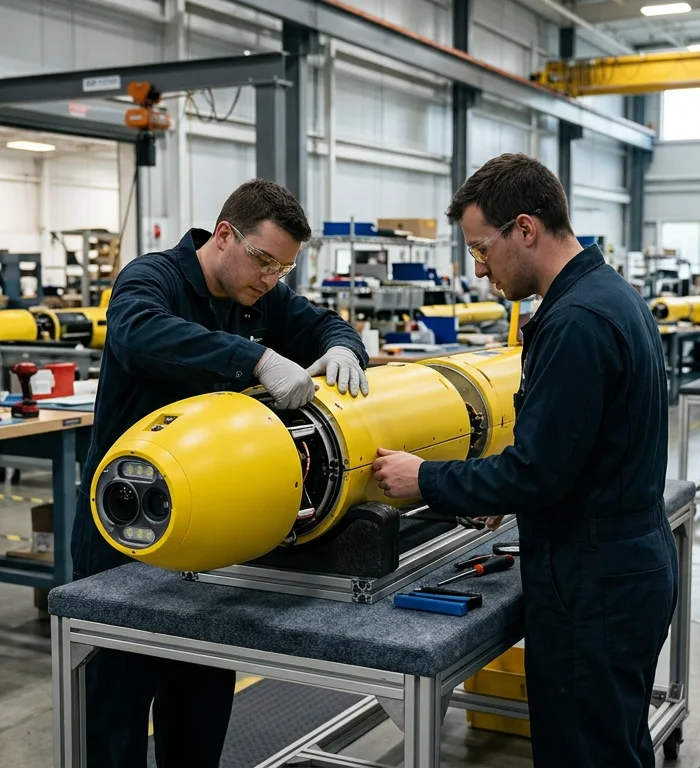
The United States Navy has finalized a contract valued at up to $347 million to procure 82 additional Lionfish small unmanned undersea vehicles (SUUVs). This procurement is part of an expanded program of record that aims to field 175 units, with a long-term objective of reaching 200 drones by 2030. The manufacturer has already delivered 50 units to the Navy since the initial contract was awarded in 2023.
The Lionfish platform is derived from a commercial modular design, utilizing an open-architecture framework intended to facilitate rapid payload integration. The system is currently designated for diverse missions, including mine countermeasures, intelligence, surveillance, reconnaissance, anti-submarine warfare, and electronic warfare. It holds the distinction of being the first cyber-compliant SUUV in production for the Navy and represents the first successful transition of an Other Transaction Authority prototype into full-scale production.
To support the increased production requirements, the manufacturer has expanded its Massachusetts-based facility by 25 percent, bringing the total footprint to 50,000 square feet. The site currently employs approximately 300 personnel and serves as a hub for the production of various unmanned surface and undersea systems. This expansion reflects a broader Pentagon strategy to accelerate the adoption of dual-use commercial technologies for military applications.
The platform's modularity allows for varying battery configurations, providing operational endurance between 10 and 30 hours. With a maximum operating depth of 1,000 feet and a top speed of 5 knots, the system is designed for high-frequency deployment in contested maritime environments. The continued investment in this program indicates a shift toward scalable, autonomous undersea capabilities to address evolving mission requirements.
More stories
- Germans oppose Ukraine aid as poll shows support slipping
- Kim Jong-un receives 10 envoys after constitutional shift
- Ukraine claims Libya strike sinks Russian naval corvette
- COP31 climate talks collapse over fossil fuels and funds
- Russian military faces 1,087 recorded suicides in Ukraine war
- US faces China, Russia in Africa minerals contest
- Russian strikes leave many Kyiv homes with 4 hours of power
- Cebu groups seek probe into protest dispersal with more than 20 hurt
- Prosecutors face De Kock claim over apartheid command evidence
- Singapore lifts retirement age to 65 from 2029
Latest news
- Trump prepares tariffs on China and other major exporters
- New-car buyers pay record average $50,087 in October
- Banks face ECB reserve debate over liquidity and profits
- Investors see Anthropic debut gains fade below $83 a share
- Iraq orders federal control over Kurdish-area oilfields
- Nvidia shares retreat as AI rally cools before PCE data
- Macy’s parade faces balloon limits as storm winds approach