

Sudan’s female-led households face 75% food insecurity
Al Jazeera reported that widows are supporting children in displacement camps as aid agencies say Sudan’s 2026 response plan is less than half funded.
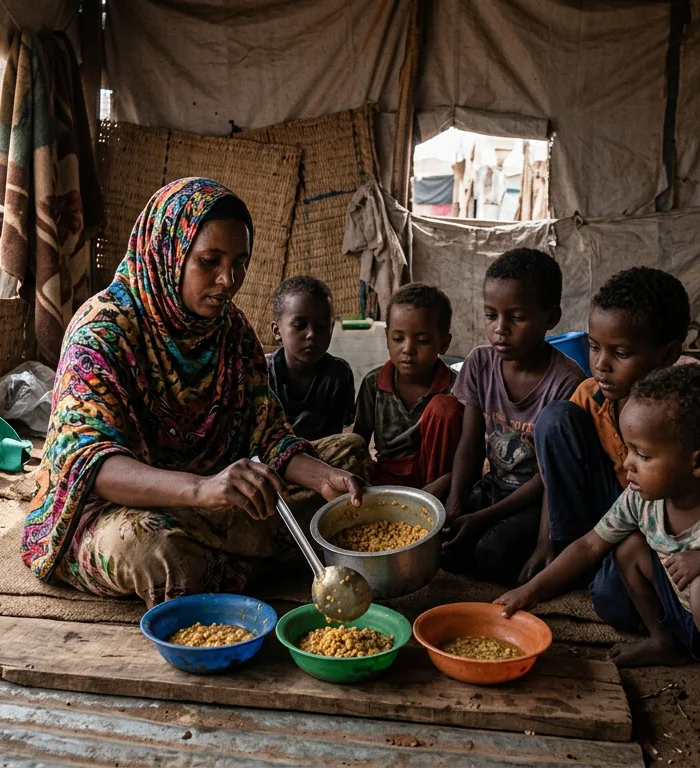
The United Nations’ 2025 Gender Snapshot found that 75% of female-headed households in Sudan were food insecure, Al Jazeera reported on Nov. 23.
The figure was three times the rate among male-headed households, underlining how Sudan’s war has shifted household survival onto women as fatalities, conscription and migration have removed many men from family life.
Al Jazeera’s report focused on widowed mothers in Port Sudan, including Arafa Abdelaziz, 33, who fled Omdurman after her husband died shortly after fighting began in April 2023 between the Sudanese Armed Forces and the paramilitary Rapid Support Forces.
Arafa told Al Jazeera that one of her sons, aged eight, was later killed by a stray bullet during clashes near Omdurman’s market. She then made a 15-day journey in late 2023 to Port Sudan with her six-year-old son, who has a brain condition affecting his development.
“I arrived in Port Sudan with nothing, having lost my husband,” Arafa said. “My son’s condition had worsened because of what we went through on the journey and because he could not receive his medication regularly.”
Arafa said RSF fighters stopped the vehicle carrying her near Jebel Aulia, south of Khartoum, and that passengers were robbed and assaulted. Her account could not be independently verified from the information in the report, and Al Jazeera attributed the allegations to her.
In October 2026, UN Women said 12.7 million people in Sudan, mostly women and girls, needed support related to gender-based violence, four times the pre-war level. The agency warned that women and girls face risks while fleeing combat zones, in displacement sites and while searching for food, water and shelter.
The war in Sudan has killed as many as 150,000 people and displaced millions, often into camps in neighbouring countries. The United Nations said income levels have fallen to 1992 levels and extreme poverty rates are worse than in the 1980s.
The Mashad Observatory said it had documented 72,202 cases of widowhood since the war began in April 2023. The group said widowhood can erode household income, stability and protection systems, while increasing dependence on humanitarian assistance.
“Their suffering is further compounded when women lose the primary source of household income or are forced to abandon their homes and communities without adequate financial resources or social support networks,” a Mashad Observatory spokesperson told Al Jazeera.
Humanitarian agencies said Sudan’s 2026 response plan, which aims to reach 20.4 million people and requires $2.9 billion, had received 47% of the funding needed. That shortfall leaves displaced families, including widowed mothers in camps, more reliant on limited aid distributions.
Source: feature report, Al Jazeera – Africa, Nov. 23, 2026
More stories
- Monrovia mayor-designate seeks $14.5m city budget
- Iran's attacks hit 25 tankers near Strait of Hormuz
- Russia strikes Ukraine as Odesa faces electricity strain
- Bahrain reports two injuries after Iranian aerial attacks
- Baltic responders fight Sparta II fire after drone strike
- Estonia to close 5 Russia road crossings for six months
- Japan pursues Quad talks alongside outreach to Xi Jinping
- UN Talks on AI-Powered Autonomous Weapons Face Opposition from Major Military Powers
Latest news
- Rwanda faces budget strain from 85% electricity access push
- ICE arrests at Seattle airport draw protests and scrutiny
- AI doubts leave Asian stocks facing a new investment test
- EU rejects COP31 deal as fossil fuel divisions block pact
- Deal Sheet: Fortis shutdown costs over 400 jobs
- Germany to pay about $11 a month into child pension accounts
- Laura Brand curbs prison messages after YouTube dispute
- Nigeria's family-planning budget falls 97%