Sam Bankman-Fried Backed the Hottest AI Startup — Then Lost the Jackpot
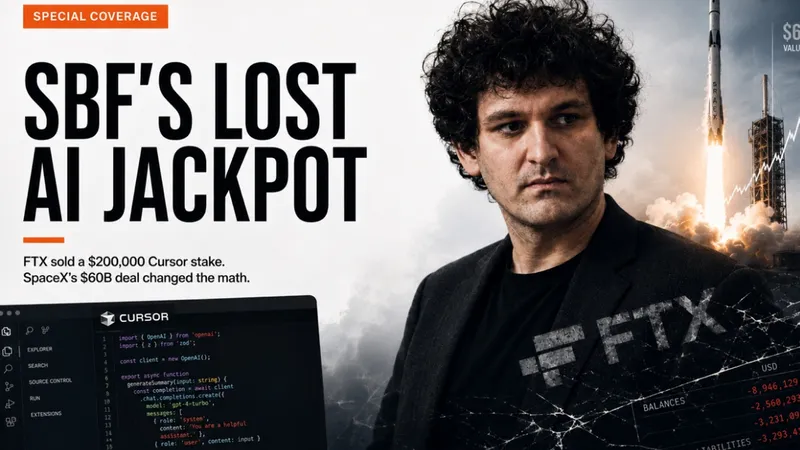
FTX reportedly sold a $200,000 Cursor stake. SpaceX’s $60 billion deal shows the ghost asset may have been worth billions.
Edward Mullen ·
By the time the AI gold rush reached Sam Bankman-Fried, he was already wearing prison khaki.
The former crypto billionaire had lost his exchange, his fortune, his political influence, his Manhattan trial, and, as of this month, his appeal. What he may also have lost — or more precisely, what FTX creditors may have lost — is one of the most spectacular venture-capital lottery tickets of the AI era.
Buried in the wreckage of FTX and Alameda Research was reportedly a tiny early stake in Anysphere, the company behind Cursor, the AI coding tool now at the center of a SpaceX deal valued at as much as $60 billion .
Alameda allegedly bought the position for about $200,000 in 2022. The FTX bankruptcy estate later sold it for roughly the same price. If that stake had survived and remained undiluted, it could now be worth about $3 billion .
That is the kind of math that makes bankruptcy lawyers wince, venture capitalists smile politely, and crypto Twitter reach for a flamethrower.
It also creates a deliciously awkward question: did Sam Bankman-Fried accidentally back one of the hottest AI startups in the world — only to watch the upside disappear from a prison cell?
The answer is messier than the meme. Bankman-Fried cannot credibly claim he was robbed of the asset. Prosecutors said FTX customer money was misused for venture investments, political contributions, real estate and other spending. He was sentenced to 25 years in prison, ordered to forfeit more than $11 billion, and the Second Circuit affirmed his conviction in June 2026.
So this is not the story of a genius investor cheated out of his prize. It is darker — and more interesting.
It is the story of how stolen customer money, a rushed bankruptcy cleanup, private-market opacity and the AI boom collided to create a multibillion-dollar “what if.”
The Trade That Wouldn’t Die
Cursor was not always a $60 billion strategic prize. In April 2022, according to CoinDesk, Alameda invested about $200,000 in Anysphere at a valuation near $4 million , reportedly receiving about 5% of the company. At the time, Anysphere was an early-stage developer-tools startup. The product that made it famous, Cursor, had not yet become the default coding companion for AI-native engineers.
Then FTX collapsed.
The estate was left with thousands of claims, assets, subsidiaries, legal disputes, crypto positions, tokens, venture investments and unresolved customer balances. The job was not to behave like a patient Silicon Valley fund. The job was to find assets, value them, sell them, litigate, recover money and return cash to creditors.
In that world, a $200,000 startup stake in an obscure coding-tool company may have looked like lint in the pocket of a burning coat.
Then AI detonated.
Cursor raised a Series A in 2024 led by Andreessen Horowitz and Thrive Capital. It said it had more than 40,000 customers . In January 2025, Cursor announced a $105 million Series B , saying it had exceeded $100 million in recurring revenue . By June 2025, it raised $900 million at a $9.9 billion valuation . By November 2025, it announced a $2.3 billion Series D at a $29.3 billion post-money valuation .
Then SpaceX entered the chat.
SpaceX materials from its 2026 IPO roadshow described a partnership with Cursor to advance Grok and disclosed an option to acquire Cursor at an implied equity value of $60 billion . Subsequent reports said SpaceX agreed to acquire Anysphere in an all-stock transaction at roughly that value.
A stake once sold for the price of a nice SUV had become, at least on paper, the kind of asset that can change the outcome of a bankruptcy.
The $3 Billion Ghost Asset
The viral version of the story is simple: Alameda bought 5% of Cursor for $200,000. FTX sold it for $200,000. SpaceX valued Cursor at $60 billion. Five percent of $60 billion is $3 billion.
That framing is irresistible. It is also incomplete.
Private startup stakes are not static. They dilute. Rights change. Preferred shares may convert differently. Early SAFEs and notes can be rewritten. Bankruptcy sales can include caveats. A buyer may assume risk. Documentation matters. Without the exact investment documents and sale terms, the clean “5% equals $3 billion” number should be treated as a back-of-the-envelope maximum, not a legal damages figure.
Still, even with heavy dilution, the missed upside could be enormous.
The most damning number is not necessarily $3 billion.
It is the gap between $200,000 and almost any plausible retained value if Cursor’s rise had been captured.
This is why the story has legs. It is not just another SBF anecdote. It is a stress test for the entire post-FTX recovery process.
Did the estate sell too early? Did it have enough information? Did it understand the asset? Could it have held? Were creditors better served by immediate liquidity or by optionality?
Was the buyer merely lucky, or did the buyer understand something the estate missed?
Those questions matter because FTX customers have already been told they are being made whole in dollar terms. But “made whole” is a slippery phrase in crypto bankruptcy. If your bitcoin was sold near the bottom and repaid later in dollars, you may be whole legally and still furious economically. The Cursor stake adds the venture-capital version of that same wound.
The Bankruptcy Problem: You Can’t HODL Everything
It is easy, in hindsight, to mock the estate.
Everyone is a genius after the chart goes vertical.
Bankruptcy administrators are not venture investors. Their mandate is different. They are typically rewarded for recovery, certainty, process and defensibility — not for taking moonshot risk. When a company collapses because of alleged fraud, the instinct is to turn weird assets into cash and stop the bleeding.
That instinct often makes sense. Most startup stakes die. Many never produce liquidity. A small stake in an unproven AI coding company in 2023 was not obviously a $3 billion recovery asset. It was one item on a very long, very ugly list.
But the Cursor case shows the danger of treating every illiquid asset like scrap metal.
Anysphere was not a random token. It was building in one of the fastest-growing software categories in the world. By 2024 and 2025, Cursor was becoming the workbench for AI-assisted software development. The company said its product was used by millions, and later said it had crossed $1 billion in annualized revenue .
This was not a rug-pull coin with a Telegram channel and a dead website. It was becoming infrastructure.
And infrastructure gets strategic buyers.
Why SpaceX Would Want Cursor
At first glance, SpaceX buying an AI coding tool sounds like Elon Musk alphabet soup: rockets, satellites, Grok, xAI, developer tools, Mars, maybe a flamethrower.
But the logic is not crazy.
SpaceX has become more than a launch company. Its public-market story now sits at the intersection of orbital infrastructure, Starlink connectivity, AI compute, defense, robotics and software. Its IPO roadshow materials highlighted xAI, Colossus compute infrastructure, and a Cursor partnership to advance Grok. The same materials disclosed an option to acquire Cursor for an implied value of $60 billion.
Cursor brings three things SpaceX and xAI would want.
First, it brings distribution into the developer workflow. AI models are powerful, but the daily interface matters. Developers do not live in press releases. They live inside tools. Cursor sits where code is written.
Second, it brings enterprise AI revenue. Cursor said it had more than half of the Fortune 500 using the product by mid-2025 and later disclosed more than $1 billion in annualized revenue .
Third, it brings a strategic bridge between models and work. SpaceX and xAI can own compute and models. Cursor owns the moment when human engineers actually ask AI to change software.
That makes Cursor more than a nice-to-have productivity app. It makes it a possible control point in the AI software stack.
For SpaceX, paying in stock also matters. A newly public, highly valued acquirer can turn market capitalization into acquisition currency. That is how large platform companies convert valuation into industrial strategy.
For the buyer of FTX’s old stake, if the CoinDesk account is correct, it may be the cleanest trade in the whole saga: buy a bankrupt estate’s forgotten AI ticket for $200,000, then watch the rocket company turn it into a potential generational windfall.
The SBF Angle: Genius, Fraud, or Dumb Luck?
Bankman-Fried’s defenders may be tempted to spin Cursor as proof that he was a misunderstood venture savant. That argument should not survive contact with the record.
The SEC alleged that FTX customer funds were diverted to Alameda and used for venture investments, among other purposes. The Justice Department said Bankman-Fried misappropriated billions of dollars of customer funds and defrauded investors and lenders. The Second Circuit affirmed his conviction.
That matters. If Alameda’s venture portfolio contained winners, the winners do not morally launder the way the money moved.
A fraudster can make a good investment. That does not make the fraud less fraudulent.
But the Cursor episode does complicate the public narrative around FTX’s assets. The estate was not only cleaning up toxic crypto debris. It was also holding claims on pieces of the future economy: AI startups, financial infrastructure, venture bets, software companies and private-market options that could behave very differently from tokens.
In other words: the corpse had gold teeth.
The question is whether creditors got full value for them.
The Buyer Nobody Is Talking About Enough
Every missed-windfall story needs a winner.
Here, the winner may not be SBF, FTX customers or SpaceX. It may be the party that bought the stake from the estate.
That buyer, if the reported transaction terms are accurate, did what distressed-asset buyers are paid to do: find ambiguity, accept illiquidity, move before the crowd and wait.
The trade would have required nerve. In 2023, AI was hot, but Cursor was not yet Cursor-the-phenomenon. FTX estate assets came with legal, reputational and documentation complexity. A small private stake may have been hard to diligence. Even if the startup succeeded, liquidity was uncertain.
Then the world changed. Developer tools became one of the biggest AI adoption surfaces. Cursor became a breakout product. SpaceX showed up with a strategic rationale and a mountain of equity value.
That is not theft. That is capitalism with a lawyer attached.
Still, creditors may reasonably ask whether the estate sold an asymmetric asset without enough imagination.
What We Know and What We Don’t
Did Alameda reportedly invest in Anysphere/Cursor?Yes, CoinDesk reported Alameda invested about $200,000 in 2022.Was the stake reportedly about 5%?
CoinDesk reported the stake was roughly 5%, but exact documents are needed to verify rights and dilution.Did the FTX estate reportedly sell it?Yes, CoinDesk reported the bankruptcy estate sold the position for about $200,000.Is the $3B number confirmed?No. It is an illustrative figure assuming a 5% undiluted stake at a $60B valuation.Did SpaceX disclose Cursor-related deal terms?SpaceX IPO materials referenced a Cursor partnership and an option to acquire Cursor for an implied $60B equity value.Can SBF claim he personally lost the money?That is a weak framing. The stronger framing is that FTX creditors may have lost upside.Does this affect SBF’s criminal conviction?No obvious reason. His conviction and sentence were affirmed by the Second Circuit.
The Funniest Part Is Also the Saddest
FTX was supposed to be the adult in the crypto room. It had celebrities, stadium naming rights, venture investments, policy ambitions, Super Bowl ads and a founder who dressed like a math-camp monk while building one of the most chaotic balance sheets in financial history.
Then the whole thing collapsed.
Now, from the ashes, we find a perfect 2026 parable: the crypto exchange that lost billions may have accidentally owned a piece of the AI tool that helps programmers build the future. And that piece may have been sold for the cost of a modest kitchen renovation.
There is a cosmic joke in there somewhere. It is just not very funny if you were an FTX customer.
The Cursor stake captures the strange cruelty of bankruptcy timing. Sell too slowly, and creditors accuse you of incompetence. Sell too quickly, and the ghost of the asset comes back wearing a $60 billion price tag.
This is the financial equivalent of throwing away a hard drive and later discovering it contained both your bitcoin keys and the first draft of the iPhone.
Why Global Financial Readers Should Care
This story is not only about SBF. It is about the new shape of asset recovery in an economy where private companies can move from seed-stage obscurity to strategic mega-deal in four years.
The old bankruptcy playbook was designed for factories, receivables, aircraft leases, inventory, loans and operating subsidiaries. The new bankruptcy estate may include tokens, AI stakes, SAFEs, model companies, compute contracts, private shares and weird little venture bets that can be worthless on Monday and worth a fortune after the next funding round.
That requires a different recovery discipline.
Creditors need more than liquidation. They need portfolio intelligence. They need venture specialists, AI-sector expertise, private-market pricing, optionality analysis and a process for deciding when not to sell.
The Cursor case may become a case study in all of that.
Not because anyone could have perfectly predicted a $60 billion SpaceX deal. They probably could not.
But because the upside profile was not symmetrical. The estate could lose only $200,000 by holding. It could gain hundreds of millions, maybe billions, if the company became important.
And Cursor became important.
Sam Bankman-Fried once wanted to be remembered as a visionary. Instead, he became a convicted fraudster whose empire imploded into one of the most complex bankruptcies in modern finance.
Cursor gives the story one last strange twist.
Somewhere inside the FTX rubble was a tiny claim on the AI future. It was sold. The buyer may have won. Creditors may have missed out. SpaceX may now be turning the asset into a strategic weapon. And SBF, who once styled himself as the rational optimizer of global capital, is left with perhaps the most painful optimization error of all:
He may have helped fund the AI trade of the decade.
He just cannot claim the jackpot.