Russia’s Ukraine war barrage targets Kyiv with missiles
Ukraine war attacks hit Kyiv and Chernihiv, killing four people as Russia reported four deaths in occupied Horlivka.
Claire Dubois ·
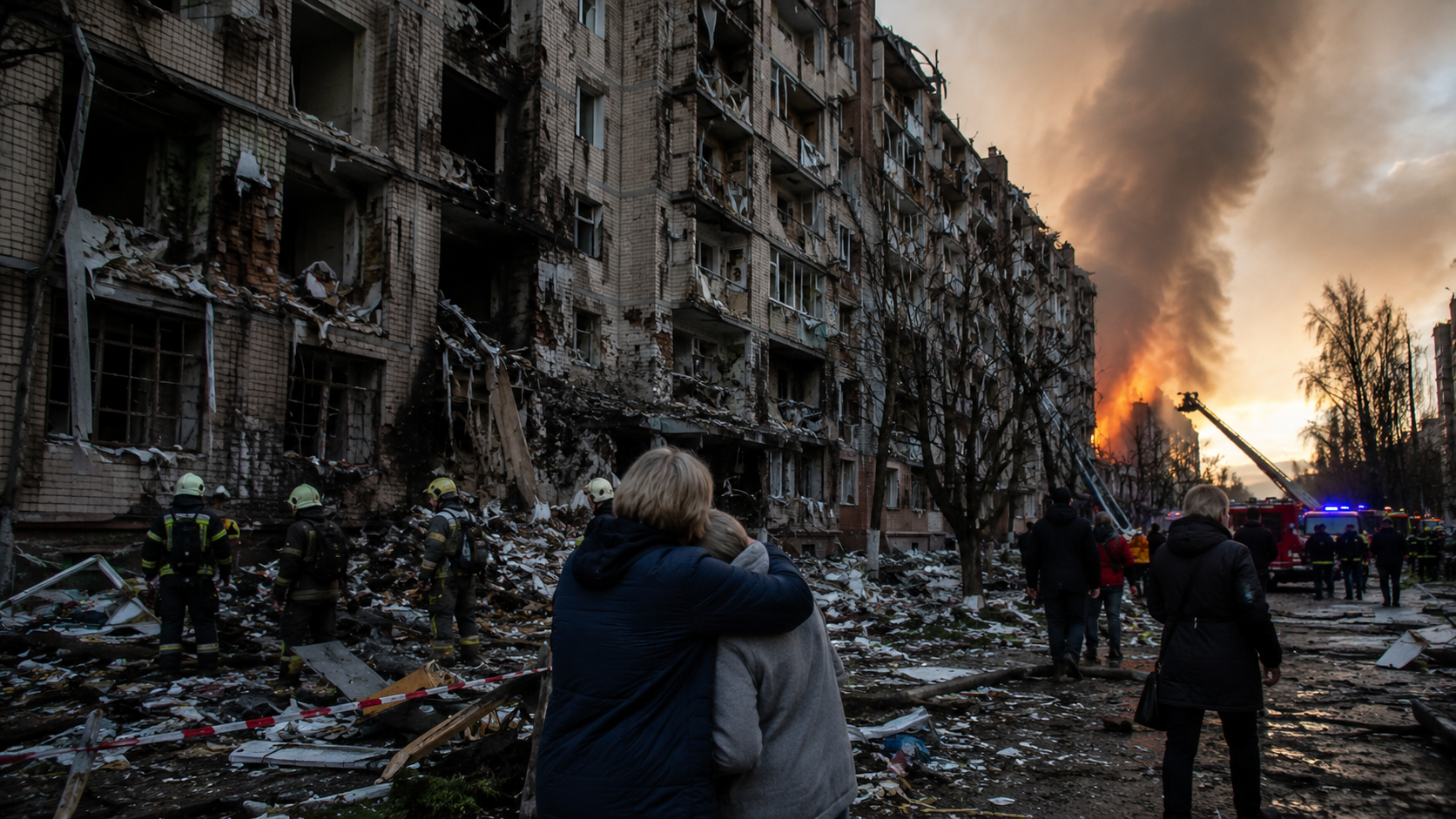
Ukraine war attacks hit Kyiv and Chernihiv on July 26, killing four people as Russia reported deaths in occupied Horlivka.
Ukraine’s air force said Russian forces struck Kyiv with ballistic missiles early Sunday, setting off explosions in the capital. Later attacks in other regions added civilian casualties, while Russia issued its own claim of deaths from a Ukrainian drone strike in territory it occupies.
Seven missiles over Kyiv
The overnight barrage included seven ballistic missiles and 136 drones fired into Ukraine, according to the Ukrainian air force. The statement identified Kyiv as a target of the missile portion of the attack, a detail that places the capital again at the center of Russia’s long-range campaign.
Ballistic missile attacks carry a different pressure than drone raids because they compress the time available for warnings and interception. The air force account did not provide a casualty figure for Kyiv in the material available, leaving the early damage picture tied to later local updates.
Chernihiv supermarket death toll
The clearest civilian toll reported by Ukrainian officials came from Chernihiv, a northern city where local authorities said a Russian drone hit a supermarket. Two people died there, one of them a 10-year-old child, and three more people were injured, according to those authorities.
President Volodymyr Zelenskiy used the Chernihiv strike to frame the day’s attacks as aimed at civilians rather than military targets. "This is deliberate Russian terror that has no military justification," Zelenskiy wrote on Telegram.
The supermarket strike matters because it puts a commercial, everyday setting at the center of the casualty count. For residents and local officials, the immediate burden is not only medical care and recovery work, but the broader problem of keeping shops, transport and public services operating under recurring air alerts.
Horlivka claims complicate the toll
Russia said four people were killed by a Ukrainian drone strike in Horlivka, a Ukrainian city under Russian occupation. That account was presented by Russia and cannot be treated as independently confirmed from the information available here.
The competing casualty claims show how civilian deaths on both sides of the front are quickly folded into wartime messaging. For Ukraine, the official account emphasizes Russian attacks on cities and civilian locations; for Russia, the Horlivka claim shifts attention to Ukrainian drone activity in occupied territory.
The day’s reported weapons mix also points to a war increasingly shaped by two parallel systems: missiles aimed at major cities and drones used across wider areas. If that pattern holds, Ukraine’s air defenses face pressure at both ends of the threat spectrum, while civilian authorities must plan for attacks that can arrive overnight and continue through the day.
The broader economic channel depends on whether future strikes remain concentrated on urban targets or move toward infrastructure. If attacks stay focused on cities and retail sites, the global macro effect is likely to run mainly through war-risk sentiment and humanitarian costs; if energy, transport or export infrastructure becomes the main target, the mechanism would shift toward supply disruption and higher insurance and logistics costs.
For Ukraine, the operational question is whether air defenses can absorb salvos combining ballistic missiles and drones without leaving cities exposed. For the wider defense sector, repeated mixed attacks sustain demand for interceptors, radar coverage and counter-drone systems, while the main uncertainty is whether either side expands the scale or geography of strikes in the coming days.