

Qatar courts Hong Kong capital to diversify beyond Western markets
Frederick Ma of the HK Trade Development Council visited Doha to advocate for deeper financial integration between the Gulf and East Asia.
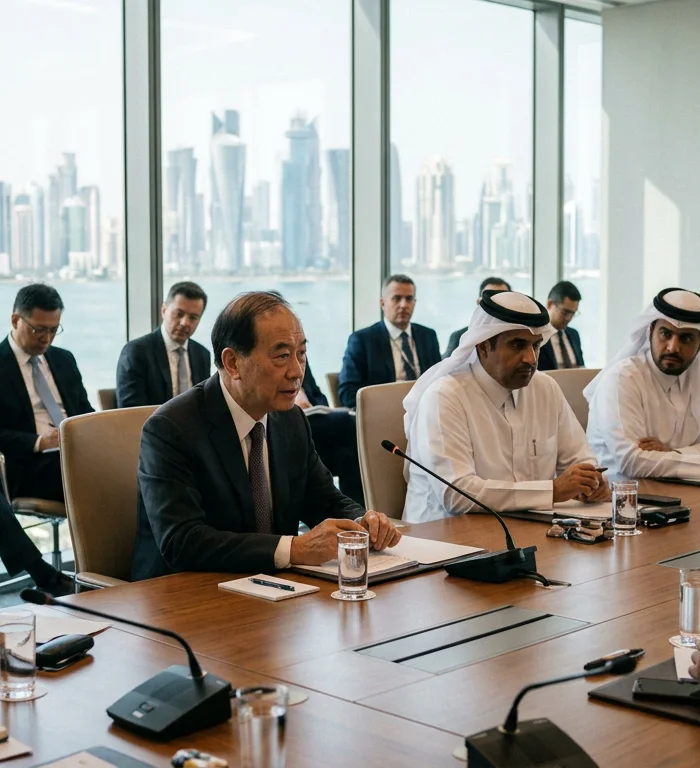
Strategic realignment in Doha
Frederick Ma, chairman of the Hong Kong Trade Development Council, visited Qatar this week to press for increased cross-border investment. His visit coincides with an accelerated push by the Gulf state to integrate its sovereign capital with Asian financial hubs as a hedge against global geopolitical instability.
The outreach follows a period where the Qatar Investment Authority (QIA) has sought to recalibrate its portfolio toward high-growth markets. By positioning Hong Kong as a gateway, Qatari officials aim to access specialized tech infrastructure and emerging trade corridors that offer alternatives to traditional exposure in North American and European markets.
The pivot toward Eastern capital
Doha Frederick Ma
The Gulf’s sovereign wealth funds have long maintained a presence in global markets, but the current shift reflects a deliberate 'Look East' policy. This structural change is designed to buffer regional assets against the friction of US-China trade volatility, which has historically complicated cross-border capital flow between the two superpowers. For Hong Kong, the courtship of Middle Eastern capital serves as a critical effort to revitalize its stock exchange and expand its influence in Islamic finance. The city-state is positioning itself as a neutral financial bridge, offering the infrastructure necessary for Gulf entities to deploy liquidity into the broader East Asian technology and real estate sectors. Global macro spillover Deepening financial ties between the Gulf and Hong Kong carry significant implications for global liquidity, particularly in the energy and fintech industries. As Gulf capital moves, it challenges the dominance of traditional Western clearing houses and shifts the center of gravity for large-scale infrastructure financing.
Should the current warming trend between these regions
This trend risks further decoupling financial markets if regulatory frameworks are not harmonized. Should the current warming trend between these regions yield sustained capital inflows, it would likely stabilize Hong Kong’s capital markets against the impact of local economic contraction and provide Qatar with the diversification it requires to navigate Western market volatility.
Future integration metrics
The primary indicator of success for this diplomatic outreach will be the formalization of cross-border regulatory frameworks, specifically those governing dual-listed sukuk and new joint venture vehicles. Market participants should monitor for the announcement of co-investment platforms between the QIA and Hong Kong-based firms before the end of 2024.
More stories
- Germans oppose Ukraine aid as poll shows support slipping
- Kim Jong-un receives 10 envoys after constitutional shift
- Ukraine claims Libya strike sinks Russian naval corvette
- COP31 climate talks collapse over fossil fuels and funds
- Russian military faces 1,087 recorded suicides in Ukraine war
- US faces China, Russia in Africa minerals contest
- Villa Vie disembarks 203 passengers in Cambodia over fuel costs
- NEITI faces methane data questions over 18 incomplete records
- British universities get MI5 alert on CGTRI project risks
- Saudi rejects Israel planes for diverted flydubai flyers
Latest news
- Trump prepares tariffs on China and other major exporters
- New-car buyers pay record average $50,087 in October
- Banks face ECB reserve debate over liquidity and profits
- Investors see Anthropic debut gains fade below $83 a share
- Iraq orders federal control over Kurdish-area oilfields
- Nvidia shares retreat as AI rally cools before PCE data
- Macy’s parade faces balloon limits as storm winds approach