Putin Lauds Modi for "Frank" Ukraine War Talks
Vladimir Putin praised PM Narendra Modi’s approach to the Ukraine conflict, highlighting India's complex diplomatic stance between global powers.
Mei Lin ·
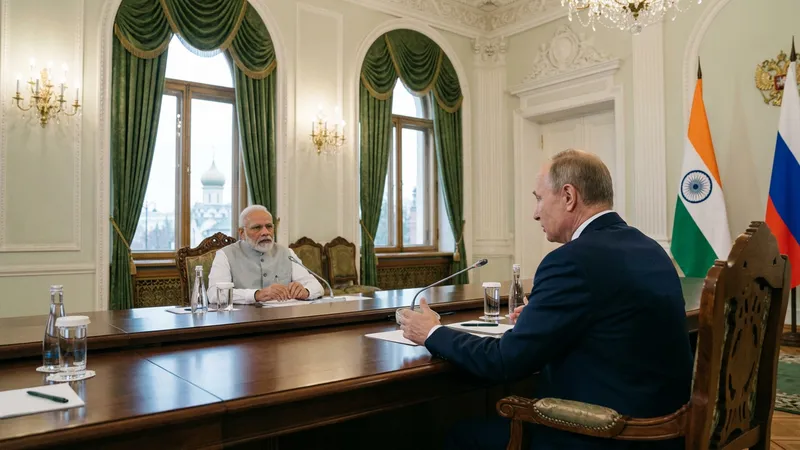
Russian President Vladimir Putin on Tuesday praised Indian Prime Minister Narendra Modi for engaging in "frank" discussions regarding the Ukraine war, highlighting a rare public acknowledgment of a leader's diplomatic approach from Moscow. Putin made the remarks during an event in Moscow, noting India's capacity to pursue an independent foreign policy.
India's Balancing Act on Global Stage
India's foreign policy tradition has long emphasized strategic autonomy, evolving from its historical non-alignment during the Cold War to a contemporary "multi-alignment" strategy. This approach allows New Delhi to maintain robust ties with diverse global partners, including long-standing military and energy relations with Russia, while simultaneously deepening strategic partnerships with Western nations. India is a key member of the Quadrilateral Security Dialogue (Quad) alongside the United States, Japan, and Australia, and participates in various economic and security initiatives with AUKUS partners (Australia, United Kingdom, United States).
Prime Minister Modi notably told Putin at a This nuanced stance is particularly evident in India's response to the Ukraine conflict. While New Delhi has consistently called for a peaceful resolution and dialogue, it has refrained from directly condemning Russia's actions or participating in Western sanctions. Prime Minister Modi notably told Putin at a summit in September 2022 that "today's era is not an era of war," a statement widely interpreted as a gentle rebuke of the conflict's continuation and praised by Western leaders.
Geopolitical Implications of Diplomatic Engagement
Putin's commendation underscores the intricate balance India navigates between its economic interests and its evolving geopolitical aspirations. India remains a significant purchaser of Russian crude oil, increasing its imports following the Ukraine invasion to capitalize on discounted prices. This economic lifeline has helped Russia mitigate the impact of Western sanctions, while providing India with crucial energy security amid global price volatility.
Beyond energy, India's defense sector relies heavily on Russian military equipment, a legacy of decades-long cooperation. Maintaining this supply chain is critical for India's national security, especially given ongoing border tensions with China and Pakistan. The public praise from Moscow could also be seen as an effort to counter Western narratives and highlight Russia's enduring diplomatic ties in the Indo-Pacific region, potentially affecting regional power dynamics and alliances like ASEAN (Association of Southeast Asian Nations) as countries assess their own positions.
Monitoring India's Diplomatic Role Should India's diplomatic engagement on Ukraine intensify The global macroeconomic picture remains influenced by the Ukraine conflict, particularly concerning energy markets and supply chain disruptions. India, as the world's most populous nation, plays a significant role in global demand for commodities and trade flows. Should India's diplomatic engagement on Ukraine intensify, it could further position New Delhi as a potential mediator, influencing the trajectory of conflict resolution efforts. Conversely, if India maintains its current approach of primarily focusing on humanitarian aid and avoiding direct mediation, Putin's praise may be viewed as a singular diplomatic gesture rather than a precursor to increased Indian involvement. The ongoing geopolitical maneuvering around the conflict will continue to affect global trade routes, inflation, and investment decisions across various industries, from commodities to advanced technology. Assessing Modi's Next Moves The main open question is whether Prime Minister Modi's public or private statements regarding future engagement on the Ukraine conflict, or specific actions taken by India in international forums related to the war, will shift by August 30, 2024. If India either hosts or plays a more prominent mediating role in discussions, or if Western leaders acknowledge India's diplomatic efforts, this would signal a significant evolution in New Delhi's proactive role. Conversely, if India's stance remains largely unchanged, focusing on humanitarian aid and avoiding direct mediation, the recent praise may reflect a consistent policy rather than a new diplomatic initiative.