Peru security coalition move brings US cartel fight home
Peru will join the US-led Shield of the Americas, adding the world’s No. 2 cocaine producer to President Trump’s regional cartel campaign.
Raj Patel ·
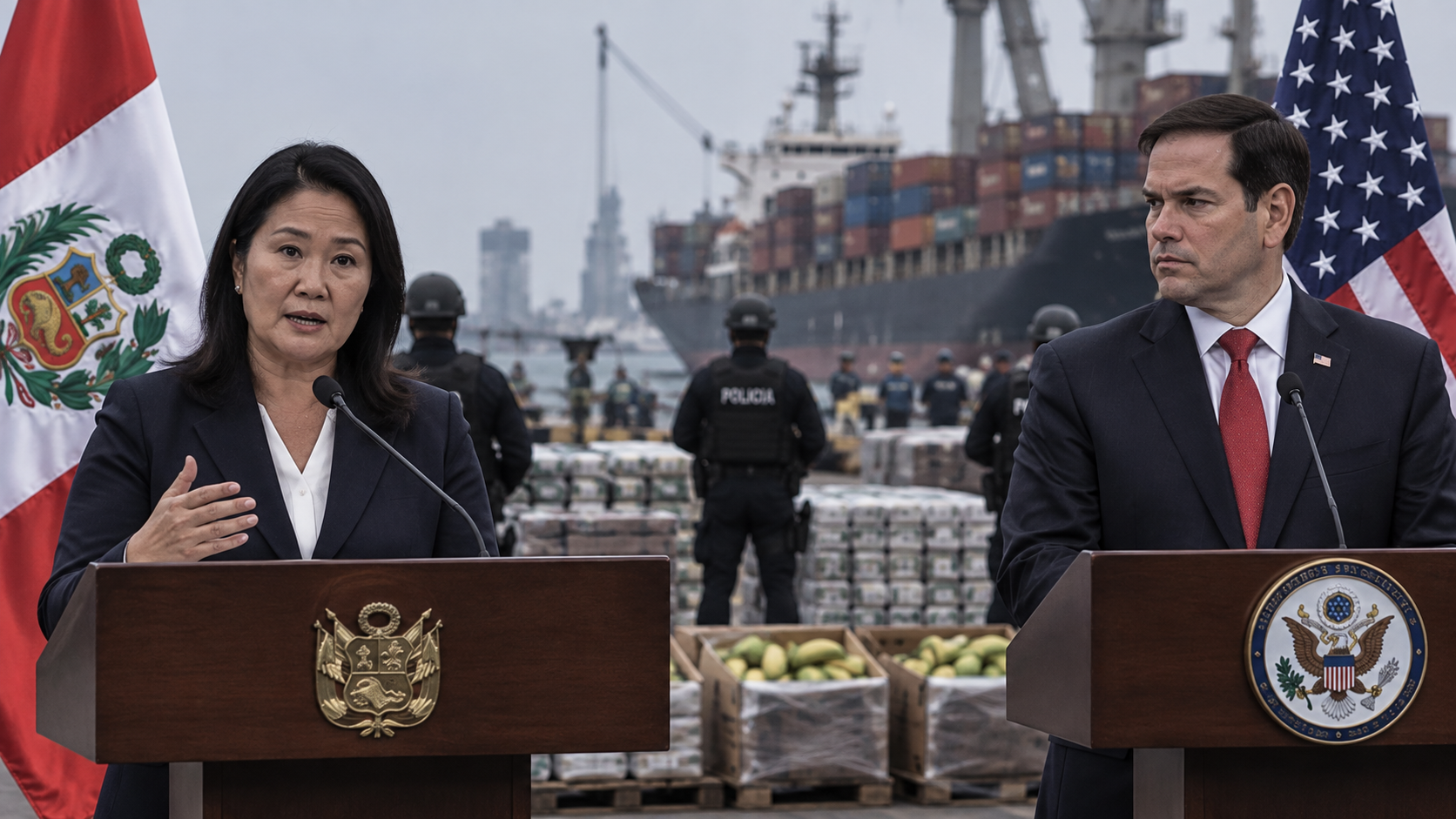
President Keiko Fujimori advanced Peru security coalition plans, adding the world's No. 2 cocaine producer to a US-led cartel campaign.
Speaking alongside US Secretary of State Marco Rubio, Fujimori said Washington had agreed to support her government against criminal networks. The public statement cited no specific form of US support, leaving implementation to determine the pact's practical weight.
Shield adds a cocaine hub
The Shield of the Americas is a security coalition created by President Trump, and Argentina and Colombia are among the conservative-led governments that have joined. Peru's entry would extend the coalition into a country whose illicit-drug role is tied to both production zones and export infrastructure.
Peru is the world's second-largest cocaine producer after Colombia, making its alignment with Washington material for regional enforcement strategy. Its ports are used to move drugs toward Europe and the US, with traffickers sometimes hiding shipments inside fruit cargoes.
Fruit shipments matter because they move through time-sensitive supply chains where delays can reduce value and reliability. That makes port enforcement a balance between finding concealed drugs and preserving the predictability that legal exporters sell to overseas buyers.
Ports carry practical test
The operational burden will fall less on summit language than on customs systems, maritime policing, prosecutors and the private companies that move legitimate cargo. If the arrangement leads to more screening at Peruvian terminals, exporters could face longer checks even when they are not suspected of wrongdoing.
For Fujimori, the pact offers outside backing against networks that use Peru's geography and port access to reach higher-value consumer markets. The political risk is that a US-led security campaign can draw criticism if enforcement is seen as imposed from abroad or if seizures disrupt lawful trade.
Regional alignment under Trump
The move also gives President Trump another regional partner for a coalition framed around cross-border cartel pressure. Colombia's presence matters because it is the only country ahead of Peru in cocaine production, and Argentina's participation widens the bloc beyond the Andean corridor.
For Washington, Peru's accession adds a Pacific-facing link to a framework intended to connect national enforcement systems rather than fight cartels country by country. For Lima, the test is whether external backing improves investigations inside Peru instead of only hardening controls at departure points.
The macro channel is indirect but concrete: drug enforcement affects shipping costs, insurance assumptions, port procedures and bilateral security spending before it shows up in national output data. A tighter US-Peru enforcement link could also influence how European and US authorities scrutinize cargo arriving from Pacific ports.
Three paths for enforcement
If US backing centers on intelligence and targeted investigations, the global effect would likely be limited to narrower trafficking corridors; Fujimori's government would gain capacity without slowing ordinary trade. Ports and fruit exporters would face fewer broad checks, but that path depends on agencies identifying cartel logistics before cargo reaches terminals.
If the coalition instead relies on heavier inspections, the macro cost would come through delays and compliance expenses on trade routes. Peru would be able to show visible enforcement, but shipping lines, port operators and produce exporters could absorb higher friction while traffickers look for alternative exits.
If political support for the arrangement weakens, the regional coalition would retain its name but lose operational depth. Fujimori would face pressure to prove domestic results, and the wider security sector would be left with a familiar problem: cartels can shift routes faster than governments can rewrite coordination rules.