Pacific security drives Peters plea for stronger US role
Winston Peters put Pacific security at the center of New Zealand’s election-season foreign policy debate, urging sustained US engagement.
Lauren Collins ·
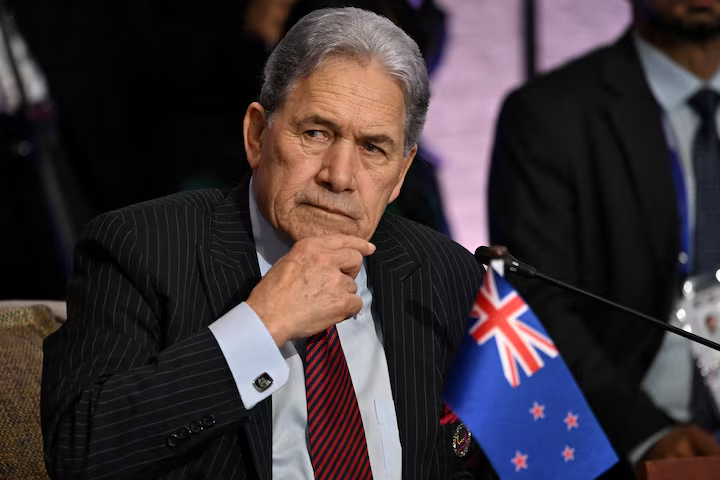
Pacific security topped Winston Peters’ final major foreign policy speech before New Zealand’s November 7 election as he urged a deeper US role.
The New Zealand foreign minister described a more unsettled strategic environment in the region, citing unauthorized missile tests, naval activity moving farther south and organized transnational crime. His remarks put regional security and US engagement near the center of Wellington’s foreign policy debate before voters go to the polls.
Peters points to missile tests
The speech was delivered as New Zealand’s center-right government uses more direct language about geopolitical competition in the Pacific. Peters said the regional environment was no longer benign, linking security pressure to both military activity and criminal networks that reach island states and New Zealand.
He did not name China in Monday’s address. Peters has previously criticized China’s test firing of an intercontinental ballistic missile into the South Pacific, while Chinese state media described the launch as a “routine arrangement” of annual military training and said it was not aimed at any country or target.
“The United States is a Pacific power, and we need an engaged America in the Pacific in support of regional prosperity and security,” Peters said. The formulation reflected Wellington’s view that US attention in the region should be measured not only by defense posture, but also by support for island governments’ stated priorities.
Palau funding enters campaign
Peters said Washington had responded during the government’s term to issues raised by New Zealand and other regional partners. He pointed to US announcements made in Palau that included $150 million in support for Pacific Islands, a figure he used as evidence of renewed American attention.
“We have talked a lot with them this term about the challenges facing the Pacific and the United States’ announcements in Palau were welcome recognition that they have listened and are responding,” Peters said. His comments framed the funding as part of a wider diplomatic push rather than a standalone aid pledge.
Drug trafficking gave Peters a domestic and regional security example for that argument. He called the trade an “evil scourge” moving across Pacific shores and said Washington had an important role in helping island countries build the capacity to disrupt criminal networks.
For Pacific governments, the appeal for US engagement sits alongside New Zealand’s own attempt to strengthen ties through aid, defense cooperation and diplomacy. Wellington has urged larger partners to listen more closely to island leaders, who often balance security requests with development needs, climate exposure and pressure on public services.
New Zealand First’s coalition weight
The address also carried an electoral edge. Peters, 81, is seeking another term as leader of New Zealand First, the junior partner in the governing coalition, and is serving his third stint as foreign minister.
His leverage comes from New Zealand’s proportional electoral system, adopted in the 1990s, which has often left smaller parties with a role in forming governments. Peters has played that role more than once, making his foreign policy positioning relevant beyond his party’s vote share.
Trade disruption meets regional competition
Peters tied the Pacific message to a wider assessment of a troubled global environment marked by disruption, uncertainty and renewed trade protectionism. For New Zealand, an export-dependent economy with close Pacific ties, that makes regional diplomacy, security cooperation and access to open markets parts of the same policy problem.
If US follow-through turns the Palau funding into sustained maritime, policing and customs capacity, Pacific island governments could gain tools to limit trafficking and reduce openings for rival security offers. If support remains episodic, Wellington may face pressure to fill gaps with its own aid and defense resources while the wider region manages a more crowded field of outside powers.
For the global economy, the mechanism is narrower but still material: secure sea routes and stable Pacific partnerships help small island states and trading economies manage disruption. The main open question is whether the November 7 election preserves the current coalition’s foreign policy line and whether Washington’s Pacific commitments become recurring engagement rather than one-off announcements.