Pacific missile test draws Pacific bloc warning to China
Pacific Island leaders urged advance warning for Chinese missile tests after a July ICBM launch, while Nauru dissented and Taiwan tensions disrupted the…
Lauren Collins ·
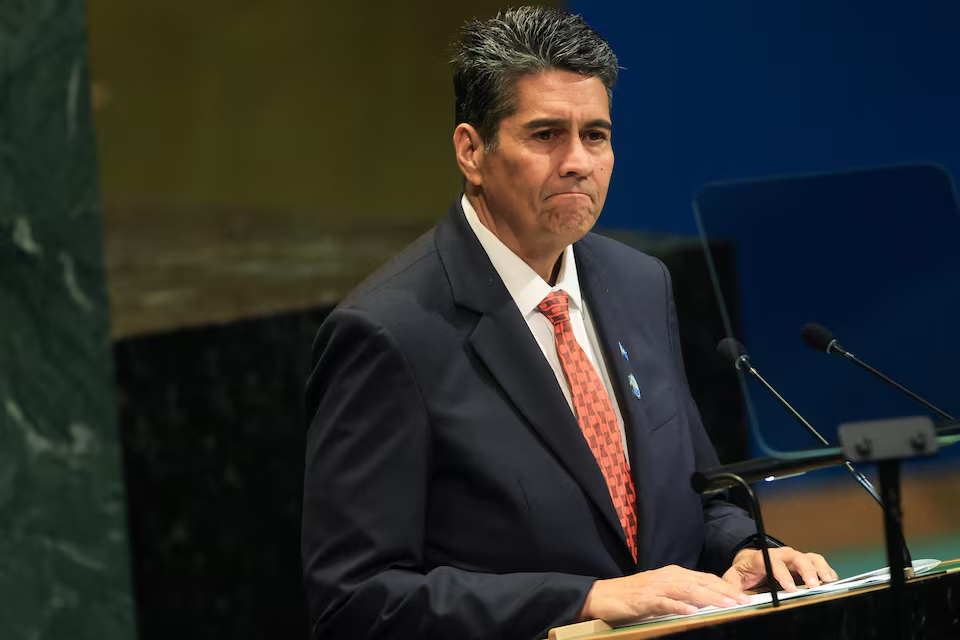
Pacific missile test by China drew concern from most Pacific Island leaders, who sought at least 24 hours' notice for future launches.
Palau President Surangel Whipps Jr., host of the Pacific Islands Forum, said Thursday that China’s July intercontinental ballistic missile test passed over several island nations without adequate warning. He described the launch as Beijing’s first known Pacific ICBM test since September 2024, giving the 18-member forum a security issue alongside its regional agenda.
Nauru breaks forum consensus
Whipps said leaders wanted any state conducting ICBM tests to provide transparency and reassurance, including advance notification of at least 24 hours in line with international practice. Reading from a prepared statement, he added: "I might note that the Republic of Nauru has dissented."
Nauru’s position mattered because the forum operates in a region where recognition of Beijing or Taipei often carries diplomatic weight beyond a single communique. Nauru restored diplomatic ties with China in 2024 after previous switches between Beijing and Taipei, making its dissent a marker of how Pacific security language can intersect with recognition politics.
China’s foreign ministry rejected the criticism on Friday, saying the country is "committed to peaceful development and pursues a defensive national defence policy." Spokesperson Guo Jiakun said China was willing to work with South Pacific countries to protect regional peace, stability, development and prosperity.
Palau’s Taiwan ties sharpen dispute
Palau had sought a formal condemnation of the missile test, a position shaped by its status as one of three Pacific Island nations with official relations with Taiwan. Beijing responded Thursday by accusing Palau of stirring "hype" over the test and said efforts to sway other island governments were "malicious and will not succeed."
The forum was also strained by China’s objection to Taiwan’s attendance. China says Taiwan is part of its territory; Taiwan, a self-governed democracy, rejects that position.
Taiwan Foreign Minister Lin Chia-lung said Friday that Chinese officials had used "wolf warrior" diplomacy at the summit and alleged they had engaged in espionage there. "This kind of Chinese 'wolf warrior' diplomacy actually easily undermines Pacific unity and it is quite off-putting and disliked," Lin said, adding that Taiwan and China were both invited guests.
Absent leaders limit the signal
The split came at a summit already thinned by the absence of five Pacific leaders, who sent lower-ranking ministers instead. That limited the political weight of the gathering even as Australia, represented by Prime Minister Anthony Albanese and Energy Minister Chris Bowen, backed the right of the majority to speak.
Bowen said Friday it was "perfectly reasonable for the vast majority of Pacific countries to express a view and for one or two to say that they have a different view." He said unanimity was not required for Pacific island states to convey strong views, framing Nauru’s dissent as a limit on consensus rather than a veto.
Notification rules define next steps
If Beijing gives 24 hours' notice before future long-range missile tests, Pacific governments would have a clearer basis for civil aviation, maritime advisories and diplomatic messaging. The global economic effect would be indirect but stabilizing at the margin: fewer surprise military signals in a region that connects major Pacific trade routes.
If launches continue without advance warning, Palau and like-minded governments may push for stronger forum language before New Zealand hosts the next summit in 2027. The mechanism would be political rather than commercial: warning rules would become a test of China’s regional conduct, and Pacific diplomacy would remain exposed to pressure from the Beijing-Taipei dispute.
A third path is that Taiwan’s participation becomes the dominant dispute, crowding out the missile issue at future meetings. Under that scenario, the regional effect would run through higher diplomatic friction, while aviation and maritime planning would stay tied to governments’ ability to get timely notice of military activity.