Hormuz options draw South Korea toward military review
South Korea is reviewing Hormuz navigation support, including military measures, while Seoul says security talks with Washington are not currently progressing.
Lauren Collins ·
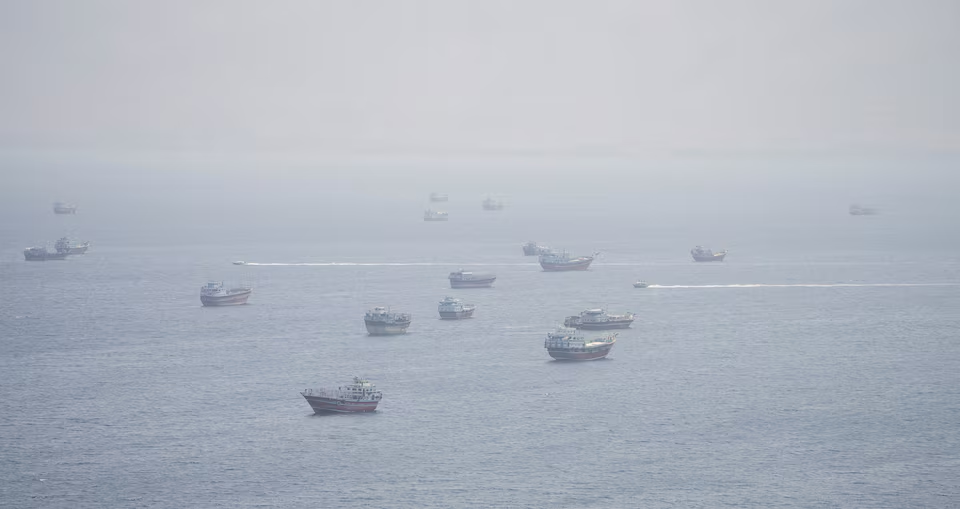
South Korea is reviewing military and other Hormuz options as Seoul denies claims it has offered no support for navigation.
A presidential Blue House official said Friday that the government is examining practical steps to support freedom of navigation in the Strait of Hormuz. The official identified military measures as one possible category but did not describe deployments, timing, or a decision-making process.
The comment responded to claims that Seoul had provided no assistance on the issue. The official said those claims were "not true," without identifying the assistance or saying whether it involved diplomatic, logistical, operational, or intelligence support.
Hormuz options reach Seoul
The Strait of Hormuz review places a maritime security question inside South Korea's alliance management with the United States. The official did not say whether Seoul had received a formal request from Washington or whether the review began through South Korea's own policy process.
The same official said South Korea-U.S. security talks were "not currently progressing." That phrasing leaves unclear whether the Hormuz review is linked to a broader negotiation track with Washington or is being handled through another channel.
Freedom of navigation is the stated frame for Seoul's review. In policy terms, that allows the government to discuss support for open sea lanes without publicly committing to a specific military role.
Chip talks share the agenda
Semiconductors are also among the issues under discussion between the allies, the official said. The remark places one of South Korea's most politically sensitive industrial sectors inside the same diplomatic conversation, although no details were given on supply chains, export controls, investment, or defense technology.
The combination matters because security coordination and technology policy can affect different parts of the South Korean economy through separate channels. A Hormuz-related step would speak first to maritime and alliance policy; chip talks would bear more directly on manufacturers, exporters, and investment plans.
The official's account does not establish whether the two issues are being traded against each other. It only confirms that both Hormuz navigation support and semiconductors are on the agenda between Seoul and Washington.
Assistance claim remains undefined
The main uncertainty is what Seoul counts as assistance. The official's denial that South Korea has done nothing does not establish the scale, legal basis, location, or operational purpose of any support.
If Seoul moves toward military measures, the immediate effect would be on the government's defense planning and alliance posture. For industry, the wider consequence would depend on whether Washington and Seoul connect security support with separate semiconductor discussions.
If South Korea confines its role to noncombat assistance, the macro effect would run mainly through diplomatic alignment rather than an identified operational change. For the technology sector, the chip agenda would remain the more direct channel for company decisions.
Next signal is specificity
The next useful signal is whether officials move from reviewing options to naming measures, dates, authorities, and responsibilities. Until then, the policy remains a declared review rather than a disclosed commitment.
The broader issue for Seoul is how far it wants to attach maritime security support to its alliance agenda with Washington. For global markets, the concrete channel is confidence around a key Gulf route, but the source material provided no verified market or trade figures to quantify that exposure.