Okinawa Marine arrest tests US-Japan base ties after death
Japan protested to the U.S. after an Okinawa Marine arrest in a Naha robbery-murder case renewed scrutiny of American bases.
Mei Lin ·
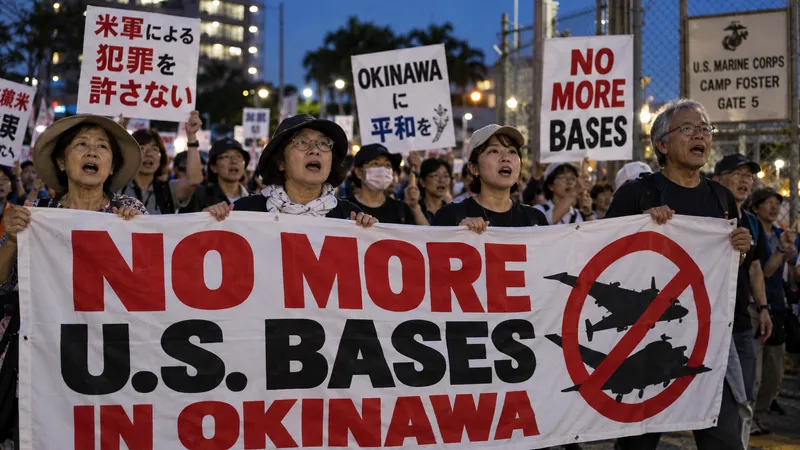
The Okinawa Marine arrest of a 20-year-old lance corporal in a Naha robbery-murder case drew a Japanese protest and renewed scrutiny of U.S. bases.
Naha hotel death prompts protest
Okinawan police said Devin Jacob Ballard is suspected of killing Anna Yagi, 39, and taking her wallet and backpack. Yagi was found dead Saturday at a hotel in Naha, the prefectural capital.
Police said Ballard denies the allegations. A U.S. official identified him as a 20-year-old lance-corporal assigned to the Third Marine Expeditionary Force, the Marine unit stationed on the island.
Prime Minister Sanae Takaichi said Sunday that Japan had lodged a strong protest with the U.S. and sought maximum cooperation with the investigation. In a post on X, she called the incident “a matter of profound regret.”
U.S. Ambassador George Glass said he had discussed the case with Japan’s Ministry of Foreign Affairs and Okinawa Gov. Genta Koja. Glass wrote on X: “We confirmed our policy of providing full cooperation with the investigation.”
Okinawa bases shape politics
The case lands in a prefecture where the U.S. military presence has been a central political issue since World War II. The island was returned to Japanese administration in 1972, but U.S. bases remained a major part of its security landscape.
Okinawa hosts about 30,000 active-duty U.S. military personnel, a concentration that has long set local politics apart from Tokyo’s national security debate. The island sits about 1,000 miles from the capital, but its location makes it central to U.S. and Japanese planning in the western Pacific.
Crimes involving American service members have periodically fueled local opposition to the bases. Each incident places the alliance’s deterrence role against a local demand for discipline, accountability and reduced daily exposure to military facilities.
Koja faces first base test
Koja’s recent election victory suggested that some voters were giving greater weight to household issues and Japan’s security challenges from China and Russia. He defeated Denny Tamaki, an incumbent closely associated with opposition to the U.S. military footprint.
The arrest gives Koja an early test of that balance. Although he belongs to Takaichi’s ruling Liberal Democratic Party, Koja said Sunday that prior requests to prevent repeat incidents had not produced adequate discipline.
He said the latest case compelled him to say the U.S. military’s efforts to enforce discipline and train personnel were “failing completely.” The phrasing aligned him with local frustration even as Tokyo relies on the U.S. presence as part of Japan’s defense posture.
The Marine Corps said it is cooperating with Japanese authorities and takes the allegations seriously. The next steps rest with Okinawan investigators and prosecutors, while U.S. commanders face pressure to show that cooperation includes access, information-sharing and visible personnel controls.
If investigators move toward charges, the case may harden calls in Okinawa for tighter restrictions on off-base conduct; if cooperation proceeds quickly, Tokyo and Washington may try to limit the diplomatic damage. The unit-level effect falls on Marine command in Okinawa, while the wider U.S.-Japan security framework will be judged on whether discipline measures can coexist with the military posture Japan says it needs.