

NASA Accelerates Lunar Landing Timeline to 2028
NASA has accelerated its lunar landing goal to 2028, utilizing a 2027 orbital test mission to validate competing lander technologies from SpaceX and Blue…
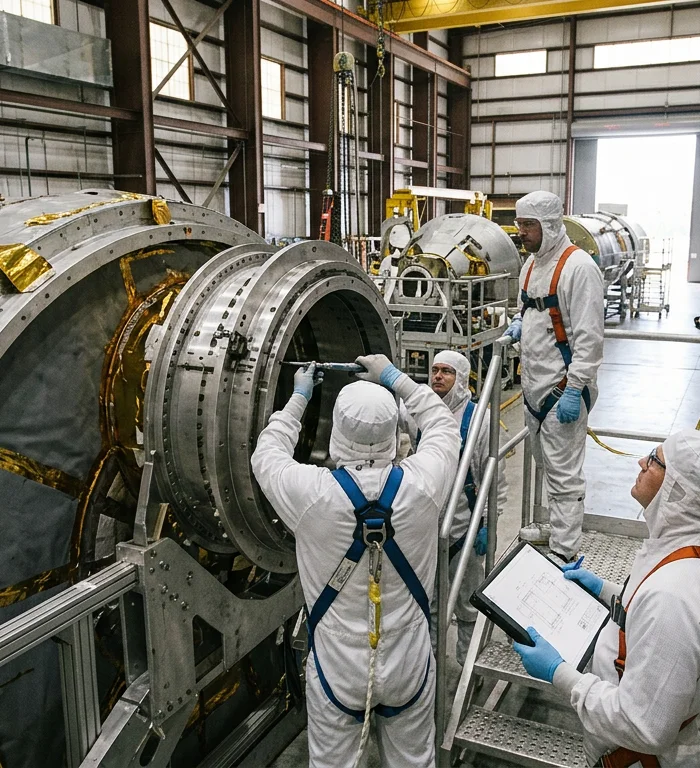
NASA has formalized an accelerated strategy to return astronauts to the lunar surface by 2028. The revised roadmap prioritizes the Artemis IV mission for the landing, preceded by a critical orbital rehearsal mission, Artemis III, scheduled for 2027. This shift is intended to establish a permanent lunar presence and secure strategic positioning in space exploration.
The Artemis III mission will serve as a technical validation phase in Earth orbit. A four-person crew aboard the Orion spacecraft will conduct rendezvous and docking maneuvers with experimental lunar landers developed by SpaceX and Blue Origin. This sequence is designed to mitigate operational risk and verify system capabilities before attempting a surface landing.
To meet the 2028 deadline, the agency has implemented internal reforms to reduce mission preparation timelines by approximately 50%. This includes a strategic pivot toward reclaiming core engineering competencies, exemplified by the internal redesign and manufacturing of critical rocket components. Officials stated that this approach has significantly reduced costs compared to previous external procurement estimates.
Artemis IV
The 2028 landing mission will utilize either the SpaceX Starship or the Blue Origin Blue Moon Mark 2 lander. SpaceX’s architecture relies on orbital refueling to facilitate the transit, while Blue Origin is developing an alternative transport system. The selection of the final landing vehicle remains contingent on the performance data gathered during the 2027 orbital tests.
Agency leadership emphasized that the accelerated schedule is a response to increasing international competition for lunar surface access. By streamlining procurement and development, the agency aims to reduce technical uncertainty and maintain a consistent cadence of missions. The focus remains on establishing a sustainable infrastructure that supports both lunar operations and future human exploration of Mars.
More stories
- Europe faces attribution gap after 16 cyber, physical incidents
- PIF backs Grand Theft Auto as Saudi players embrace game
- Signal limits screenshots to curb AI access to messages
- Cognition runs Devin Mac workspaces on EC2 in 6 AWS regions
- Salesforce engineers cut 600-failure triage to 90 minutes
- Türkiye Desk: GTA 6 puts console access and network demand in focus
- Nvidia opens board inquiry into alleged foreign targeting
- Nvidia opens board inquiry into alleged foreign targeting
- Microsoft says 300,000 people try Minecraft daily, but the metric obscures the real business
- A Chinese platform is renting human faces for $15 to populate AI game assets
Latest news
- Trump prepares tariffs on China and other major exporters
- New-car buyers pay record average $50,087 in October
- Banks face ECB reserve debate over liquidity and profits
- Investors see Anthropic debut gains fade below $83 a share
- Iraq orders federal control over Kurdish-area oilfields
- Germans oppose Ukraine aid as poll shows support slipping
- Kim Jong-un receives 10 envoys after constitutional shift
- Ukraine claims Libya strike sinks Russian naval corvette