

KinoGen researchers report 90% contact preservation in 8 robot tasks
The arXiv preprint describes a video-generation method for producing robot motion references, with claims tested on a Unitree G1 humanoid.
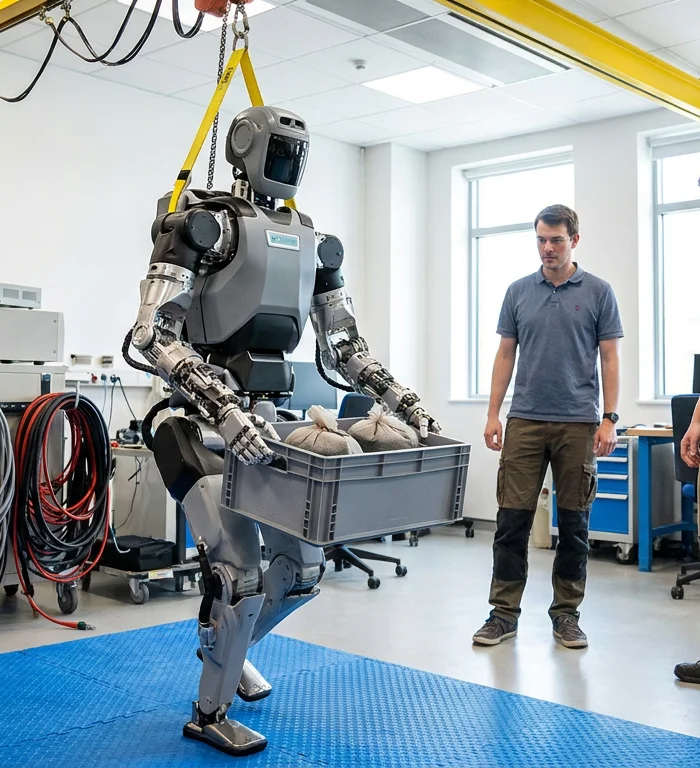
KinoGen researchers reported preserving more than 90% of annotated contacts across eight humanoid loco-manipulation tasks in an arXiv preprint submitted on Oct. 14.
The preprint matters because humanoid robots need usable motion references before they can be trained to move objects while walking. The authors said KinoGen also produced less penetration and foot skating than video-based baselines across the eight tasks.
KinoGen is a framework for creating customizable references for humanoid loco-manipulation, a robotics term for moving through space while handling objects. The paper was written by Qi Wu, Lulu Zhao, Sanghyun Hahn, Rishi Yennu, Emmy Yang, Dingqi Zhang, Tao Pang, Jiuguang Wang and Kuan Fang.
The authors said KinoGen uses a pretrained video generator conditioned on calibrated renders of the target robot and object in a simulated task. It then reconstructs the reference by fitting the same robot and object models to generated two-view video, keeping the output within the robot’s own configuration space rather than relying on a human-body proxy.
The paper said users can edit a keyframe to specify a target object pose, regenerate video around that state and obtain a reference that meets the prescribed pose. The authors said customized references satisfied every prescribed target and produced substantially less penetration than direct interpolation.
The work remains early research. The arXiv paper is a preprint and has not been peer reviewed, and the source text does not provide commercial performance data, training cost, sample sizes beyond the eight tasks, or a comparison against deployed industrial systems.
The authors said tracking policies trained on the generated references were deployed on a Unitree G1 humanoid with dexterous hands. The paper lists a project webpage for the work.
Source: arXiv preprint, Oct. 14, 2026
More stories
- LLM crisis reports capture 5.4%-11.0% of official figures
- Türkiye Desk: Tencent’s Flow Games move tests Türkiye’s mobile thesis
- Rockstar plans GTA 6 PC release by March 2027, GamesBeat says
- Loadout’s $LOAD launch tests funding model for 40 games
- Robotics at Amazon tests balance between speed and safety
- Message passing lifts small-model Sudoku score to 72%
- NASA taps Relativity Space to deliver Aeolus Mars mission
- Capital Factory founder Joshua Baer killed in jet crash
Latest news
- NEXANS request sets two-week wait for Cyprus cable surveys
- Fairfax wins Cabinet approval for ₹52,878 crore IDBI stake
- Poundland bosses back buyout for about 600 stores
- Fairfax faces CSB choice in $5.6bn IDBI stake deal
- Stocks face rotation risk at 5.9% Treasury yield, according to BofA
- Wolfspeed faces dilution risk in $1.5bn Pentagon loan
- Iran targets Starlink with jail terms of up to 5 years
- Natacha Polony joins France's 2027 presidential race