

Robotics at Amazon tests balance between speed and safety
Amazon plans more robots for its million-plus fleet, as a study links warehouse automation to fewer severe injuries but more strains.
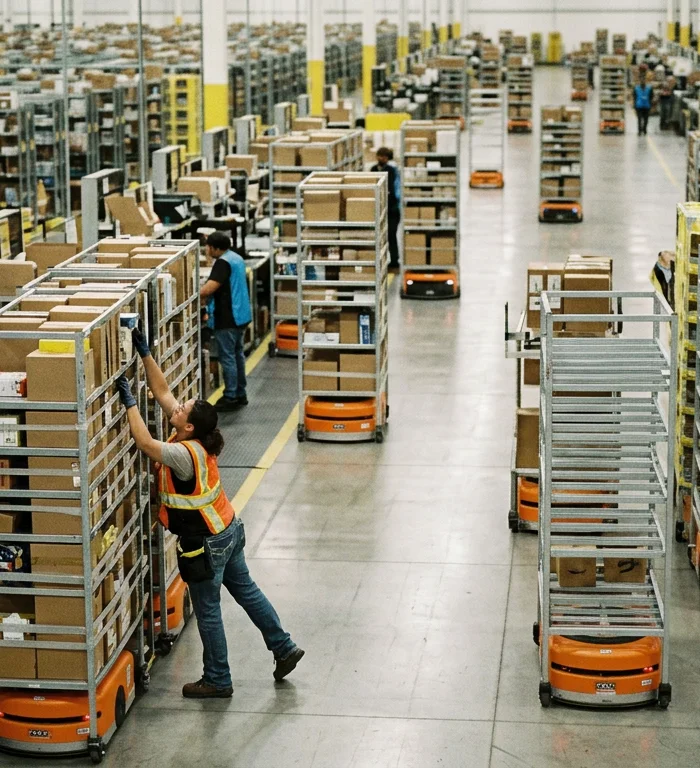
Amazon plans more robots for its million-plus fleet, as a study links warehouse automation to fewer severe injuries but more strains.
The expansion increasingly involves robotic arms rather than just machines that transport inventory. Amazon CFO Brian Olsavsky said during July’s earnings call that the company expected its arm deployments to more than double in 2026; Amazon Robotics vice president Scott Dresser put the existing total in the low thousands.
Automation is expanding alongside a large workforce: Amazon reported more than 1.5 million employees across full-time and part-time positions in its 2025 annual report. The central workplace issue is not simply which tasks machines can perform, but how their speed affects people handling the remaining work.
Injury findings split by severity
A study published in ILR Review in April 2025 found severe injuries were 40% lower at robot-equipped Amazon facilities than at conventional fulfillment centers. However, injuries involving less serious repetitive physical strain were 77% higher at the automated sites.
Those findings suggest a distinction between removing demanding physical tasks and reducing every category of injury. Coauthor Brian Greenwood, a business professor at George Mason University, identified faster picking expectations as a possible mechanism linking automation with strains and sprains.
The study examined weekly records spanning 2016–2019 from over 150 Amazon warehouses. That makes its findings evidence about an earlier generation of operations, rather than a direct assessment of the newest robotic arms.
Amazon disputes critical assessments that rely on older operations and says its overall safety record has improved. A company spokesperson reported a 43% reduction in its global recordable incident rate and a 70% decline in its lost-time incident rate since 2019, without providing separate figures for automated and conventional facilities.
Robot arms take on harder tasks
Amazon’s purchase of Kiva Systems in 2012 established the foundation for its warehouse robotics business. Machines that deliver storage racks to workers still dominate the fleet, but newer arms address sorting, packing and manipulating individual products.
Vulcan adds force sensing to visual information, allowing it to place or retrieve goods inside storage compartments. Amazon says assigning it high and low shelves reduces employees’ need to climb or bend; initial operations began in Spokane, Washington, and Hamburg, Germany, in 2025.
Dresser said wider Vulcan deployment was expected in 2027. Separately, Amazon announced manufacturing facilities in Austin, Texas, and Greenwood, Indiana, during 2026 to support further robot production, supplementing its Massachusetts manufacturing operations.
Maintenance jobs and warehouse pace
Amazon presents technical employment as another benefit of automation. The company says its advanced robotic warehouses typically need 30% more staff in maintenance, engineering and reliability functions, although that comparison does not establish whether total staffing rises or falls.
If newer machines remove difficult tasks without accelerating repetitive work, Amazon could improve throughput while reducing employee strain. Across logistics, similar results would support automation as a complement to human labor; globally, the economic benefit would depend on whether productivity gains translate into lower distribution costs.
If machine speed instead raises repetitive demands, some safety gains could coexist with greater physical strain, as the earlier study suggests. For Amazon and competing warehouse operators, that scenario would put task design and staffing under scrutiny, while any broader productivity benefit would need to be weighed against injury-related costs.
The unresolved comparison is between workers’ outcomes at newer robotic sites and otherwise comparable conventional warehouses. Separate injury categories, staffing levels and work-rate expectations would help establish whether the next deployment improves conditions or redistributes the physical burden.
More stories
- Binance shuts mining pool as trading business remains open
- Gears E-Day No. 2 player-count claim sparks debate
- Message passing lifts small-model Sudoku score to 72%
- DualQuant may lower LLM memory use by 2.61x
- Loops AI raises $3.5 million seed round with a16z Speedrun
- Nvidia China share falls to 34% as Huawei gains
- PlayStation and PC software sales rise to 21 million in Japan behind Capcom's latest hit
- Open AI breaches Medicare patient records
Latest news
- Citigroup profit beats estimates as bond trading hits decade high
- Konya exports near $4 billion as leaders assess risks
- Sharjah Islamic Bank profit rises 9% as financing expands
- UAE green plans put Dh200 billion investment target in focus
- Marotta deepens submarine role with three-year Electric Boat deal
- Skydance's $110 billion deal tests US media oversight
- Oil’s 2% drop steadies risk tone before US CPI
- UK spy chief says Iran, Russia escalate campaigns