

IsoMoE lifts hybrid MoE decoding speed 1.26x with exact outputs
A compression layout and arithmetic alignment resolve execution discrepancies and memory bandwidth bottlenecks when splitting large language models across…
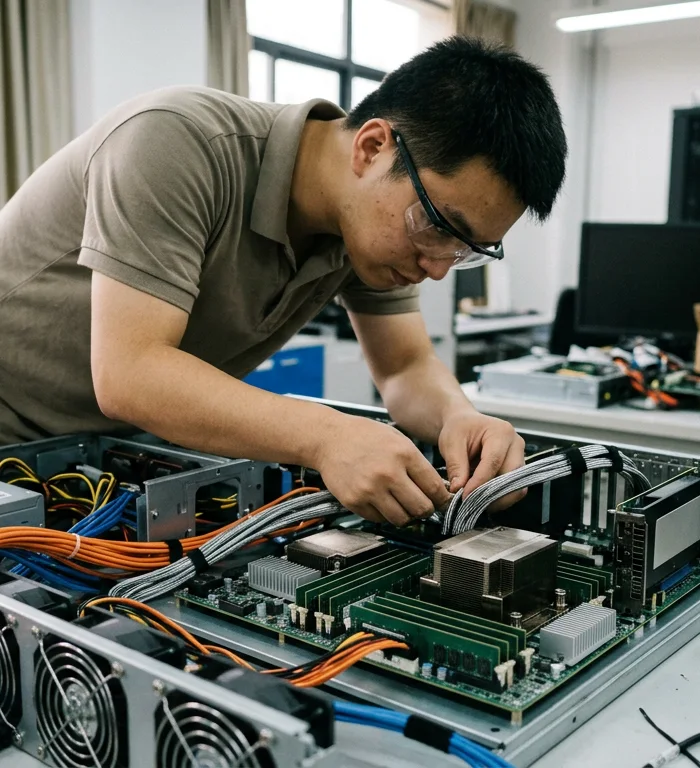
University of Science and Technology of China researchers introduced IsoMoE, an inference engine achieving an average 1.26-fold decoding speedup across hybrid CPU-GPU hardware, in a computer science preprint published on Nov. 23.
The framework guarantees bitwise identical text generation regardless of where mixture-of-experts parameters sit in physical memory, outperforming existing hybrid baselines by up to 1.54 times while preventing shifting GPU allocations from altering outputs.
Serving massive mixture-of-experts models on a single graphics processor requires offloading weights to system memory. For instance, the parameters for Qwen3-235B-A22B demand roughly 454 gigabytes in 16-bit brain floating-point format, far exceeding the 80-gigabyte capacity of high-end accelerators. Existing offloading systems like llama.cpp and FreeToken distribute experts between host processors and graphics cards based on available memory at startup, but subtle numerical rounding differences between the two architectures often alter which experts are routed.
In benchmark tests on Qwen3-30B-A3B across 56 mathematical problems, llama.cpp preserved identical outputs on only five problems after shifting 12 layers of experts to a graphics processing unit. Halving the FreeToken expert cache changed outputs across all 56 problems, while a competing process consuming 4 gibibytes of accelerator memory caused 13 out of 16 solutions to diverge. Such variations complicate accuracy benchmarking and introduce non-deterministic errors during inference audits and reinforcement learning workflows.
To eliminate output drift, IsoMoE forces the graphics card kernel to bitwise replicate the arithmetic executed by the central processor. The authors implemented the system on top of KTransformers and introduced a custom memory layout tailored to central processing unit vector registers. By combining fixed-length 12-bit lossless expert compression with AVX-512 dot-product instructions, the system allows the processor to decompress weights directly inside registers, lifting central processor expert computation to 1.35 times the speed of 16-bit floating point.
By contrast, traditional entropy compression techniques such as zstd and Huffman coding ran at 0.59 to 0.61 times baseline speed due to sequential CPU decoding bottlenecks. IsoMoE pairs the compressed weight layout with a dual micro-batch schedule adapted from DeepSeek-V3 to overlap processor and accelerator operations without perturbing batch calculations. The researchers released the underlying codebase in an open-access repository for independent verification.
Source: academic preprint, arXiv, Nov. 23, 2026.
More stories
- Europe faces attribution gap after 16 cyber, physical incidents
- PIF backs Grand Theft Auto as Saudi players embrace game
- Signal limits screenshots to curb AI access to messages
- Cognition runs Devin Mac workspaces on EC2 in 6 AWS regions
- Salesforce engineers cut 600-failure triage to 90 minutes
- Türkiye Desk: GTA 6 puts console access and network demand in focus
- Apple CEO change puts Ternus atop AI supply strain today
- Robotaxi expansion pits Zoox against Waymo in US cities
Latest news
- Trump prepares tariffs on China and other major exporters
- New-car buyers pay record average $50,087 in October
- Banks face ECB reserve debate over liquidity and profits
- Investors see Anthropic debut gains fade below $83 a share
- Iraq orders federal control over Kurdish-area oilfields
- Germans oppose Ukraine aid as poll shows support slipping
- Kim Jong-un receives 10 envoys after constitutional shift
- Ukraine claims Libya strike sinks Russian naval corvette