Iran protests omitted from UN summary of Guterres talks
Iran protests were absent from a UN readout after António Guterres met Masoud Pezeshkian during a summit in Bishkek.
Amira Hassan ·
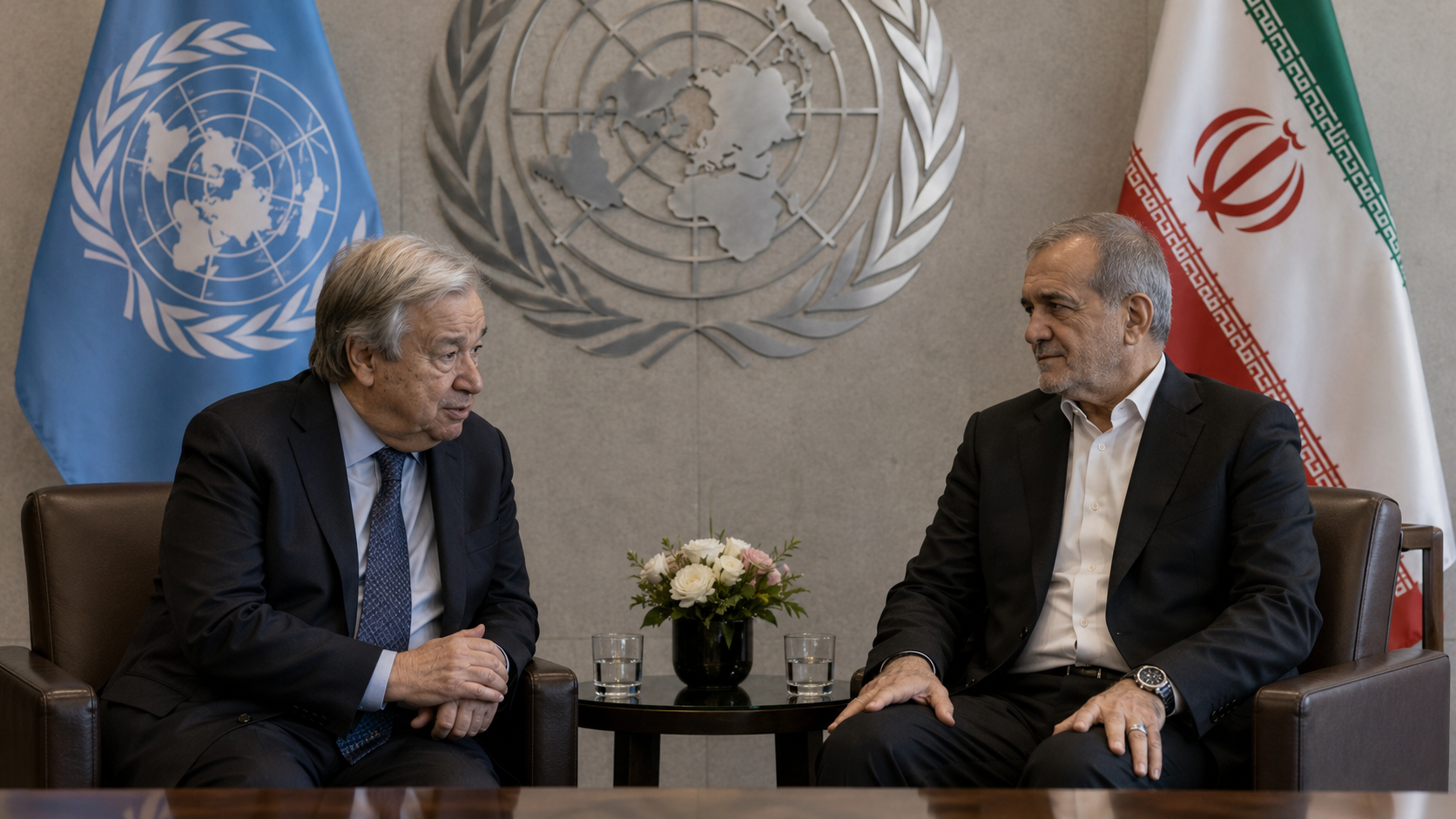
The UN Iran meeting Tuesday left protest cases out of its public summary, limiting scrutiny of detainee treatment and executions.
Bishkek readout omits detainees
United Nations Secretary-General António Guterres met Iranian President Masoud Pezeshkian on the sidelines of the Shanghai Cooperation Organization summit in Bishkek. The UN's account of the meeting said Guterres discussed the humanitarian and economic consequences of the conflict involving Iran, along with diplomacy and respect for international law.
The same readout did not refer to Iranians detained after January's nationwide protests. The provided account said those detainees continue to face prison sentences, alleged torture, and a rising number of death sentences and executions.
Dujarric cites other meetings
At a UN briefing Tuesday, Stéphane Dujarric, spokesperson for the secretary-general, was asked whether Guterres raised protesters, executions, or torture allegations directly with Pezeshkian. Dujarric said he had "nothing to add to the readout."
Dujarric said the secretary-general had addressed those subjects with senior Iranian officials in separate settings. "I can tell you that in other meetings with senior Iranian leaders, in New York and other places, the secretary-general has raised those issues directly," Dujarric said.
The distinction matters because UN readouts set the public record of high-level diplomacy. When human rights cases are left out, governments, campaigners, and families of detainees have less visible evidence of whether the issue was placed before a head of state.
Protest cases frame the stakes
The January protests form the human rights backdrop to the meeting, but the available material gives no verified total for detainees, sentences, death penalties, or executions. That limits what can be stated about scale; the claims about torture and punishment remain allegations or reported outcomes unless confirmed by court records, official notices, or independent monitors.
For Iran, the diplomatic risk is that private assurances do not carry the same cost as public language. If international pressure stays behind closed doors, Tehran faces less immediate reputational exposure; if the issue enters official summaries, it becomes harder to separate economic diplomacy from rights scrutiny.
For the United Nations, the episode shows the trade-off in meetings with governments accused of abuses. Public confrontation can narrow access; private engagement can preserve channels, but it may leave victims' cases invisible in the documents governments and diplomats later cite.
Diplomacy and conflict channels
The readout's emphasis on humanitarian and economic consequences places the meeting inside a broader diplomacy track around Iran. It did not identify a specific agreement, timetable, or mechanism, so the near-term effect rests on whether subsequent UN statements or Iranian responses add detail.
If diplomatic engagement holds, the macro channel would run through lower conflict uncertainty and fewer disruptions to trade, finance, and regional risk pricing. For Iran, that would preserve room for talks; for the wider diplomatic sector, it would support continued use of summit margins as a forum for de-escalation.
If rights cases become more visible in UN messaging, the global effect would be less about immediate markets and more about the political cost attached to engagement with Tehran. For Pezeshkian's government, the pressure would center on prisons, courts, and execution practices; for rights organizations and foreign ministries, it would create a clearer benchmark for follow-up.
If the public record remains limited, the open question is whether detainee cases are being raised with enough specificity to affect outcomes. The next signals are any UN wording after future meetings, any Iranian statement on the prisoners, and any verified change in sentences, torture investigations, or executions.