

Haemanthus funding rises to as much as $20m for home tests
The startup founded by Billy Evans has no released products, while a consultant says its Raman spectroscopy work differs from Theranos.
Billy Evans, Elizabeth Holmes' husband, appears in a new documentary and founded Haemanthus in 2022, a home-testing startup reporting up to $20 million in funding, WIRED said Oct. 19.
The figure compares with the $3.5 million investment from friends and family that The New York Times reported last year, giving the still-unproven company a higher profile in home diagnostics.
Evans is a major figure in You Can See Everything, a new documentary by Nathan Fielder and Lance Oppenheim, WIRED said. In the film, WIRED said Evans agrees with the description that he and Holmes are making “Theranos 2.0.”
Haemanthus has rejected that comparison on social media, saying it is “not Theranos 2.0,” according to WIRED. A person familiar with the business told The Wall Street Journal that Holmes is not involved, and WIRED said her name does not appear in Haemanthus incorporation documents.
Eric Potma, a UC Irvine chemistry professor and Haemanthus consultant, told WIRED that his role limited what he could discuss. “The engineers at Haemanthus are legit, and they are really trying to push the Raman detection technology into interesting directions,” he said.
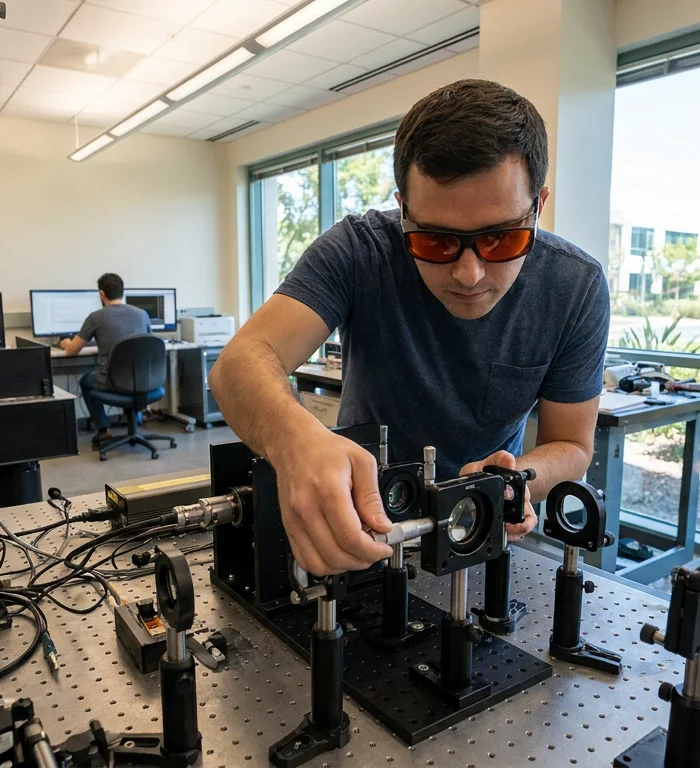
Haemanthus aims to bring blood, urine and saliva analysis into U.S. homes through a countertop-size machine, WIRED said. The company has released no products and has little public information, including only a limited LinkedIn presence rather than a full public website, WIRED said.
The company's patent for a Raman Spectroscopy System was granted Jan. 21, 2025, WIRED said. Raman spectroscopy reads molecular information from light scattered by a sample; WIRED said perhaps one in 1 million photons shifts frequency in a way that can be measured.
That low signal helps show the technical burden behind the pitch. WIRED said the challenge is to turn a sensitive research and hospital technique into a home appliance that can measure health markers quickly and accurately enough for regulatory review.
The approach differs from Theranos' reported strategy, which sought to shrink existing diagnostic methods into a small machine using limited blood samples, WIRED said. Haemanthus instead describes a system based on high-power light sources applied to biological samples.
Evans declined WIRED's interview request and did not answer specific questions, the article said. He told David Friedberg, a cohost of the All-In podcast, that he had not yet seen the documentary: “I might think this is the dumbest thing that I have done.”
More stories
- DeepSeek updates AI model as speed and cost rivalry grows
- CoreWeave bond yields hit 15% as AI funding doubts deepen
- The Week in Games: Selective capital meets harder scoreboards
- Bhaag Neha Bhaag draws 2,700 players in CJP protest game wave
- Japan & Asia: Switch 2 leads Famitsu chart with 22,420 units
- Kotukh maps quantum side-channel edge to AES-128 rank 2^58.6
- Groq funding resets startup value after Nvidia talent deal
- Colorado River reservoirs hit records as drought deepens
Latest news
- UAE tops MENA disaster-readiness trust at 87%
- MSCI warning weighs on Indonesia's currency and its bonds
- Rubio urges Ukraine peace as leaders' meeting stays open
- France unrest puts Macron's budget agenda under pressure
- France faces election strain after 2,000 protest arrests
- Mnangagwa warns ZANU PF dissenters over 2030 rule bid
- Greece plans 15% homebuyer tax for non-EU investors
- Pope Leo XIV faces lung cancer diagnosis after lobe removal