Groq funding resets startup value after Nvidia talent deal
Groq funding of $350 million values the AI infrastructure company at $3.5 billion as it reworks its business after Nvidia's talent deal.
Jason Kwon ·
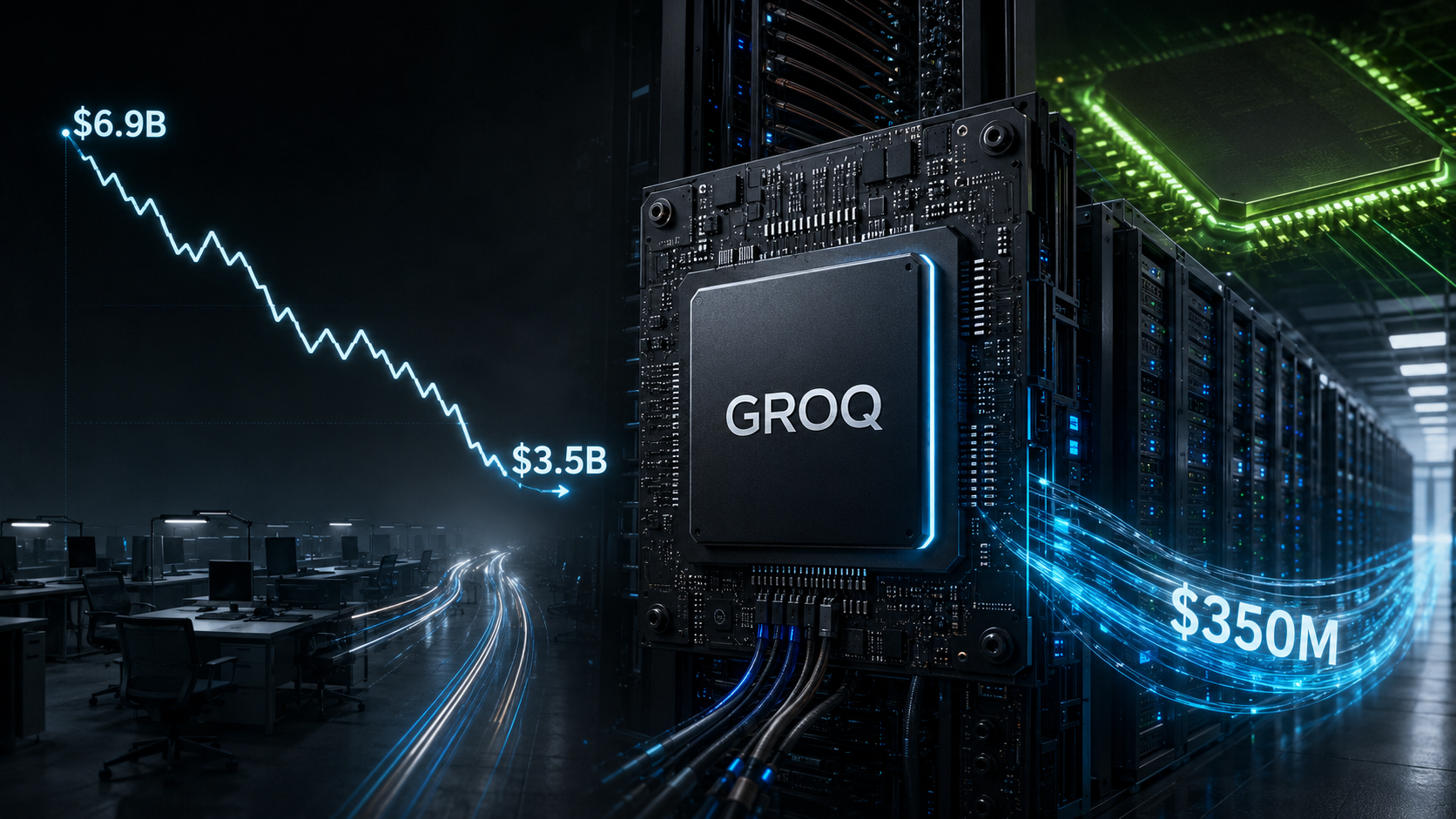
Groq funding totals $350 million at a $3.5 billion valuation, giving the AI infrastructure startup fresh capital after a reset.
The financing is set to be announced Monday and is led by Dallas-based investment firm Disruptive, according to a Groq representative. Nvidia is also expected to invest in the round, the representative said; Nvidia did not respond to a request for comment.
Disruptive leads $350 million round
The new valuation is roughly half the $6.9 billion level Groq reached last September, before a licensing agreement with Nvidia and the departure of several senior employees. The lower figure gives investors a new price for a company trying to reposition itself in the AI infrastructure market.
Disruptive's role gives the round a close link to Groq's boardroom. Alex Davis, Groq's executive chairman and the founder of Disruptive, said in a statement that the company would focus on model developers that need computing capacity.
"Inference will without a doubt become the largest and most critical layer of AI infrastructure,"
Davis said. "We will be focused on supporting the most important model makers."
Nvidia deal reshapes Groq
Groq began in 2016 as one of several companies building chips intended to compete with Nvidia, the dominant supplier of AI accelerators. Its founder and chief executive officer, Jonathan Ross, later moved to Nvidia along with other key employees as part of the licensing arrangement.
The structure put Groq among a group of AI startups whose technology and employees have been drawn into larger platforms without a full acquisition. Meta Platforms and Alphabet's Google have also used licensing arrangements involving AI startup talent, according to the source account provided for this article.
For Nvidia, the planned investment would sit alongside a prior agreement that gave it access to Groq assets and people. For Groq, the financing adds capital after a period in which its original chipmaker identity was reduced by the loss of its founder and other staff.
Inference becomes Groq's bet
Groq has worked to remake itself as a data center operator serving inference, the process of running AI software after a model has been trained. That shift puts the company closer to customers paying for compute capacity rather than only buyers evaluating a new chip architecture.
The company announced a separate $650 million raise in June to support that effort, but it did not disclose the reset valuation attached to that financing. The Monday round gives a public marker for the repricing: $3.5 billion compared with last September's $6.9 billion.
The main company-level question is whether Groq can turn new capital into contracted capacity quickly enough to justify the pivot. The named risk is execution after the loss of Ross and other key employees, especially in a market where customers often buy infrastructure from large cloud providers or Nvidia-linked suppliers.
Three paths from the reset
If demand for inference capacity keeps expanding, Groq's data center strategy could give the company a clearer commercial role than its former challenge to Nvidia's hardware base. At the sector level, that path would add another supplier of AI compute capacity; at the global level, it would reinforce a shift in tech spending from model training toward the cost of running AI services.
If customers concentrate spending with the largest cloud platforms instead, Groq's lower valuation may become a constraint rather than a reset. The company would need to show that its capacity, pricing or performance can win business in a market where scale and supply access matter.
A third path is more consolidation through licensing, hiring and minority investments rather than full takeovers. If that pattern holds, Groq's deal would point to an AI infrastructure sector where large technology companies absorb talent and technology while leaving smaller corporate shells to find narrower operating roles.