Stairs test Deep Robotics DR02 in China's humanoid race
Deep Robotics showed its DR02 humanoid climbing outdoor concrete stairs as it seeks a STAR Market IPO and broader commercial traction.
Jason Kwon ·
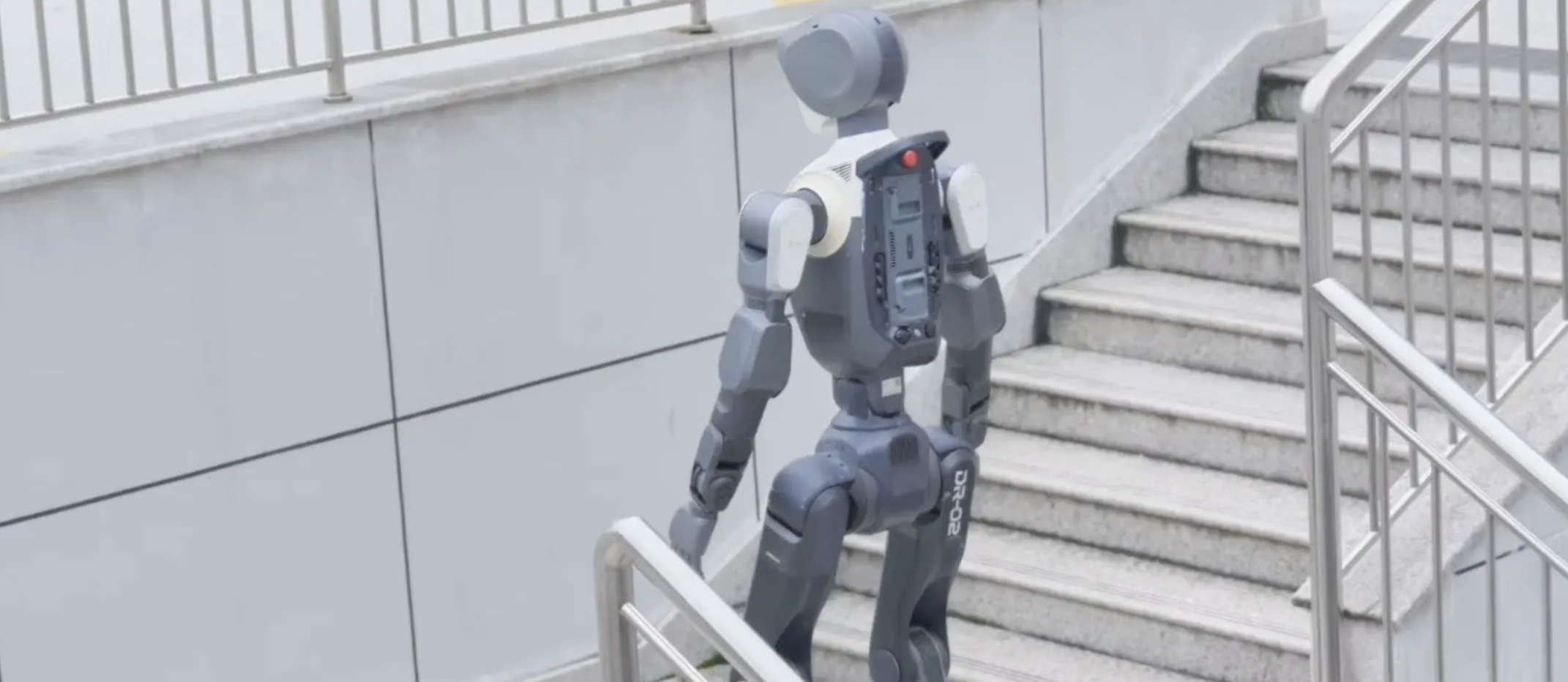
Deep Robotics DR02 climbed outdoor concrete stairs in new footage as the Hangzhou company seeks a STAR Market IPO and wider humanoid credibility.
The video shows the humanoid handling a basic but unforgiving mobility task: moving up exterior concrete steps rather than a flat indoor lab surface. For robotics buyers and investors, that distinction matters, since stairs expose balance, joint control and foot placement in ways that polished demo floors often do not.
DR02 takes stairs outside
Deep Robotics presented the stair climb as evidence that DR02 can keep moving on demanding outdoor terrain. The source material did not give the robot's height, weight, battery life, walking speed or payload capacity, leaving the demonstration narrower than a full product specification.
The footage still gives the company a clearer hardware story at a point when humanoid robotics is crowded with controlled videos and early-stage claims. A machine that can work beyond level flooring is closer to the operating conditions found in factories, logistics yards, campuses and inspection sites.
The central technical question is not whether DR02 can climb one set of stairs on camera. It is whether the same system can repeat the task across different step heights, wet surfaces, outdoor lighting and operator conditions without manual intervention that limits commercial use.
IPO filing adds pressure
The stair video lands as Deep Robotics has applied to raise about $367.4 million through an initial public offering on Shanghai's STAR Market. That target is roughly 87 times the company's reported first-ever net profit of about $4.2 million in 2025, a gap that puts future growth assumptions near the center of the listing case.
The application has been accepted, according to the source material, placing the company in a more visible stage of the capital-raising process. STAR Market investors usually look for technical differentiation, but humanoid robotics also requires proof that prototypes can become repeatable products with service revenue, maintenance infrastructure and defensible margins.
Deep Robotics' timing reflects a broader push by Chinese robotics companies to turn legged machines from research hardware into commercial platforms. In that contest, mobility demonstrations are not just marketing assets; they are proxies for autonomy, mechanical durability and software control under less predictable conditions.
Tibetan antelope test added altitude
The company has also pointed to a separate field deployment involving a robot dog tracking Tibetan antelopes at 4,700 meters. That test, set in high-altitude terrain rather than urban infrastructure, captured migration and feeding behavior while showing operation outside low-risk indoor environments.
The antelope deployment and the DR02 stair climb address different parts of the same credibility problem. Quadrupeds are typically more stable on rough ground, while humanoids promise compatibility with human-built spaces, tools and stairs but face harder balance and control constraints.
For Deep Robotics, the commercial value of DR02 will depend on whether it can move from staged movement tasks into jobs with measurable output. Inspection, security patrol, warehouse support and light industrial assistance all require uptime, navigation reliability and cost per task that customers can compare with human labor or wheeled automation.
Three paths for DR02
If DR02's outdoor mobility proves repeatable, Deep Robotics could use the STAR Market process to frame itself as more than a demo-led hardware maker. At the macro level, that would support China's effort to build domestic robotics supply chains; for Deep Robotics, it would strengthen the IPO narrative; for the sector, it would raise the bar for field evidence.
If the system remains limited to narrow conditions, the impact would be different. Global capital would likely keep treating humanoids as a long-duration automation bet, Deep Robotics would need to lean harder on quadruped deployments and the industry would face more scrutiny over whether public demos overstate readiness.
A third path is slower commercialization, where DR02 improves through pilots but does not quickly become a broad platform. In that case, macro effects would stay modest, Deep Robotics' near-term valuation case would rest on execution milestones, and competitors would have more time to define standards for safety, reliability and total operating cost.